
Back injuries at work can derail your career and finances. Ohio’s workers’ compensation system provides back injury Ohio benefits to help you recover, but navigating the process requires understanding your rights.
At Robin J Peterson Company, LLC, we’ve guided hundreds of injured workers through this system. This guide walks you through the types of injuries covered, how to file your claim, and what benefits you can expect.
What Back Injuries Does Ohio Workers’ Compensation Actually Cover
Ohio’s workers’ compensation system covers three distinct categories of back injuries, and understanding which category your injury falls into directly affects how you prove your claim and what benefits you receive. The state does not distinguish between back injuries based on how they happen-what matters is whether the injury arose out of and in the course of employment.
Acute Traumatic Injuries Have Clear Medical Causation
Falls from heights, strikes from equipment, and motor vehicle accidents at work all qualify as acute traumatic injuries. These cases are straightforward to document because a single incident caused the damage. A worker who falls off a ladder and fractures a vertebra, or gets hit by machinery and ruptures a disc, has clear medical causation. Fractures typically require bracing for 6 to 12 weeks and may need surgery, while soft tissue damage from the same impact can take several months to heal. The Workers’ Compensation Research Institute reports that back injuries cost an average of $40,000 to $80,000 nationally in medical expenses and lost wages, though Ohio cases vary by severity and treatment intensity.
Herniated Discs Require Strong Medical Evidence
Herniated discs and nerve compression injuries are more common than fractures and often more complicated to prove. When a disc ruptures and presses on a nerve, the injured worker experiences pain, weakness, or numbness that radiates into the legs or arms. These symptoms can persist for months, and treatment ranges from pain management and cortisone injections to spinal fusion surgery. The problem is that a herniated disc does not always show a single traumatic moment-it can result from poor lifting technique, repetitive bending, or an accident that aggravated a pre-existing condition. This is why medical imaging becomes essential. An MRI or CT scan showing the herniated disc and nerve compression, combined with a neurologist’s or orthopedist’s report linking your symptoms to that imaging, makes your claim significantly stronger. The Ohio Bureau of Workers’ Compensation expects documentation that proves the disc herniation caused your functional limitations.
Cumulative Injuries Face the Strictest Scrutiny
Cumulative strain injuries developed over time present the hardest battle in Ohio. These injuries develop gradually without a single incident-chronic back pain from years of heavy lifting, poor posture at a desk job, or repetitive bending. Ohio law requires you to prove the injury arose out of the course and scope of employment, which is straightforward for acute injuries but extremely difficult for cumulative injuries. The BWC and Ohio Industrial Commission scrutinize these claims heavily because age, fitness level, and weight can all contribute to degenerative conditions. To win a cumulative injury claim, you need a doctor willing to state that your job duties were the primary cause of the injury, not your lifestyle or age. Daily symptom diaries documenting when pain worsened, photographs of your workplace setup or hazards, and statements from coworkers about the physical demands of your job all strengthen causation arguments. Medical records spanning years of treatment also help establish that the problem developed at work, not outside it. Claims involving surgery are eight to nine times more likely to become high-cost cases according to the Workers’ Compensation Research Institute, which means the BWC applies extra scrutiny to these cumulative injury cases before approving expensive procedures.
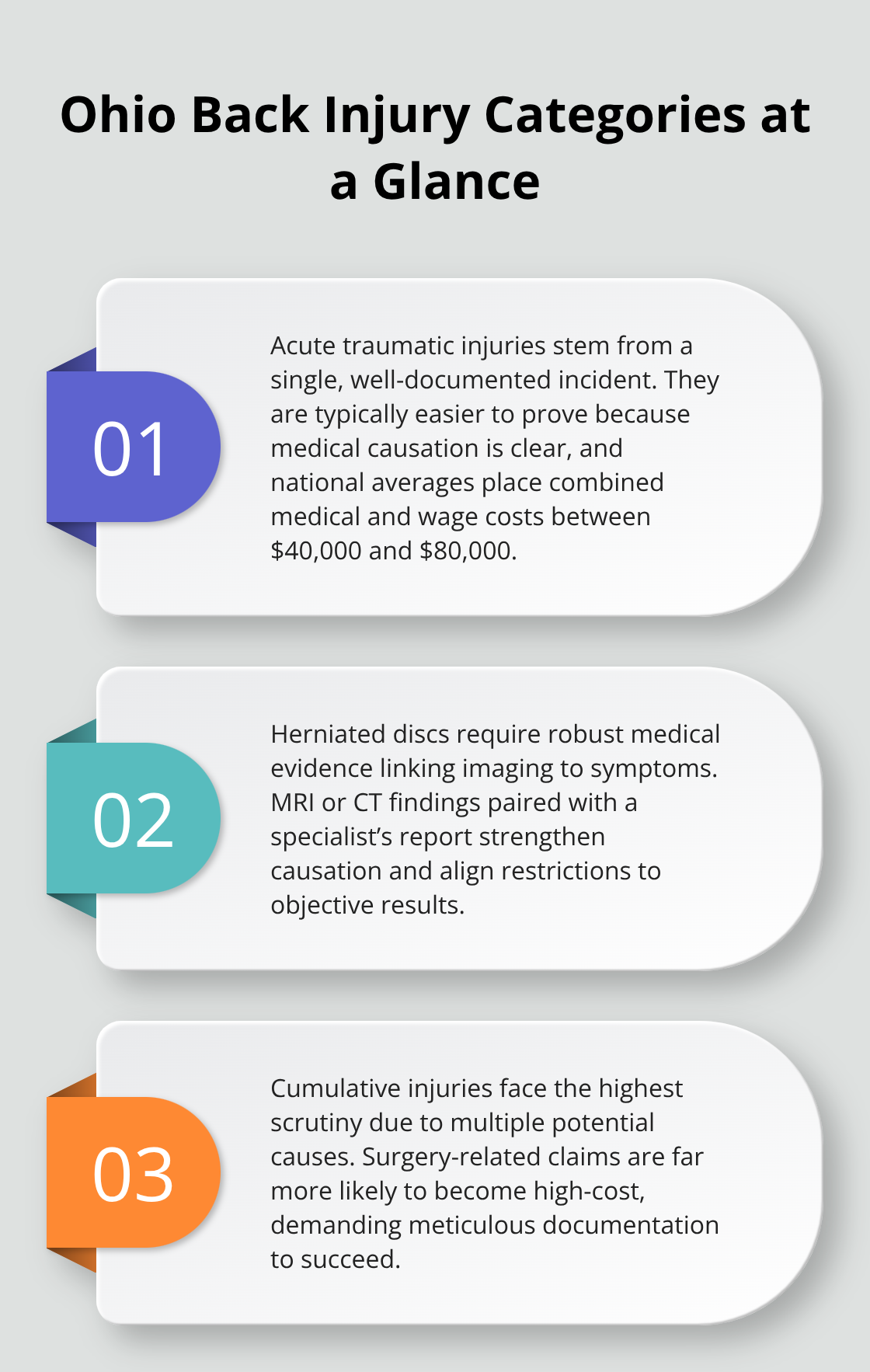
Understanding which category your injury falls into shapes your entire filing strategy and the evidence you need to gather before you file your initial claim with the BWC.
How to File and Navigate Your Back Injury Claim in Ohio
Report Your Injury Immediately and File the Correct Forms
You must report the injury to your employer within 24 hours. Your employer then has 14 days to file with the BWC. If your employer delays or refuses to file, contact the BWC directly at 1-800-644-6292 to file yourself. The BWC-1 form must arrive within one working day of the employer’s filing, and missing this deadline can bar your benefits entirely.
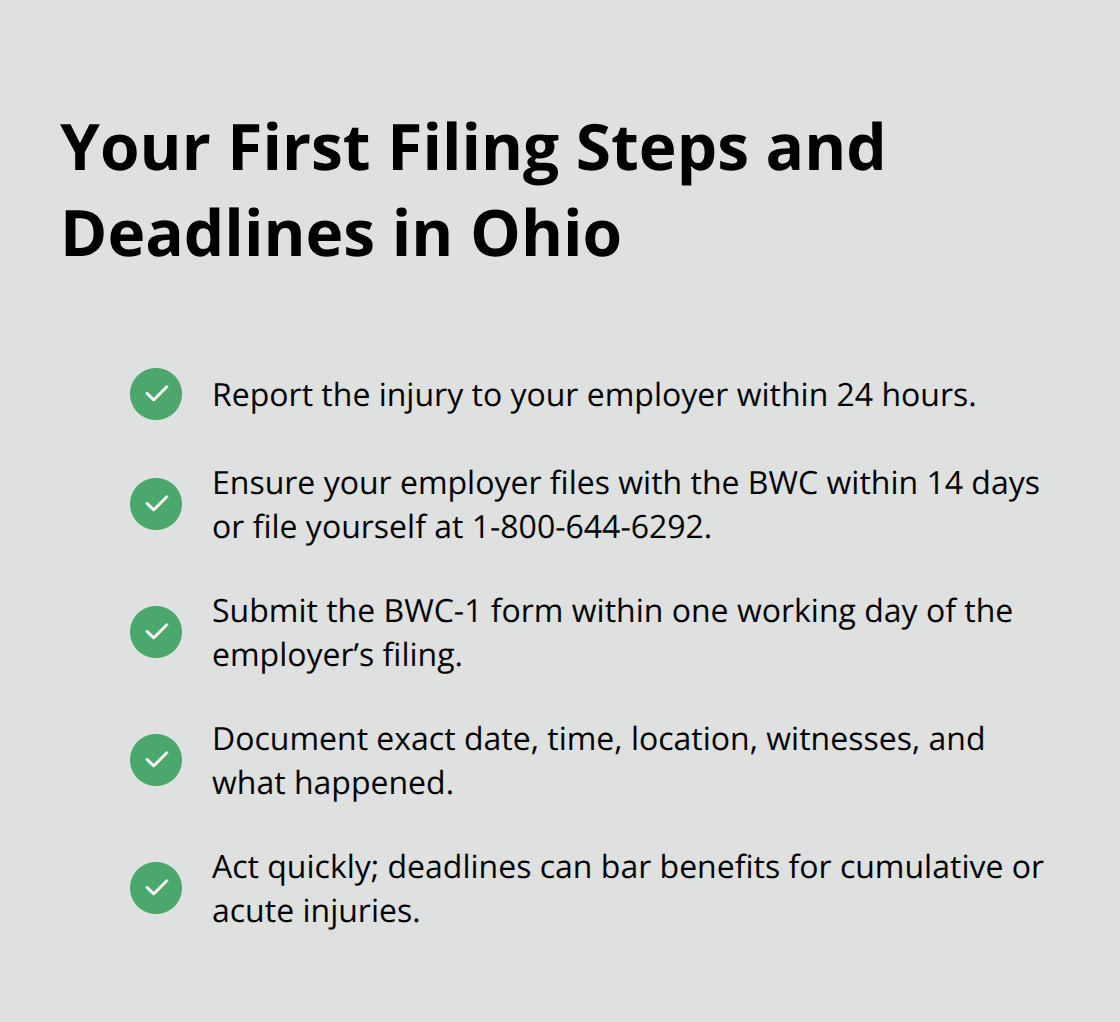
When you file, provide the exact date, time, and location of the injury. Include a detailed description of what happened and the names of any witnesses. For cumulative injuries, document the job duties that caused the condition and when symptoms first appeared. The statute of limitations runs from your injury date, so act quickly.
Gather Medical Evidence That Proves Your Claim
Medical documentation determines whether you win or lose your claim. Seek treatment from a doctor within the approved provider network under your Managed Care Organization immediately after the injury. An MRI or CT scan showing the exact nature of your back damage is essential for all serious injuries, not optional.
For herniated discs and nerve compression, obtain a report from an orthopedist or neurologist specifically stating that your imaging results explain your functional limitations and work restrictions. For cumulative injuries, gather medical records spanning years that show the condition developed progressively at work. Keep daily symptom diaries noting pain levels, functional limitations, and which job activities made symptoms worse. Take photographs of your workplace hazards, your workstation setup, or unsafe equipment. Get written statements from coworkers about the physical demands of your job.
Understand the BWC’s Decision Timeline
After filing, the BWC issues a notice of allowance or denial within about 28 days. If allowed, temporary benefits are calculated based on two-thirds of your pre-injury weekly wage, capped at Ohio’s average weekly wage. If denied, you have the right to request a hearing before the Ohio Industrial Commission.
Appeal Low Ratings and Fight Denials
When the BWC denies your claim or assigns a low impairment rating, you can appeal to the Ohio Industrial Commission. An attorney can present stronger medical evidence and argue for a higher rating, which directly increases your compensation. The difference between accepting a low impairment rating and appealing can amount to tens of thousands in additional compensation.
Contact the Ohio Industrial Commission Ombuds Office if you have questions about the process or believe the BWC has mishandled your claim. The appeals process requires navigating tight deadlines and complex procedures, and professional guidance protects your rights throughout the claim. Understanding how to build a strong case with proper documentation and medical evidence positions you to move forward with confidence when facing the next stage of your claim.
What Back Injury Benefits Actually Cover in Ohio
Once your claim is approved, the Ohio Bureau of Workers’ Compensation covers medical treatment through your Managed Care Organization, and this coverage is broader than most injured workers realize. Your MCO coordinates all care, meaning you access doctors, physical therapists, surgeons, and imaging through approved providers without paying out of pocket. The BWC pays for doctor visits, hospital care, medications, injections, physical therapy, and surgery if medically necessary. This is not a reimbursement system where you pay first and receive money back later-the BWC pays providers directly.
Use Approved Providers Within Your MCO Network
You must use approved providers within your MCO network. If you see an out-of-network doctor without authorization, the BWC may deny payment. Contact your MCO immediately after injury to understand which providers are available in your area, and always confirm that a provider is approved before scheduling treatment. Do not assume your regular doctor is in the network. The Ohio Bureau of Workers’ Compensation maintains a provider directory, and your MCO can provide a current list of orthopedists, neurologists, and surgeons accepting new patients.
Temporary Total Disability Replaces Your Lost Wages
Wage replacement begins immediately if your claim is approved and you cannot work. Temporary Total Disability pays two-thirds of your pre-injury weekly wage, calculated using your Full Weekly Wage at the time of injury, capped at Ohio’s average weekly wage. TTD typically lasts 12 to 52 weeks depending on injury severity, though more serious injuries extend beyond that period. Once you reach maximum medical improvement-the point where further treatment will not improve your condition-TTD ends and you transition to Permanent Partial Disability if permanent impairment exists.
Impairment Ratings Determine Your PPD Award
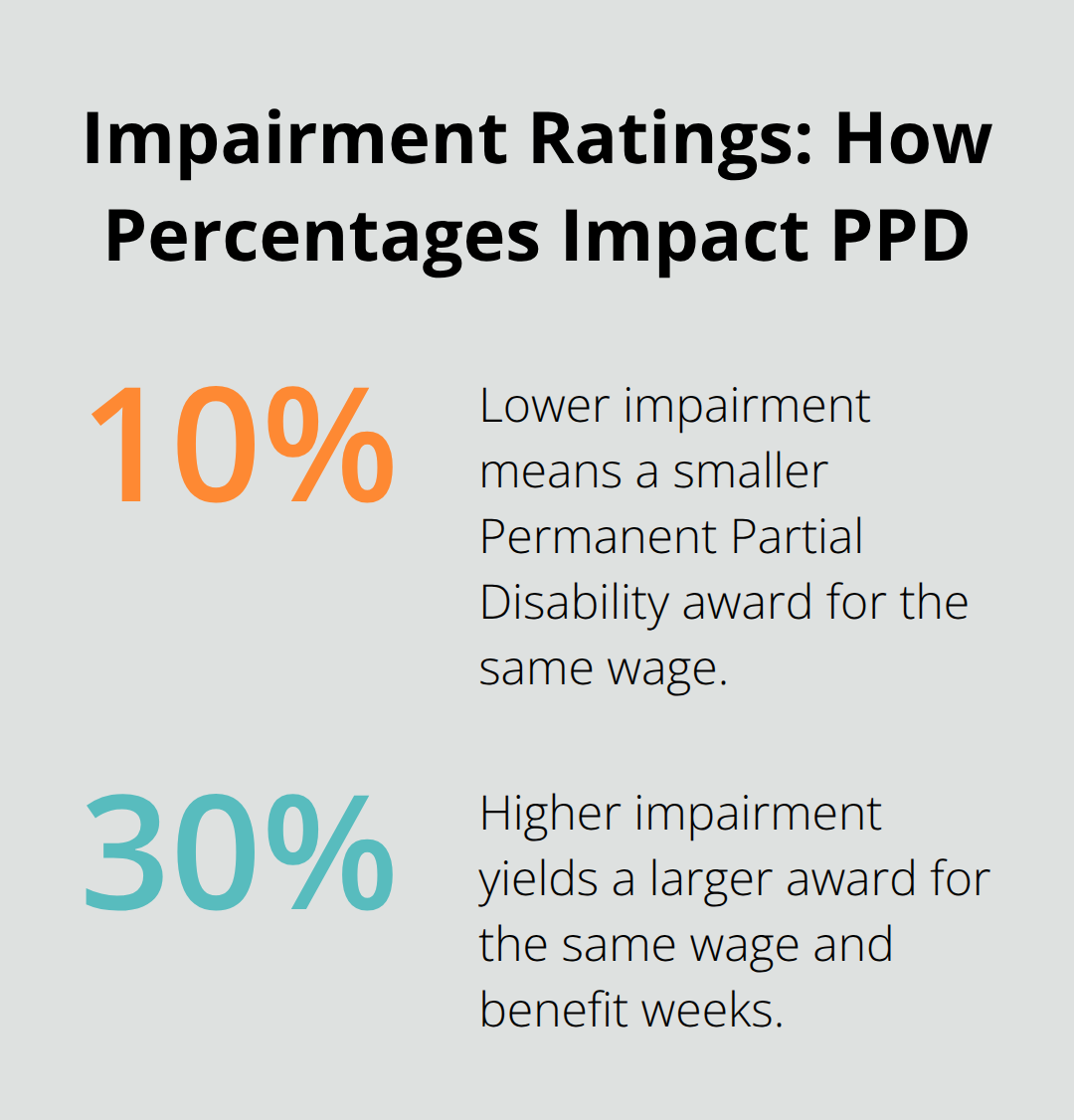
The Ohio Bureau of Workers’ Compensation assigns an impairment rating as a percentage based on medical evidence, imaging results, and functional testing. This percentage directly determines your PPD award amount, calculated as your weekly wage multiplied by the impairment rating multiplied by the state’s benefit weeks for the spine. A 10 percent impairment rating produces a smaller award than a 30 percent rating for the same pre-injury wage.
If you return to work but earn less due to work restrictions, Wage Loss Compensation supplements your income for up to five years. For severe cases where you cannot work at all after maximum medical improvement, Permanent Total Disability provides ongoing weekly benefits for life.
Vocational Rehabilitation Helps You Return to Work
Many injured workers overlook vocational rehabilitation services, which the BWC offers to help you retrain and return to work if your back injury prevents you from doing your previous job. These services include job counseling, retraining programs, and job placement assistance, all paid by the BWC. Living Maintenance benefits support you financially while you participate in approved vocational rehabilitation. If you qualify for vocational services, accept them-returning to stable work prevents long-term financial decline and demonstrates to the BWC that you are committed to recovery rather than prolonging benefits indefinitely.
Final Thoughts
Back injury Ohio benefits exist to protect you, but the system minimizes payouts by design. The BWC denies legitimate claims regularly, assigns impairment ratings lower than medical evidence supports, and counts on injured workers not understanding their rights or missing critical deadlines. We at Robin J Peterson Company, LLC have represented hundreds of injured workers across Ohio who faced exactly this situation, and workers who file alone lose more often than they win.
The BWC scrutinizes back injury claims heavily, especially cumulative injuries and cases involving surgery. Medical documentation that seems sufficient to you may not meet the BWC’s standards, and impairment ratings assigned by the BWC’s doctors are frequently lower than what independent medical exams reveal. Settlement offers from the BWC often undervalue your injury and aim to close your case quickly rather than fairly compensate your damage.
We fight denials by gathering stronger medical evidence, obtaining independent medical exams that challenge the BWC’s impairment rating, and presenting your case to the Ohio Industrial Commission with the documentation and legal arguments the system demands. Contact Robin J Peterson Company, LLC to discuss your back injury claim with an attorney who understands Ohio workers’ compensation law and will fight to secure the benefits you are entitled to.