
Returning to work after a workplace injury in Ohio comes with specific legal protections you need to know about. Your employer has obligations, and understanding your return to work Ohio rights puts you in a stronger position to advocate for yourself.
At Robin J Peterson Company, LLC, we’ve helped countless workers navigate this process. This guide breaks down exactly what your employer must provide and how to protect yourself every step of the way.
Your Legal Right to Return to Work in Ohio
Ohio’s Workers’ Compensation Laws Protect Your Job
Ohio’s workers’ compensation system rests on a foundational principle that protects your job when you suffer a workplace injury. State law explicitly prohibits employers from retaliating against you for filing a claim or exercising your rights during recovery. This protection carries real weight-the Ohio Bureau of Workers’ Compensation enforces it, and the state takes retaliation complaints seriously. What this means in practice is straightforward: your employer cannot fire you, demote you, or create a hostile work environment because you got hurt on the job. The Ohio Supreme Court has consistently upheld this protection across multiple cases. If your employer violates this rule, you have grounds for additional claims beyond your workers’ compensation benefits. Many workers underestimate how strong this protection actually is, which is why understanding it matters before you even return to work.
The Role of the Ohio Bureau of Workers’ Compensation
The Ohio Bureau of Workers’ Compensation coordinates your entire return-to-work process and holds your employer accountable to legal standards. Once your claim is accepted by the BWC, your employer must cooperate with your return-to-work plan as your treating physician outlines it. This cooperation is not optional or negotiable. Your assigned Managed Care Organization verifies that any work offered aligns with your medical restrictions.
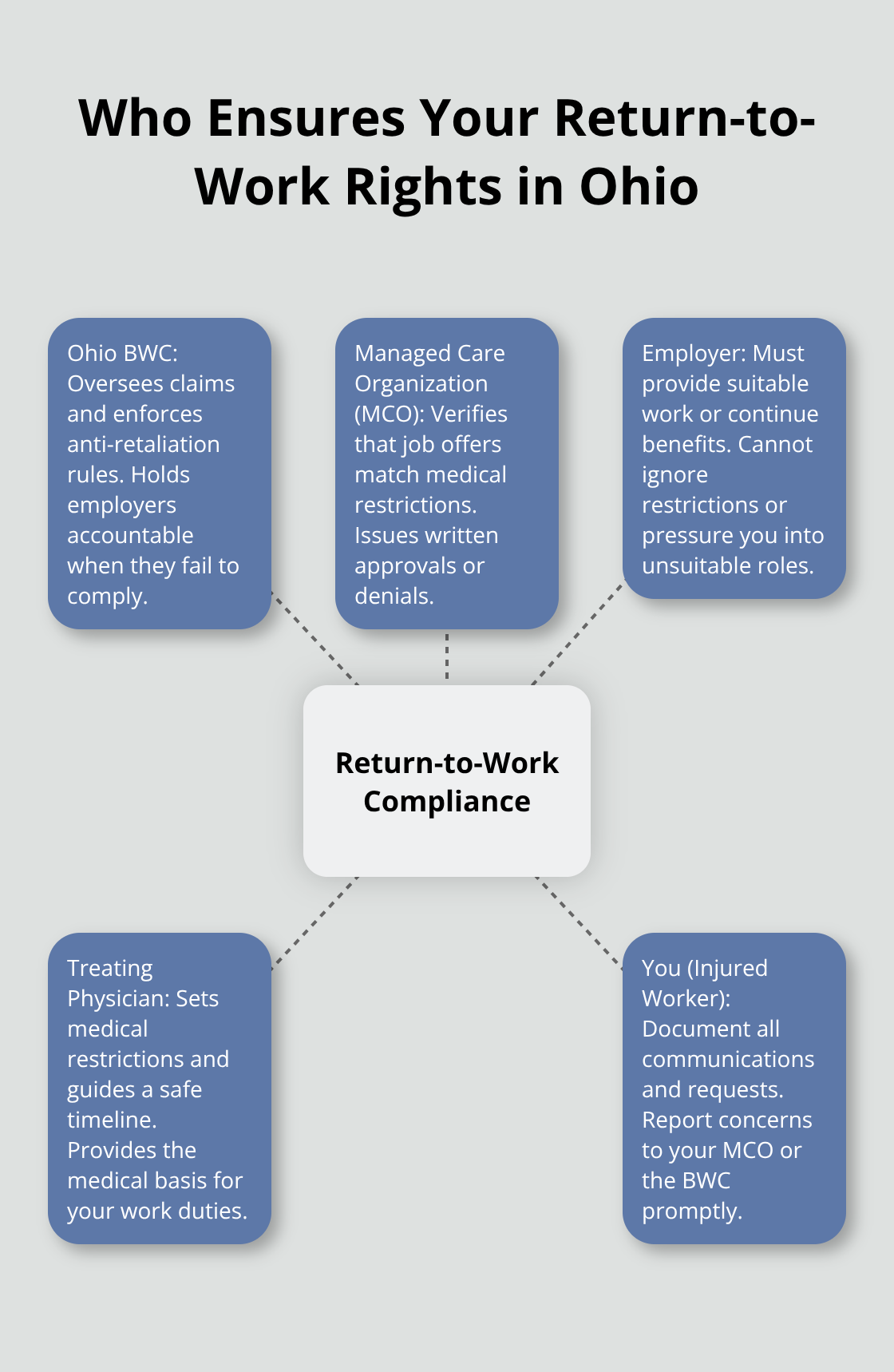
You can contact the MCO directly at 1-800-644-6292 to confirm whether a proposed job meets your doctor’s requirements. This verification step protects you from being forced into positions that could worsen your injury or jeopardize your benefits.
Timeline Requirements for Employer Notification
Your employer’s obligations start immediately after you report your injury. Your employer must notify the BWC of your workplace injury within 14 days, though reporting sooner protects everyone involved and speeds up benefit processing. Once the BWC accepts your claim, your employer must either provide compliant work that matches your restrictions or continue paying your temporary total disability benefits if no suitable position exists. If your doctor releases you to work with restrictions, your employer cannot simply ignore those restrictions or pressure you into unsuitable roles. Request written confirmation from your MCO that any proposed work complies with your restrictions-this documentation protects you if disputes arise later and ensures your employer cannot claim ignorance about what your doctor actually approved.
What Your Employer Must Provide During Recovery
Work That Matches Your Medical Restrictions
Your employer’s obligations during your return to work extend far beyond simply offering you a job. Under Ohio law, any work offered must align precisely with your treating physician’s medical restrictions, and this alignment is not negotiable. If your doctor states you cannot lift more than 10 pounds or must avoid prolonged standing, your employer cannot assign you duties that violate these limits. The Ohio Bureau of Workers’ Compensation requires your Managed Care Organization to verify compliance before you accept any position. This verification protects you from accepting work that could delay your healing or jeopardize your temporary total disability benefits.
Request written documentation from your MCO confirming that proposed duties match your restrictions. Do not rely on verbal assurances from your supervisor or human resources department. In State ex rel. Pacheco v. Industrial Commission, the Ohio Supreme Court ruled that light-duty arrangements must be meaningful and legitimate, not simply created as a placeholder or warning to discourage future claims.
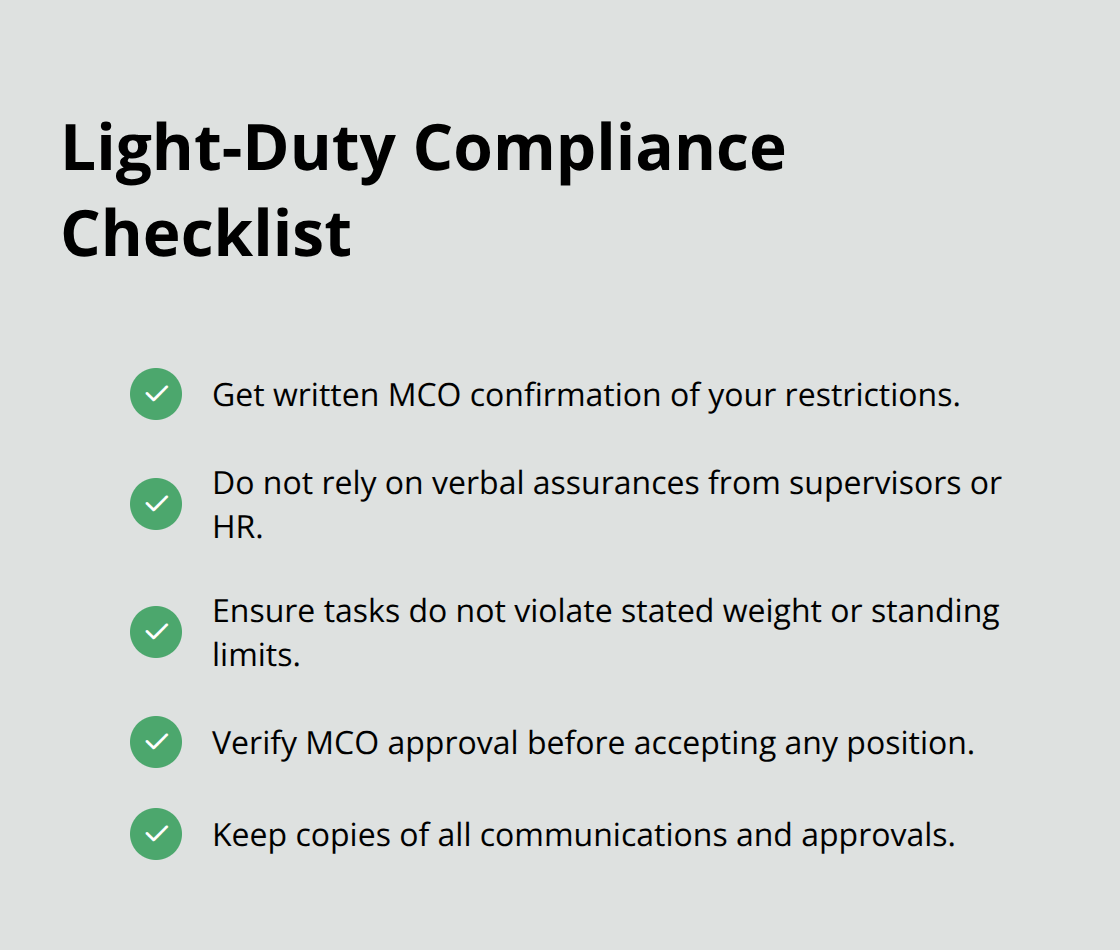
This means your employer cannot offer you make-work tasks designed to pressure you into declining and losing benefits. The position must involve real work with genuine business value.
Reasonable Accommodations and Workplace Modifications
Your employer must provide reasonable accommodations that enable you to perform compliant work safely. If your restrictions require you to avoid certain motions or limit your hours, your employer must adjust your schedule accordingly without reducing your temporary total disability rate if no full-duty work exists. Workplace modifications such as ergonomic equipment, adjusted workstations, or accessible parking near your work area fall within reasonable accommodation requirements.
Your employer cannot charge you for these modifications or use them as justification to reduce your benefits. If your employer claims a requested accommodation is too costly or burdensome, they bear the burden of proving undue hardship under Ohio law, not the other way around. Document every accommodation request in writing, including the date, what you requested, and your employer’s response. Keep copies of all communications.
What Happens When Your Employer Refuses
If your employer refuses reasonable accommodations without legitimate justification, this refusal can constitute unlawful retaliation, giving you grounds for additional claims beyond your workers’ compensation case. Your job is to make the request clear and in writing, then let the law protect you if your employer responds improperly. Workers in the Cleveland, Akron, and Canton areas who face accommodation denials often find that documenting these refusals strengthens their position significantly.
The next step involves understanding how to protect yourself when disputes arise over what your employer owes you and what you actually owe them in return.
How to Document and Assert Your Rights
Start Recording Details From Day One
Documentation transforms vague employer promises into enforceable obligations and protects you when disputes arise. Write down the date, time, and name of the person you told about your injury at work. If your supervisor or HR representative mentions returning to work, send a follow-up email summarizing what was discussed and what you understood to be agreed upon. This email serves as your contemporaneous record and forces your employer to correct any misunderstandings immediately rather than claiming later that something different was said. Many workers assume their employer will remember conversations accurately, but memory fades and interests diverge once a claim is filed. Your written record becomes the truth in disputes.
Request Written Confirmation of Medical Restrictions
When your treating physician releases you to work with restrictions, request that your MCO provide written confirmation of those restrictions and send it directly to your employer’s human resources department. Do not accept a situation where only you carry this information. The MCO can be reached at 1-800-644-6292 to verify compliance with any proposed work and to issue written approval or denial. This verification step protects you from accepting work that could delay your healing or jeopardize your temporary total disability benefits.
Demand Specifics Before Accepting Light-Duty Work
If your employer offers a light-duty position, demand a written job description that specifies every physical demand, the exact location of the work, the schedule, and the supervisor’s name. Vague offers like “return to light-duty” without specifics are red flags. Before you accept, send your employer a written response that lists the duties as you understand them and confirms they match your doctor’s restrictions.
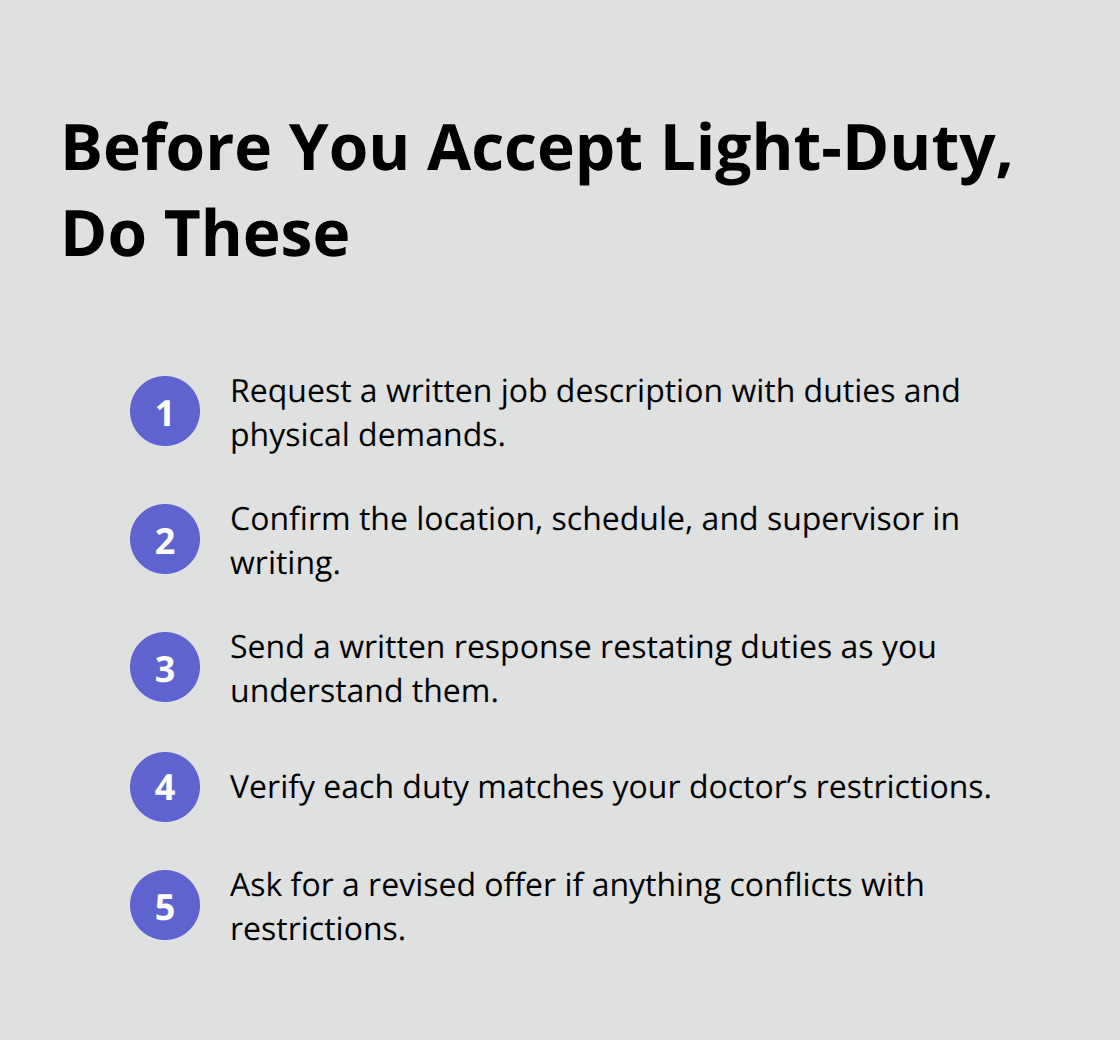
If they do not match, state that clearly in writing and request a revised offer.
If your employer refuses to provide written details or becomes evasive about the specific duties, this resistance itself is evidence that the offer may not be legitimate. The Ohio Supreme Court’s decision in State ex rel. Pacheco v. Industrial Commission makes clear that employers cannot use light-duty as a tactic to discourage claims or create make-work positions. When your documentation shows your employer avoided putting details in writing, that avoidance supports your position if you later need to defend declining an improper offer.
Protect Yourself Against Retaliation and Refusals
If your employer refuses accommodations or retaliates after you return to work, your detailed written record of requests, dates, and responses becomes invaluable evidence. Workers in Ohio who face these disputes significantly strengthen their cases by maintaining thorough communication records from day one. Keep copies of all communications with your employer, your MCO, and your treating physician. This documentation trail (including emails, letters, and written job descriptions) protects your benefits and supports your position if disputes arise later.
Final Thoughts
Your return to work Ohio rights protect your health and your income throughout recovery. Ohio law prohibits retaliation, requires your employer to offer work matching your medical restrictions, and mandates written documentation of every agreement. The Ohio Bureau of Workers’ Compensation and your Managed Care Organization verify compliance and hold employers accountable when they fail to meet these obligations.
These protections work only when you actively assert them. Many workers hesitate to push back on vague offers or missing documentation, assuming their employer will act fairly, and that assumption costs workers their benefits and delays their recovery. Your employer’s legal obligations are not suggestions-they are requirements backed by state law and enforced by the BWC.
If your employer refuses accommodations, offers work that violates your restrictions, or retaliates against you for filing a claim, you need experienced legal guidance. At Robin J Peterson Company, LLC, we represent injured workers throughout the Cleveland, Akron, and Canton areas who face these disputes, and we fight to secure the benefits and compensation you are entitled to under Ohio law. Contact us for a complimentary case evaluation to review your situation and understand your options.