
Returning to work after an injury in Ohio comes with specific legal protections you need to understand. At Robin J Peterson Company, LLC, we help injured workers navigate this complex process and protect their rights.
Whether you’re facing disputes over job accommodations or struggling with employer resistance, knowing what you’re entitled to makes all the difference. This guide covers the protections available to you and the practical steps to take during your recovery.
Your Rights as an Injured Worker in Ohio
Protection Against Retaliation
Ohio law prohibits your employer from retaliating against you for filing a workers’ compensation claim or exercising your rights under the system. This protection stands as foundational to the entire workers’ compensation framework. The Ohio Bureau of Workers’ Compensation enforces this rule strictly, and violations carry serious consequences for employers. Your employer cannot fire you, demote you, reduce your hours, or treat you unfairly because you filed a claim or sought medical care for your injury.
Your Right to Medical Treatment
You have the legal right to receive all reasonable and necessary medical care for your compensable injury without paying out of pocket. The state insurance fund covers hospital services, medications, surgical procedures, and ongoing treatment related to your work injury. Your treating physician determines what medical care you need-not your employer or the insurer. If your doctor prescribes specific treatment, you have the right to receive it. This protection ensures that your recovery takes priority over cost considerations.
Wage Loss Benefits During Recovery
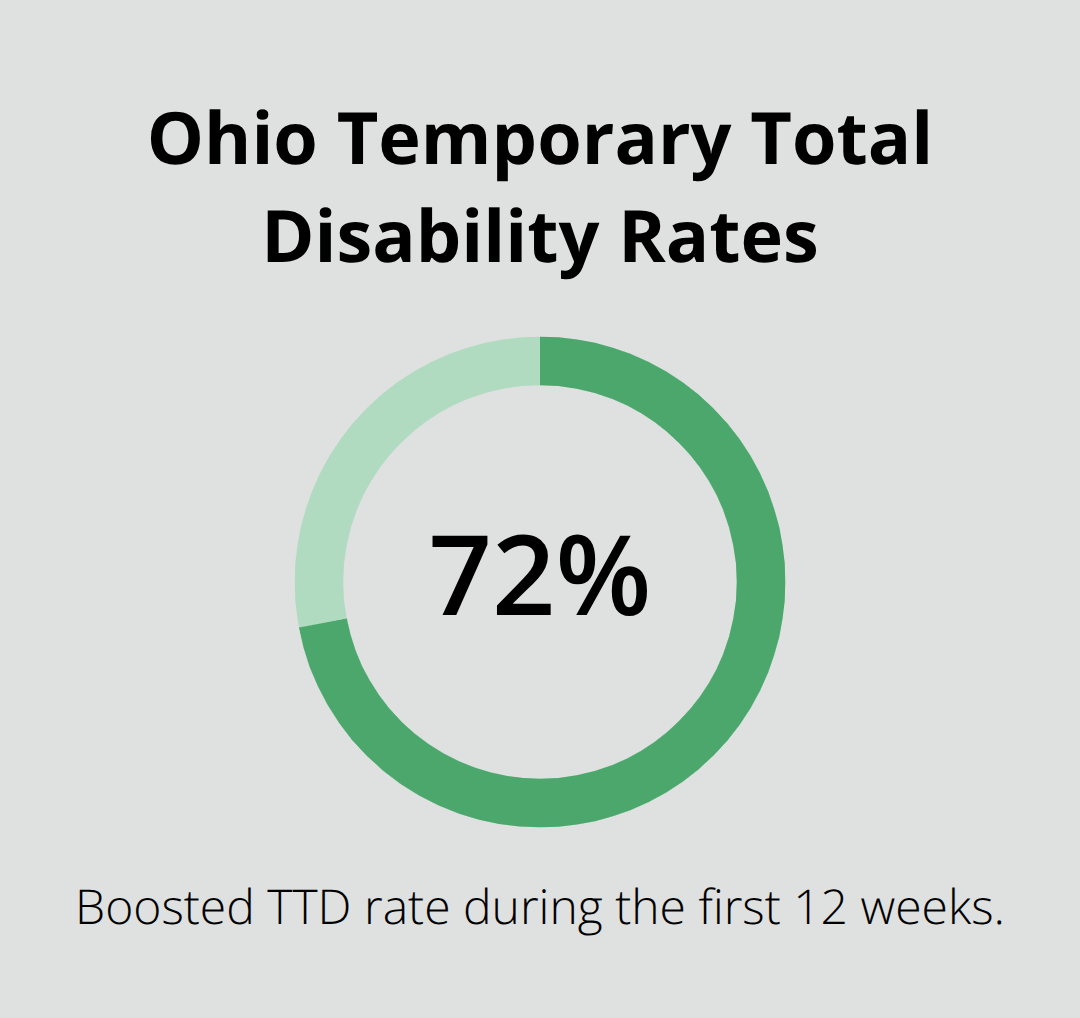
If you cannot work due to your injury, Ohio provides temporary total disability benefits. These benefits pay 66 2/3 percent of your average weekly wage, with a boosted rate of 72 percent during the first 12 weeks. After 12 weeks, the rate returns to 66 2/3 percent and continues as long as you remain unable to work and your claim stays active.
If you return to work but earn less than your pre-injury wages due to restrictions, Ohio provides partial wage replacement. You receive 66 2/3 percent of the difference between your pre-injury earnings and your current earnings. This benefit can extend up to 200 weeks, or longer in certain circumstances, allowing you to maintain income while you recover.
Your Right to Legal Representation
You can hire an attorney to help you navigate claims, appeals, and disputes with your employer or insurer. An experienced workers’ compensation attorney understands how the system operates, knows insurer tactics, and helps you avoid costly mistakes. The Ohio Industrial Commission Ombuds Office also provides free assistance if you encounter problems with your claim or need help understanding your rights. Contact the Ohio Bureau of Workers’ Compensation office at 30 W. Spring St., Columbus, OH 43215-2256 for support navigating the system.
Understanding these protections puts you in a stronger position as you move forward. The next step involves learning how to actually exercise these rights during the return-to-work process itself.
Executing Your Return to Work Plan
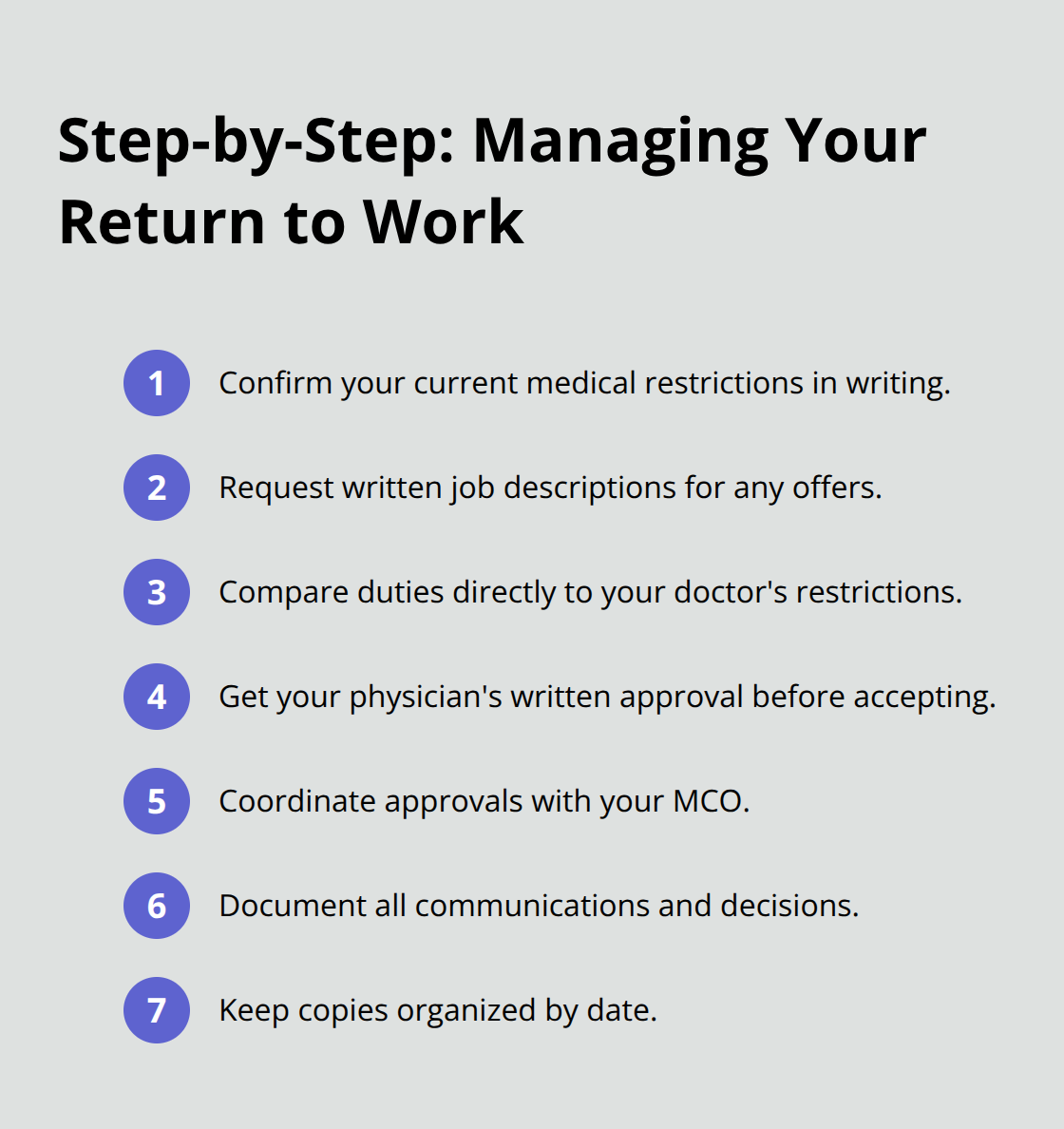
Once you understand your rights, the practical work of returning to your job begins. Your return to work happens in stages, not all at once, and how you manage each stage determines whether you recover fully or face setbacks. Your doctor controls the medical restrictions, your employer controls the available positions, and you control how you respond to offers. This three-way dynamic requires clear communication and detailed documentation from day one.
Understanding Light Duty Work
Light duty work typically means different tasks, reduced hours, or modified responsibilities compared to your regular job. Your employer is not legally obligated to create a position that fits your restrictions if no suitable role exists in their operation. However, if they do offer light duty work that aligns with your doctor’s restrictions, refusing that offer usually terminates your temporary total disability benefits immediately. The Ohio Bureau of Workers’ Compensation system assumes that returning to work gradually, even at reduced capacity, benefits your recovery more than sitting idle.
Evaluating Job Offers Against Medical Restrictions
Before accepting or rejecting any light duty offer, obtain a written confirmation from your treating physician that the specific duties comply with your medical restrictions. This document protects you if disputes arise later about whether you actually refused suitable work. Your employer should provide the job description in writing, including hours, duties, and physical demands. Compare this description directly against your doctor’s restrictions. If gaps exist, ask your doctor to clarify whether the work is safe. Do not guess about medical compatibility.
Your managed care organization (which you can identify through the MCO lookup or by calling 1-800-644-6292) coordinates medical approvals and can help verify whether proposed work aligns with your treatment plan.
Building Your Documentation Record
Keep every piece of communication about the job offer, including emails, text messages, and handwritten notes from conversations. Document the date, time, and person you spoke with. Record what was discussed, what restrictions were mentioned, and what was offered. This record becomes invaluable if your claim enters disputes over whether you refused suitable work or whether the work actually complied with your medical limits.
If your employer offers work that violates your restrictions, document the specific violations and report this to your managed care organization immediately. Request written confirmation from your MCO that the work does not comply with your medical restrictions. This creates a paper trail showing you did not unreasonably refuse work, which protects your benefits eligibility and strengthens your position if disagreements emerge later.
What Really Blocks Your Return to Work in Ohio
Job Accommodation Disputes
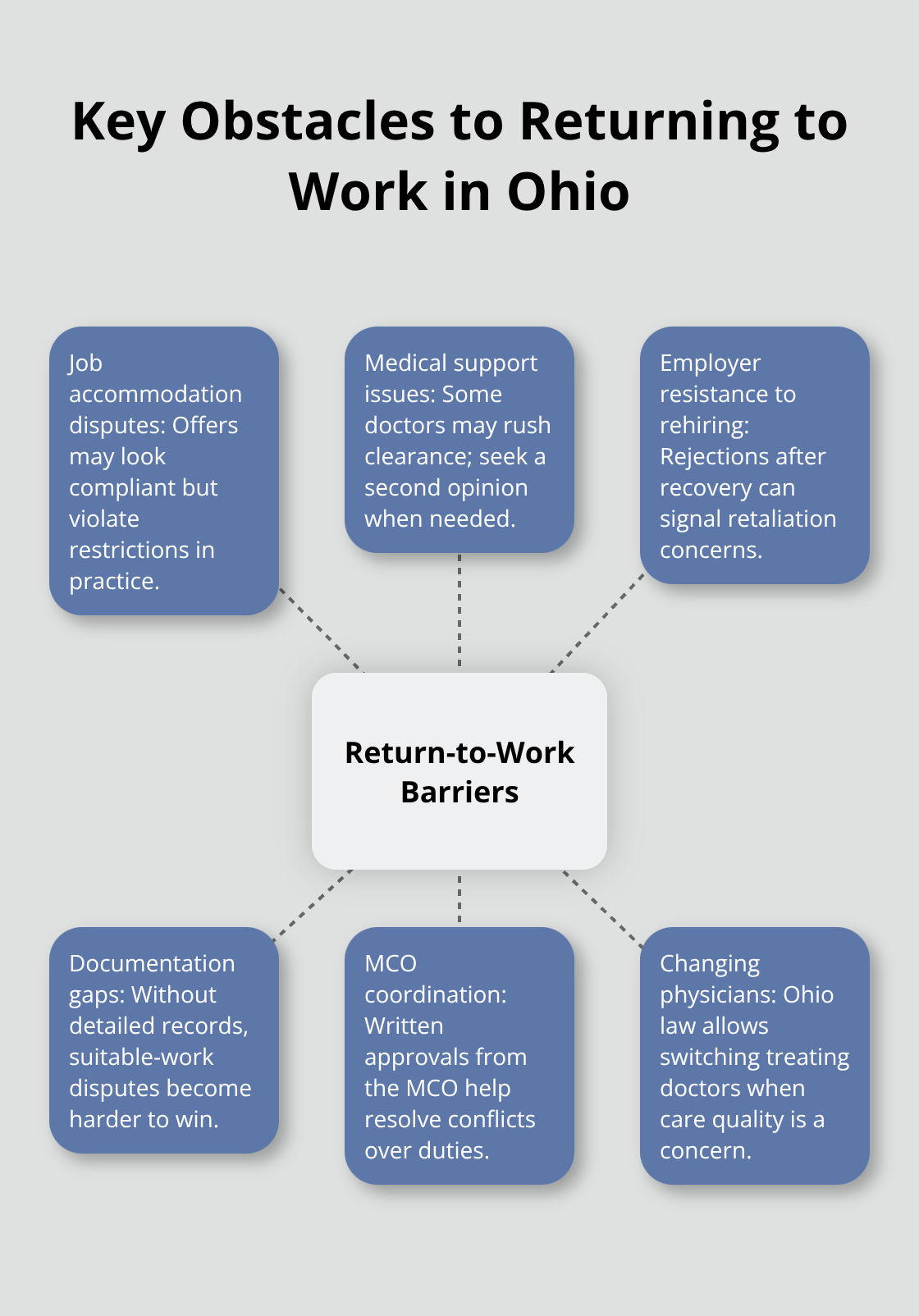
Disputes over job accommodations happen because employers and insurers often propose work that sounds compliant with your restrictions but actually violates them in practice. An employer might offer light duty that stays within stated hours but involves physical demands your doctor prohibited, or they might assign tasks that require standing when your restrictions specify sitting only. The Ohio Bureau of Workers’ Compensation system assumes good faith from all parties, but good faith does not always match reality.
You must document the exact physical demands of any proposed role before you accept it. Request your doctor’s written approval of those specific demands, not just a general approval of light duty work. If your managed care organization approves the work medically, obtain that approval in writing from the MCO directly. When disputes arise later, this documentation determines whether you refused suitable work or whether the work actually violated your restrictions.
Medical Support and Treatment Concerns
Inadequate medical support creates a different obstacle entirely. Some occupational health doctors working with insurers or employers face pressure to clear workers for return to work faster than medical evidence supports. Your treating physician’s restrictions matter most legally, but if that physician seems to be minimizing your injury or rushing your recovery, you have every right to seek a second opinion from another qualified doctor.
Ohio law allows you to change your treating physician if you have legitimate concerns about the care quality. You should document any instances where prescribed restrictions were ignored or where you experienced pain or setbacks after returning to work on inadequate restrictions. This evidence strengthens your position if you need to challenge return-to-work decisions later. The Ohio Industrial Commission Ombuds Office can help you navigate concerns about medical care quality without requiring formal legal action first.
Employer Resistance to Rehiring
Employer resistance to rehiring surfaces when workers complete recovery but face rejection from their original employer despite being fully capable of performing their old job. This crosses from accommodation into potential discrimination territory. Ohio law prohibits retaliation against workers who file claims, and refusing to rehire someone solely because they filed a workers’ compensation claim violates that protection.
The reality is messier than the law. Employers sometimes claim performance issues, attendance concerns, or changed job requirements rather than openly stating they do not want a former injured worker back. You should gather concrete evidence of your work history before the injury, including performance reviews, attendance records, and testimonials from coworkers or supervisors.
If you suspect discrimination in rehiring decisions, consult with an experienced workers’ compensation attorney immediately. Retaliation claims require documentation showing the employer knew about your claim and made adverse employment decisions afterward, so timing and communication records become critical evidence in these situations.
When your injury prevents you from returning to your previous job, vocational rehabilitation services may become available to help you transition into new work through retraining and job placement support.
Final Thoughts
Return to work Ohio requires you to understand your legal protections, document every step of the process, and verify that job offers actually comply with your medical restrictions before you accept them. Light duty work can accelerate your recovery if it aligns with your doctor’s limits, but refusing unsuitable work does not automatically end your benefits when you have legitimate medical reasons for that refusal. The difference between protecting your recovery and losing your benefits often comes down to whether you have written documentation showing the work violated your restrictions.
Disputes over accommodations, inadequate medical support, and employer resistance happen frequently enough that you should not navigate them alone. An experienced workers’ compensation attorney understands how the Ohio Bureau of Workers’ Compensation operates, recognizes when employers or insurers overreach, and helps you avoid decisions that damage your claim. We at Robin J Peterson Company, LLC represent injured workers throughout Ohio who face these obstacles, and we know how to fight for the benefits you earned through your injury.
Contact an attorney who understands workers’ compensation law in Ohio to discuss your situation with someone who knows the system and knows how to win. Whether you need help evaluating a job offer, challenging a claim denial, or addressing employer retaliation, professional guidance protects your rights and your recovery. Reach out to Robin J Peterson Company, LLC today.