
Workplace injuries can threaten your job security, but Ohio law provides strong protections. We at Robin J Peterson Company, LLC know that understanding your injury rights at the workplace is the first step toward safeguarding your employment.
This guide walks you through your legal protections, the workers’ compensation process, and what to do if your employer retaliates against you.
Your Rights as an Injured Worker in Ohio
Ohio law explicitly prohibits employers from firing, demoting, or reducing your hours because you filed a workers’ compensation claim or reported a workplace injury. This protection exists under Ohio Revised Code Section 4123.90, which makes retaliation illegal regardless of your employment status or how long you’ve worked there. Federal OSHA law reinforces this by protecting workers from punishment for reporting hazards or refusing unsafe work.
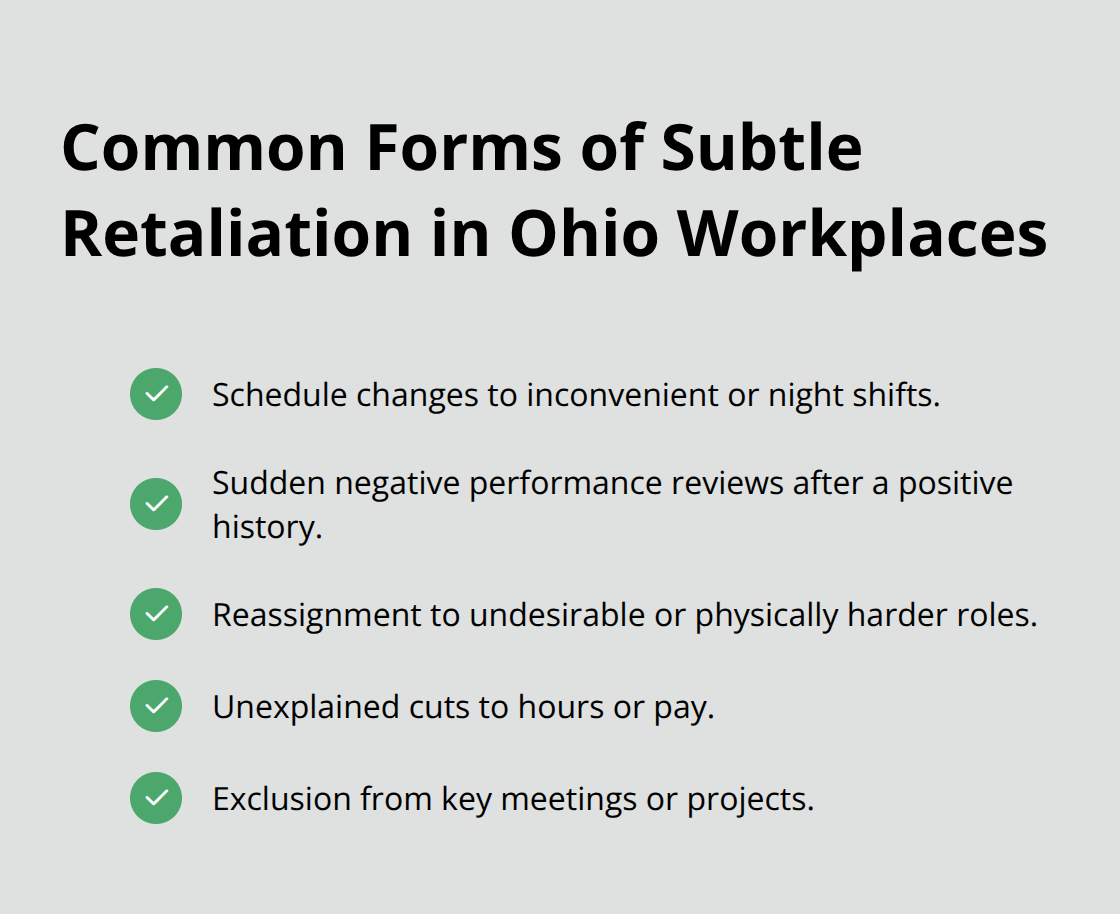
Many injured workers fail to recognize these protections, which leaves them vulnerable to employer pressure. Employers often retaliate subtly through schedule changes, negative performance reviews, or reassignment to undesirable positions rather than outright termination. Subtle retaliation is harder to prove but equally illegal. If your employer cuts your hours, assigns you to a worse shift, or suddenly criticizes your performance after you file a claim, document everything immediately with dates, times, and witnesses.
Keep copies of emails, text messages, and written communications.
Ohio law also guarantees your right to return to your original job or an equivalent position once you recover, unless the employer can show the position was eliminated for legitimate business reasons unrelated to your injury.
What Happens to Your Job During Recovery
Your employer cannot simply replace you or eliminate your position while you recover. Ohio requires employers to hold your job or provide substantially equivalent work at the same pay rate and benefits. If your injury prevents you from returning to your original duties, you have the right to vocational rehabilitation services through the Bureau of Workers’ Compensation, which can help you retrain for different work.
The Industrial Commission of Ohio handles disputes over job restoration. You can file a complaint if your employer violates these provisions. This agency investigates violations and can order your employer to restore your position or provide appropriate compensation.
How to Respond to Retaliation
If you experience retaliation, you have two pathways available. First, file a complaint with the Industrial Commission of Ohio alleging a violation of the anti-retaliation statute. Second, you can pursue a separate civil lawsuit against your employer for damages beyond workers’ compensation benefits.
The statute of limitations for retaliation claims is typically one year from the date of the retaliatory action, so act quickly. Written documentation strengthens your case significantly. An experienced workers’ compensation attorney who understands Ohio law can evaluate whether your situation qualifies as retaliation and what remedies you can pursue. When retaliation occurs, your next step involves understanding the complaint process and what evidence will support your claim.
Navigating the Workers’ Compensation Claim Process
The moment you suffer a workplace injury in Ohio, the clock starts ticking. You must report your injury to your employer within a specific timeframe, typically within 30 days, though some employers require notification within 7 days depending on their internal policies. Failure to meet this deadline can result in a denied claim, regardless of whether your injury is legitimate.
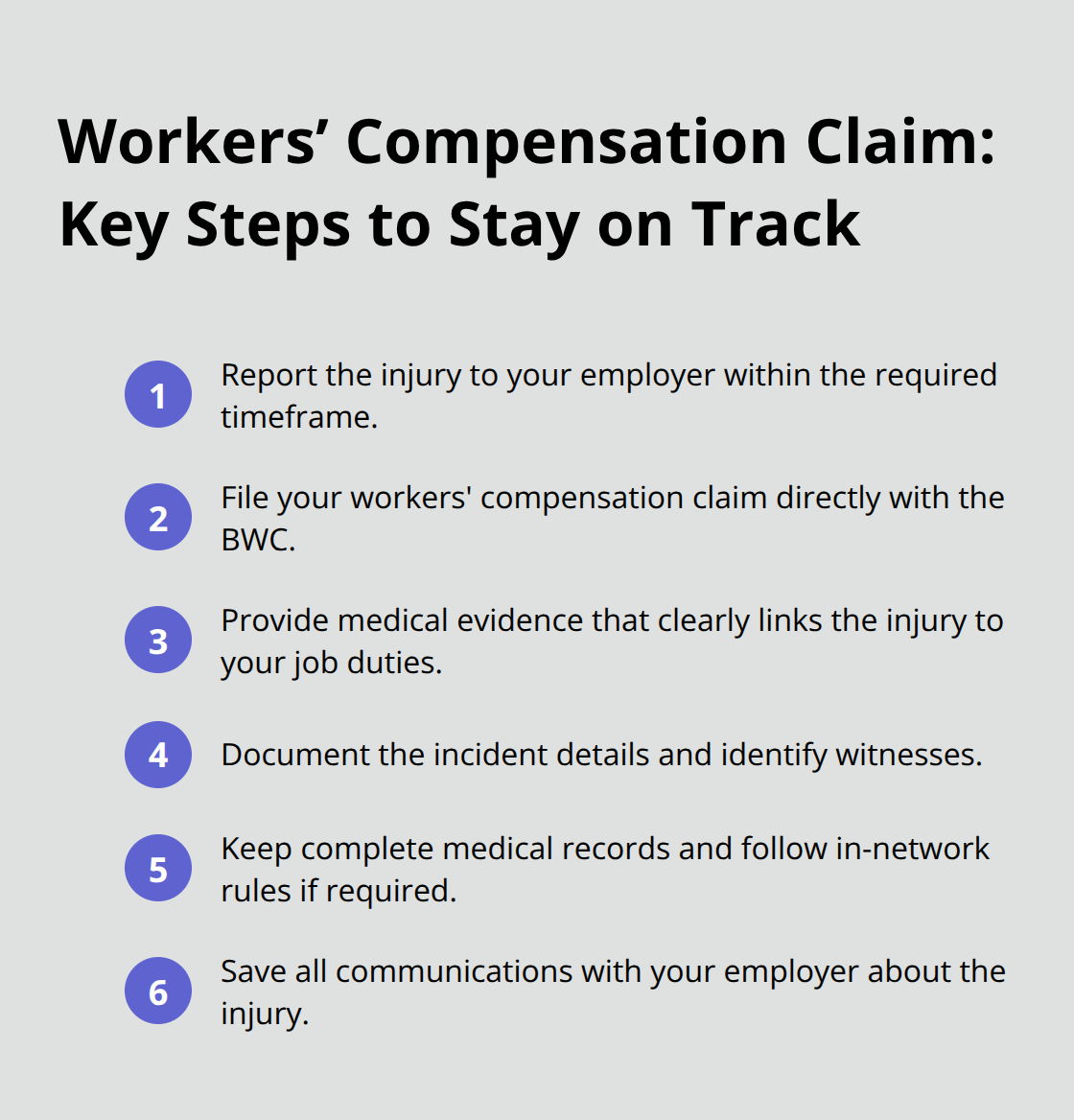
After reporting to your employer, you need to file a formal claim with the Ohio Bureau of Workers’ Compensation. The BWC processes claims differently than you might expect: they don’t automatically investigate your employer’s reports. You must submit your own documentation to establish the injury occurred at work and resulted from your job duties. Many injured workers assume their employer will handle this correctly, but employers often submit incomplete or inaccurate information that works against you.
Submit Your Claim Directly to the BWC
File your claim directly with the BWC by submitting the appropriate forms along with medical evidence from your treating physician. Your doctor’s report must specifically state that your injury is work-related and describe how it occurred during employment. Generic medical records without this connection to your job will likely result in denial. The BWC scrutinizes medical documentation heavily, so ensure your physician understands the importance of linking your condition directly to your work duties.
Gather Evidence Before the BWC Decides
Documentation determines whether you receive benefits or face denial. Immediately after your injury, write down exactly what happened, including the date, time, location, what you were doing, and how the injury occurred. Include names and contact information for any coworkers who witnessed the incident. Photographs of the scene, equipment, or hazardous conditions that caused your injury strengthen your case significantly.
Medical records form the foundation of your claim, so obtain copies of all treatment notes, test results, imaging reports, and diagnoses from every healthcare provider you see. The BWC denies claims when medical evidence is missing or contradictory. If your employer required you to use a specific in-network doctor, follow that requirement exactly; using an out-of-network provider without authorization can result in denial or reduced benefits.
Keep detailed records of all expenses related to your injury, including travel costs to medical appointments, prescription receipts, and any adaptive equipment you purchased. The BWC will request this information during their investigation. Additionally, preserve all communications with your employer about the injury (emails, text messages, written incident reports). These communications often reveal whether your employer tried to discourage you from filing or minimize the severity of your injury.
Hire an Attorney Before Submitting Your Claim
Hiring an attorney early in the process significantly improves your chances of approval and prevents costly mistakes. Many injured workers attempt to navigate the BWC system alone and make errors that result in permanent benefit reduction. An experienced workers’ compensation attorney understands Ohio’s specific requirements, knows which documentation the BWC scrutinizes most heavily, and can respond immediately if the BWC denies your claim.
The Industrial Commission of Ohio handles appeals when the BWC initially denies your claim, and these appeals require detailed legal arguments backed by medical and vocational evidence. An attorney familiar with the Industrial Commission knows how to present your case effectively and what evidence carries the most weight with the commission’s judges. Consulting with an attorney before submitting your claim rather than waiting until after denial prevents common filing errors that delay benefits by months.
Most workers’ compensation attorneys work on a contingency basis, meaning they only receive payment if you win your case, so there is no upfront cost to you. Once your claim moves through the BWC and you understand your benefits, you need to prepare for the possibility that your employer may not welcome your return to work.
When Your Employer Retaliates After Your Injury Claim
Retaliation happens more often than injured workers realize, and it rarely looks like immediate termination. After you file a workers’ compensation claim in Ohio, your employer may shift your schedule to night hours, suddenly create performance issues that never existed before, reassign you to physically demanding work that conflicts with your recovery, or create a hostile environment that pressures you to quit. These tactics are deliberate attempts to punish you for asserting your legal rights, and Ohio law treats them as serious violations. The reality is that subtle retaliation is harder to recognize than outright firing, which means you need to know exactly what warning signs to watch for and how to respond immediately when they appear.
Recognize the Signs of Workplace Retaliation
Your employer may retaliate in ways that seem unrelated to your injury claim at first glance. Schedule changes that force you into inconvenient shifts, sudden critical performance reviews after years of positive evaluations, reassignment to positions incompatible with your medical restrictions, or exclusion from meetings and projects all signal potential retaliation. Your employer might also reduce your responsibilities, cut your hours without explanation, or pass you over for promotions and raises that you would normally receive. Pay attention to timing-if negative actions follow your injury report or claim filing within days or weeks, retaliation is likely occurring. Coworkers may also report that management spoke negatively about your claim or questioned whether your injury was real, which indicates your employer views your claim as a threat rather than a legitimate workplace matter.
Document Everything Immediately
Write down the date, time, what happened, who was involved, and what was said the moment retaliation starts, then save this record outside of work systems (personal email, cloud storage, or your phone). If your employer cuts your hours, take screenshots of your schedule changes. If you receive critical performance reviews after years of positive evaluations, request copies and note the timing relative to your injury claim. If coworkers report that management spoke negatively about your claim, ask them to write down what they heard. The Industrial Commission of Ohio requires concrete evidence that your employer’s actions were motivated by your workers’ compensation claim, and your detailed documentation provides exactly that foundation. Without written records, your claim becomes your word against your employer’s explanation, and the commission rarely rules in your favor based on testimony alone. Ohio Revised Code Section 4123.90 explicitly protects you from retaliation, but only if you can prove the connection between your claim and the employer’s negative action.
Contact an Attorney Within Days
Reach out to an experienced workers’ compensation attorney within days of recognizing retaliation, not weeks or months later. The statute of limitations for retaliation claims is one year from the date of the retaliatory action, but waiting months weakens your case because memory fades and the chain of events becomes harder to establish. An attorney can immediately notify your employer in writing that you are aware of the retaliation and are protected under state law, which often stops further violations.
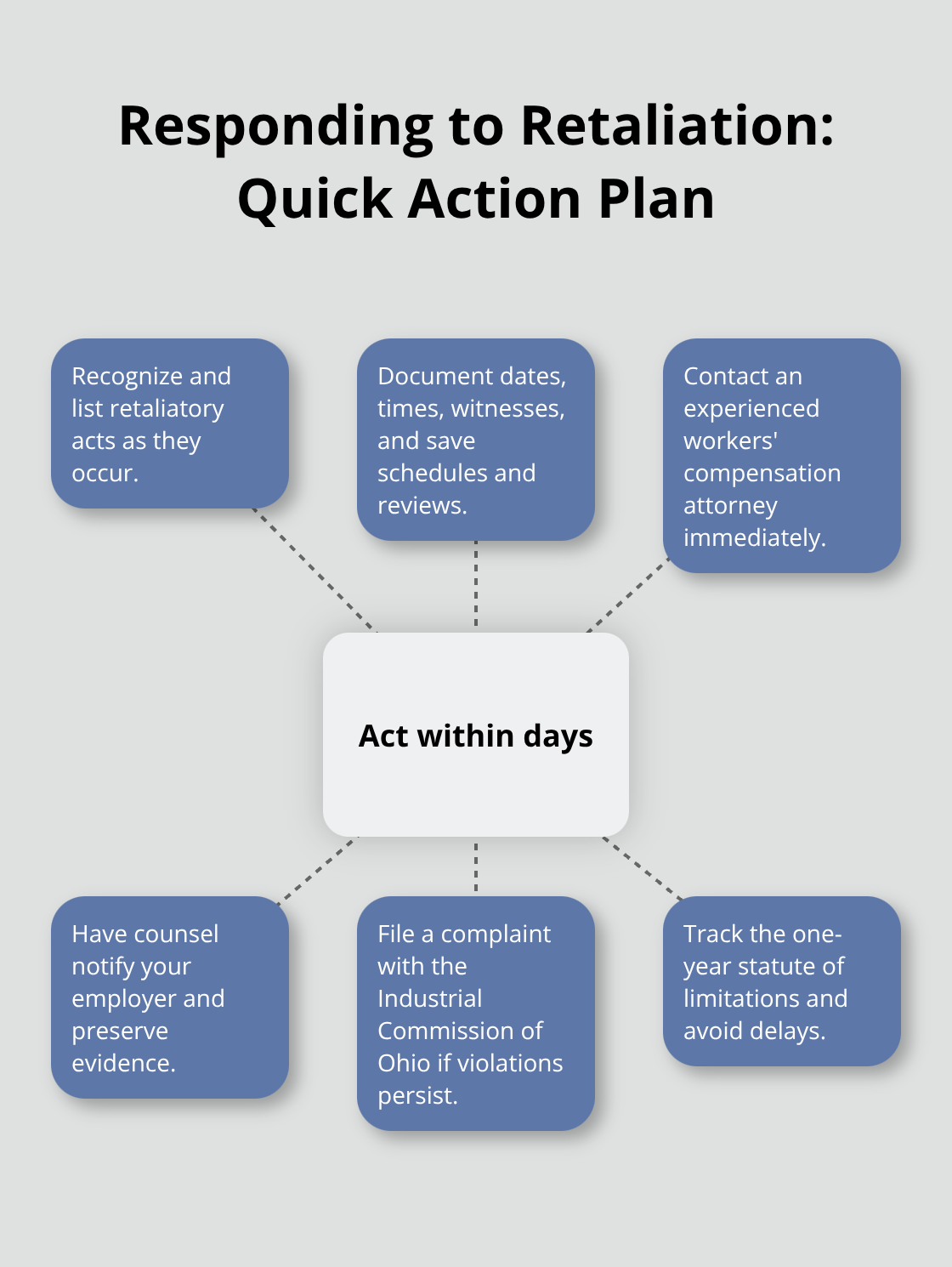
Your attorney will also preserve evidence, advise you on what communications to avoid, and prepare your complaint for the Industrial Commission of Ohio. Many employers back down once they receive formal notice from legal counsel because they understand the liability they face.
File Your Retaliation Complaint with the Industrial Commission
You file a retaliation complaint directly with the Industrial Commission of Ohio, separate from your workers’ compensation claim. Your attorney submits the complaint along with your documentation showing the timeline of events, the employer’s actions, and how those actions relate to your injury claim. The commission investigates by reviewing records, interviewing witnesses, and examining whether your employer’s stated reason for the action holds up under scrutiny. If the commission finds that your employer retaliated against you, it can order reinstatement to your position, restoration of your hours and pay, and additional compensation for the harm you suffered. Ohio takes retaliation seriously because it undermines the entire workers’ compensation system by discouraging injured workers from reporting injuries or filing legitimate claims.
Final Thoughts
Your injury rights at the workplace extend far beyond filing a claim and receiving benefits-they protect your job, your income, and your ability to recover without fear of employer punishment. Ohio law provides concrete protections, but only if you act decisively when violations occur. Report your injury within the required timeframe, file your claim with complete medical documentation, and hire an attorney who understands Ohio’s workers’ compensation system.
When retaliation happens, document it immediately and contact legal counsel within days rather than waiting months. The statute of limitations moves quickly, and early intervention stops further violations. You have the right to medical treatment, wage replacement during your healing period, and vocational rehabilitation if you cannot return to your original job-these protections exist because Ohio recognizes that injured workers deserve security while they heal.
Robin J Peterson Company, LLC represents injured workers throughout Ohio’s Cleveland, Akron, and Canton areas, fighting for the benefits and compensation you are entitled to receive. If you face a denied claim, employer retaliation, or uncertainty about your injury rights at the workplace, contact our firm for experienced legal guidance.