
Workplace injury rights in Ohio are more complex than most workers realize. At Robin J Peterson Company, LLC, we’ve helped countless injured employees navigate the system and secure the protections they deserve.
This guide walks you through your legal rights, what injuries are covered, and the critical mistakes that derail claims. You’ll learn exactly what steps to take if you’re injured on the job.
Understanding Ohio Workers’ Compensation Coverage
What Ohio Employers Must Cover
Ohio’s workers’ compensation system operates on a no-fault basis, meaning injured workers don’t need to prove their employer was negligent to receive benefits. This fundamentally changes how workplace injuries are handled compared to traditional lawsuits. Most employers in Ohio must carry workers’ compensation insurance through the Ohio Bureau of Workers’ Compensation, with very few exceptions like certain public employers. The coverage activates immediately when an injury arises out of and in the course of employment, which is the legal standard that matters most.
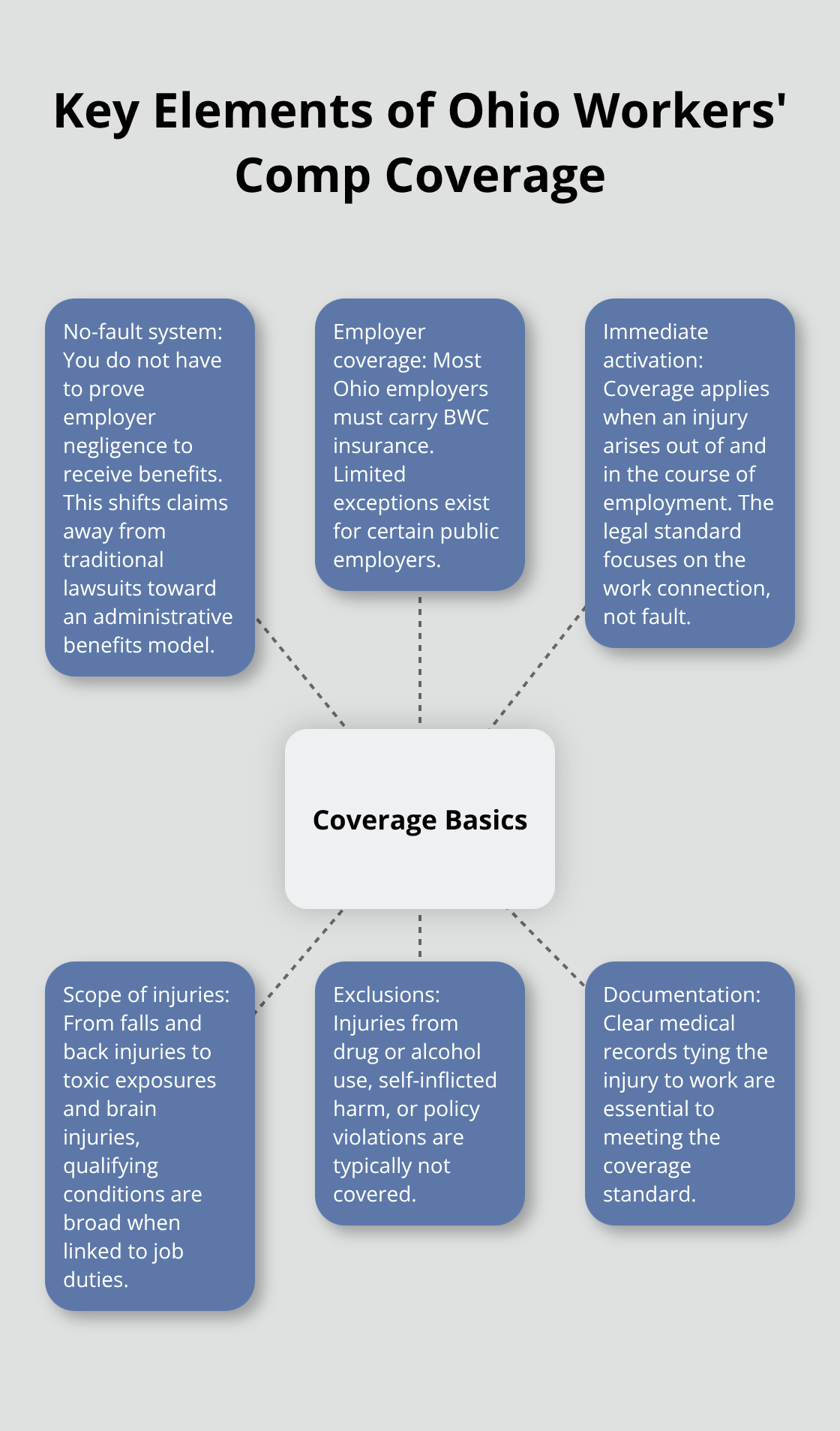
An injury qualifies if it happens while you perform job duties or at a work location, but it doesn’t have to occur during standard business hours. If you sustain an injury during a lunch break at work or while traveling to a client site for your job, you typically receive coverage. What isn’t covered tells you just as much: injuries from drug or alcohol use, self-inflicted wounds, policy violations, or injuries that have no connection to your work duties fall outside the system.
Which Injuries the System Actually Covers
The Ohio BWC covers an impressively broad range of workplace injuries. Falls, back injuries, broken bones, soft tissue damage, crush injuries, amputations, and injuries from moving patients in healthcare settings all qualify. Toxic exposures and brain injuries from workplace accidents receive coverage too. The critical point is that the injury must have a direct link to your employment-the medical records must clearly state this connection.
Report the injury to your employer the same day it happens if possible, and tell your medical provider immediately that the injury is work-related. This documentation step determines whether your claim succeeds or fails. Many denials stem from weak medical evidence linking the injury to work, not from coverage gaps.
Filing Your Claim Correctly
File your claim online with the Ohio Bureau of Workers’ Compensation rather than using paper forms, as online filing processes faster. You have time to file, but delays complicate everything: the longer you wait, the harder it becomes to prove when and how the injury occurred. Ohio law doesn’t specify an exact deadline for filing, but waiting weeks or months gives employers and insurers reasons to question your claim’s legitimacy.
The practical reality is that prompt reporting and accurate medical documentation (including witness statements and photos taken soon after the incident) transform a questionable claim into a defensible one. Strong medical records that explicitly connect your injury to work duties form the foundation of a successful claim. When you file online, provide thorough details about how the injury occurred and your specific job responsibilities at the time.
What Happens After You File
Once you submit your claim, the Ohio Bureau of Workers’ Compensation reviews it for eligibility. If your employer hasn’t reported the injury yet, your filing can trigger their obligation to report. The BWC examines whether the injury truly arose from employment and whether medical evidence supports your account. This review process determines whether you move forward with benefits or face a denial that requires appeal.
Understanding your coverage options and the filing process sets the stage for protecting your actual rights as an injured worker-which extend far beyond simply receiving medical care.
What You’re Actually Entitled to as an Injured Worker
Your Right to Choose Your Medical Provider
The moment you file a workers’ compensation claim in Ohio, specific legal protections activate regardless of your job title or employment status. You have the right to receive medical treatment from a provider of your choice for the first 30 days after your injury-this matters because you control which doctor evaluates your condition and documents the connection to your work. After 30 days, a managed care plan may be assigned, but you retain the right to appeal treatment decisions if you disagree with restrictions or denials. This appeal right is enforceable, meaning the system has formal channels to challenge your MCO’s decisions rather than leaving you powerless.
Wage Loss Compensation and Third-Party Claims
Wage loss compensation covers your lost income while you cannot work, calculated based on your average weekly wage before the injury. The Ohio Bureau of Workers’ Compensation publishes specific formulas for these calculations, so your benefit amount isn’t arbitrary-it’s determined by concrete wage data. You also retain the right to pursue third-party liability claims if another party’s negligence caused your injury, which means you can potentially recover additional compensation beyond workers’ comp benefits if, for example, defective equipment or a contractor’s mistake caused your accident.
The Appeal Process: Your Path to Overturning Denials
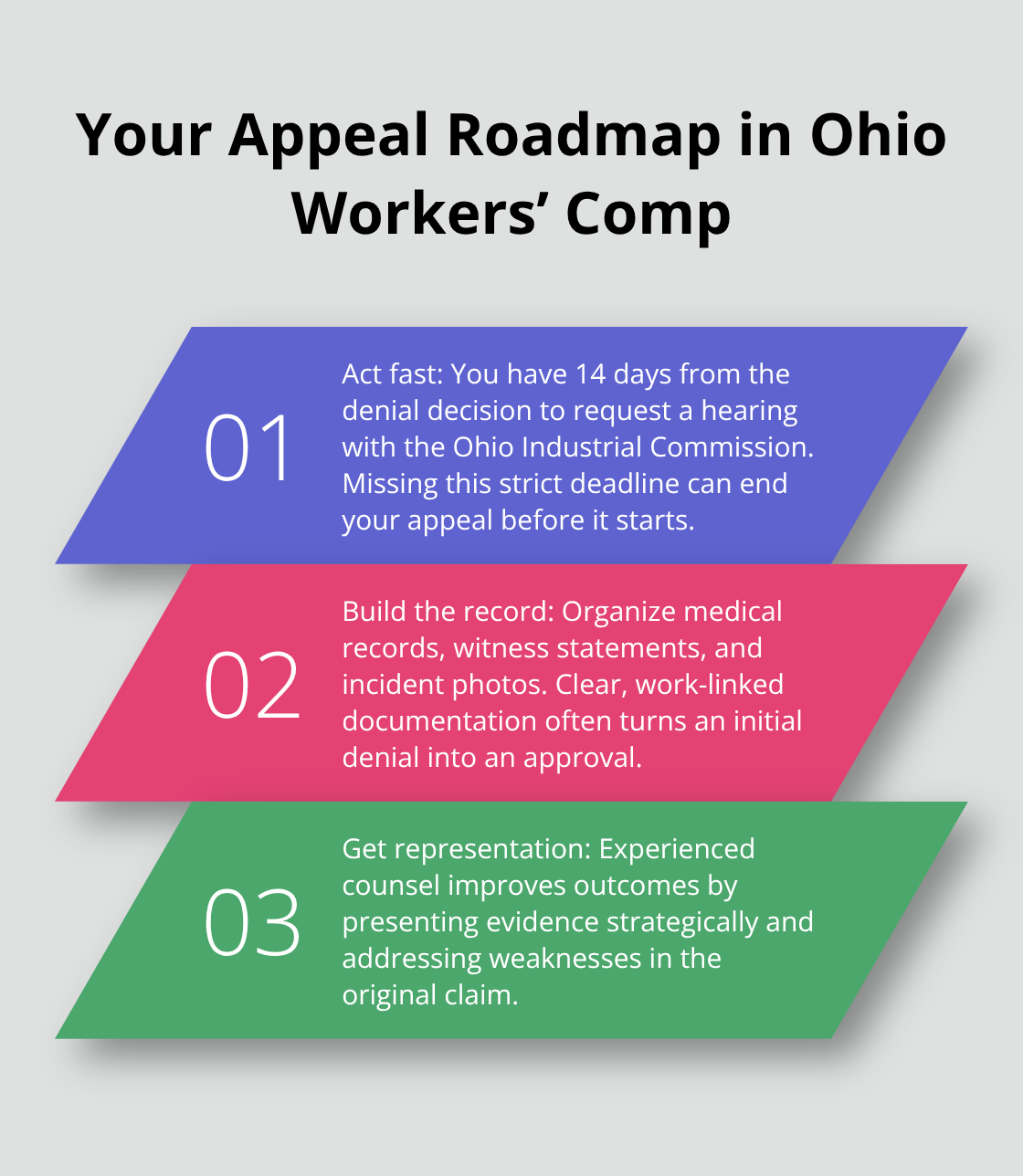
The appeal right deserves special emphasis because denials happen frequently and most are overturned with proper evidence. You have 14 days from a denial decision to request a hearing before the Ohio Industrial Commission, and this deadline is strict. Legal representation during appeals significantly improves outcomes according to cases handled through the system-organized evidence and strategic presentation transform weak documentation into winning cases. Strong documentation from day one (witness statements, detailed medical records, and photos taken immediately after the incident) prevents most denials, but when denials occur, the appeal process itself isn’t optional-it’s your protected mechanism to challenge the system’s initial decision.
Getting Help With Your Appeal
If you face a denial, contact the Ohio Industrial Commission’s Ombuds Office at 1-800-644-6292 for guidance, or consult an attorney who specializes in Ohio workers’ compensation to evaluate whether grounds exist for a successful appeal. An experienced workers’ compensation attorney can review your case, identify weaknesses in the initial decision, and present evidence effectively before the Industrial Commission. This legal support often makes the difference between accepting a wrongful denial and reclaiming the benefits you earned through your injury.
Understanding what you’re entitled to protects you from accepting less than the law provides, but knowing your rights means nothing without taking action when those rights are threatened-which is exactly what happens when your claim faces denial or your employer retaliates against you for filing.
Common Mistakes That Hurt Your Claim
Report Your Injury Immediately
Timing determines everything in Ohio workers’ compensation. Report your injury to your employer the same day it occurs-not the next morning, not after you finish your shift. The Ohio Bureau of Workers’ Compensation tracks when you report the incident, and delays create immediate credibility problems. Employers who receive injury reports weeks later question whether the injury actually happened at work or whether you’re fabricating a connection.
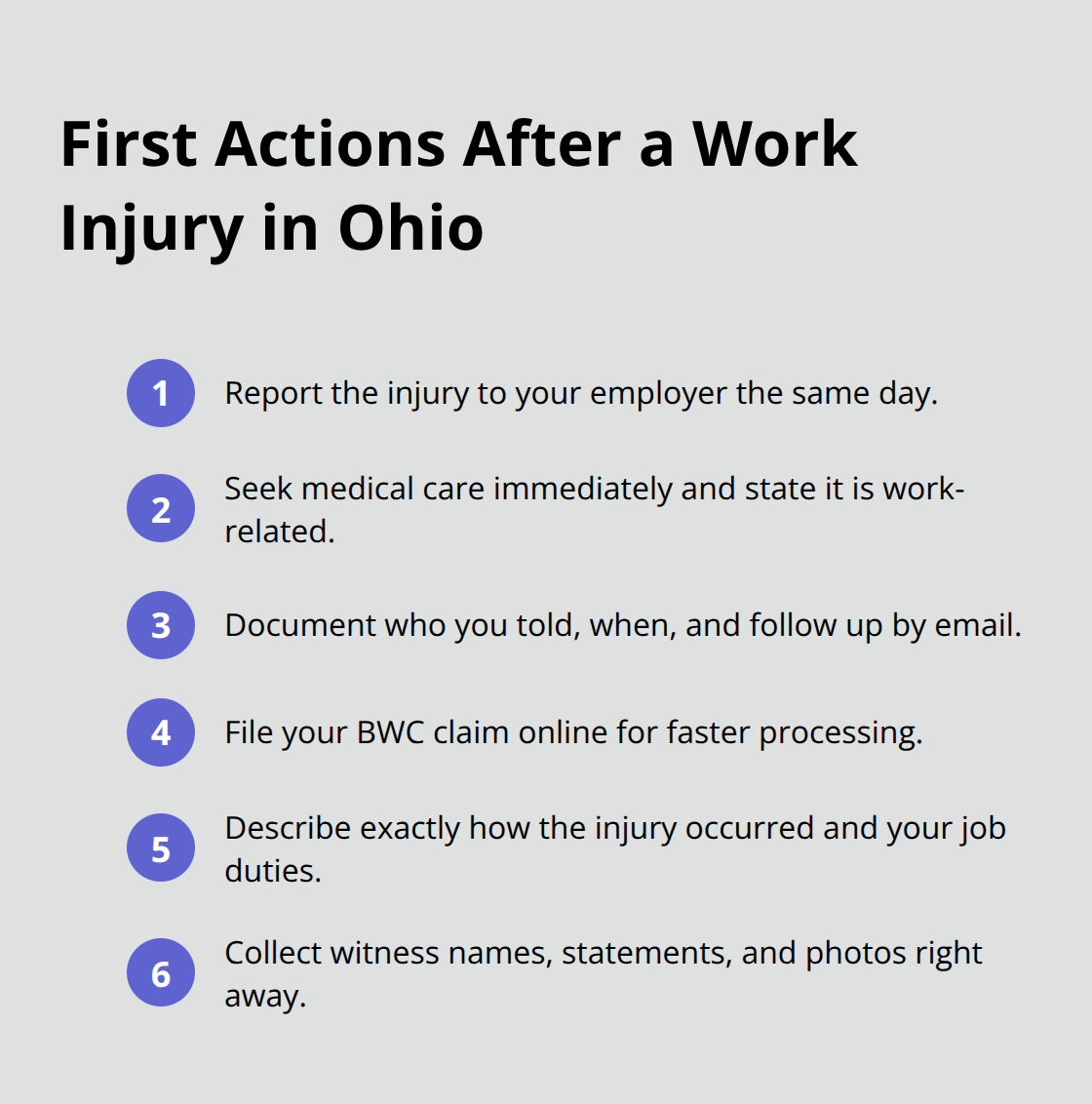
Medical providers also note the date you first sought treatment, and significant gaps between the injury date and the medical visit weaken your claim substantially. If you wait two weeks to see a doctor after a back injury, the insurer will argue that your condition developed from something unrelated to work. Document exactly when you reported the injury to your employer-the specific time, the person you told, and follow up with written communication via email. This creates an undeniable record that protects you if the employer later claims they never received notice.
Provide Strong Medical Documentation
Medical documentation quality separates approved claims from denials more than any other factor. When you see a healthcare provider, explicitly state that your injury is work-related and describe exactly how the injury occurred during your job duties. Vague medical records that fail to connect your condition to work give the Ohio Bureau of Workers’ Compensation grounds to deny your claim outright.
Take photos of the injury and the scene where it happened immediately after the incident-these images provide concrete evidence that supports your medical provider’s assessment. Gather witness names and contact information from coworkers who saw what happened, because witness statements corroborate your account when the employer contests your claim. Strong medical records that explicitly connect your injury to work duties form the foundation of a successful claim.
Avoid Accepting Settlement Offers Too Quickly
Many injured workers accept settlement offers without understanding what they’re surrendering. Settlement agreements typically close your claim permanently, meaning you cannot file for additional benefits later if your condition worsens or complications arise. Before accepting any settlement, consult with an attorney who can evaluate whether the offer covers your actual losses and future medical needs.
An experienced workers’ compensation attorney can review your case and identify whether the settlement amount reflects your true entitlements under Ohio law. Reject early settlement offers and pursue the full benefits you’re entitled to under Ohio law rather than accepting reduced compensation to resolve the claim quickly. If you believe the BWC’s decision is unfair, you have the right to challenge a workers’ comp decision through the proper appeal process. This legal support often makes the difference between accepting inadequate compensation and reclaiming the benefits you earned through your injury.
Final Thoughts
Ohio’s workers’ compensation system provides real protections that most injured workers don’t fully understand until they need them. The no-fault structure eliminates the burden of proving negligence, your medical provider choice remains protected for 30 days, and your right to appeal denials gives you a genuine path to challenge unfair decisions. These aren’t theoretical protections-they’re enforceable rights backed by the Ohio Industrial Commission and the Bureau of Workers’ Compensation.
The difference between a successful claim and a denied one often comes down to one factor: how quickly and thoroughly you document everything. Report your injury the same day, seek immediate medical care with explicit mention of the work connection, and file your claim online without delay. Strong documentation from day one prevents most denials entirely, but when the system fails you, the appeal process exists specifically to correct those failures.
Workplace injury rights in Ohio extend further than medical benefits alone. You can pursue third-party liability claims if another party’s negligence caused your injury, you retain wage loss compensation based on your actual earnings, and you cannot face retaliation for filing a claim. When your claim faces denial or complications arise, contact our firm to discuss your case and understand your options moving forward.