
A self-insured employer in Ohio workers’ comp handles your claim very differently from a company that buys coverage through the state insurance fund. Instead of the Bureau of Workers’ Compensation managing everything, your employer, or a company it hires, decides many of the early questions about your claim, your medical treatment, and your benefits. Knowing how that system works gives you real control over your claim from the very first day after an injury.
At Robin J Peterson Company, LLC, we help injured workers across Ohio understand how their claims are handled and how to protect their rights, so you can move forward with confidence. This guide explains what self-insured status actually means, how a claim moves through a self-insuring employer, what to do when the employer contests your claim, and the mistakes that most often cause problems.
What Self-Insured Status Actually Means in Ohio
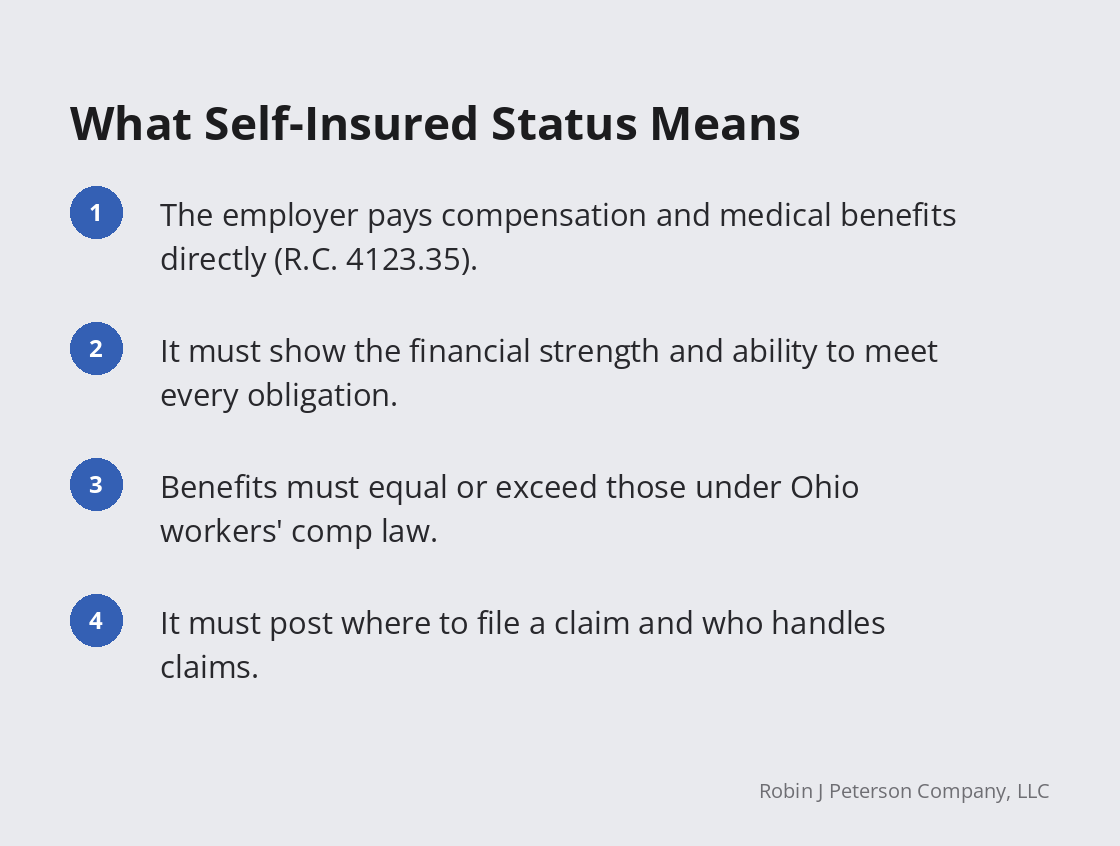
Many Ohio employers pay into the state insurance fund, and the Bureau of Workers’ Compensation (BWC) processes claims for their workers. Some employers take a different route. Ohio Revised Code Section 4123.35 allows qualifying employers to be granted the privilege to pay compensation and furnish medical, surgical, nursing, and hospital services directly to injured employees, giving them status as a self-insuring employer.
That status changes who handles your claim day to day, but it does not change the basic protections Ohio law gives you. Understanding the difference helps you know where to file, who to call, and what deadlines the employer must meet.
How an Employer Becomes Self-Insured
Self-insured status is not automatic. Under Ohio Administrative Code Rule 4123-19-03, an employer granted the privilege to pay compensation and benefits directly must demonstrate sufficient financial strength and administrative ability to assure that all of its obligations will be met promptly. The BWC administrator reviews the employer’s financial records and denies the privilege when an employer cannot show that ability.
The same rule requires self-insuring employers to contribute to the self-insuring employers’ guaranty fund and, when the BWC requires it, to provide additional security such as a surety bond. Those safeguards come into play if a self-insuring employer later defaults on its obligations.
Your Benefits Are the Same Under the Law
A common worry is that a self-insured employer can offer less than the state system. Rule 4123-19-03 states that the security a self-insuring employer provides is conditioned on furnishing benefits equal to or greater than those provided by the Ohio workers’ compensation law, and on full compliance with the rules and procedures of the Industrial Commission and the BWC.
In practical terms, the types of benefits available in your claim, such as medical treatment and compensation for time missed from work, come from the same statutes that govern state fund claims. What changes is who processes the paperwork and makes the first decisions.
How to Tell If Your Employer Is Self-Insured
Rule 4123-19-03 requires a self-insuring employer to post notices of its self-insuring status that show where to file a claim and the job title and department of the employees responsible for processing workers’ compensation claims. Look for that notice near time clocks, break rooms, or human resources offices.
Some self-insuring employers use an outside company to administer their claims. If you are unsure, ask human resources directly and request the name of the person or company handling your claim, then write it down along with the date you asked.
How a Claim Moves Through a Self-Insuring Employer
In a state fund claim, the BWC investigates and issues orders. With a self-insuring employer, the employer takes on many of those responsibilities itself. Ohio’s rules set specific timelines the employer must follow, and knowing those timelines helps you spot delays early.
Keep copies of everything you submit and everything you receive. With a self-insured claim, your own records are often the clearest way to show when the employer learned of your injury and how quickly it responded.
Reporting Your Injury and Filing the Claim
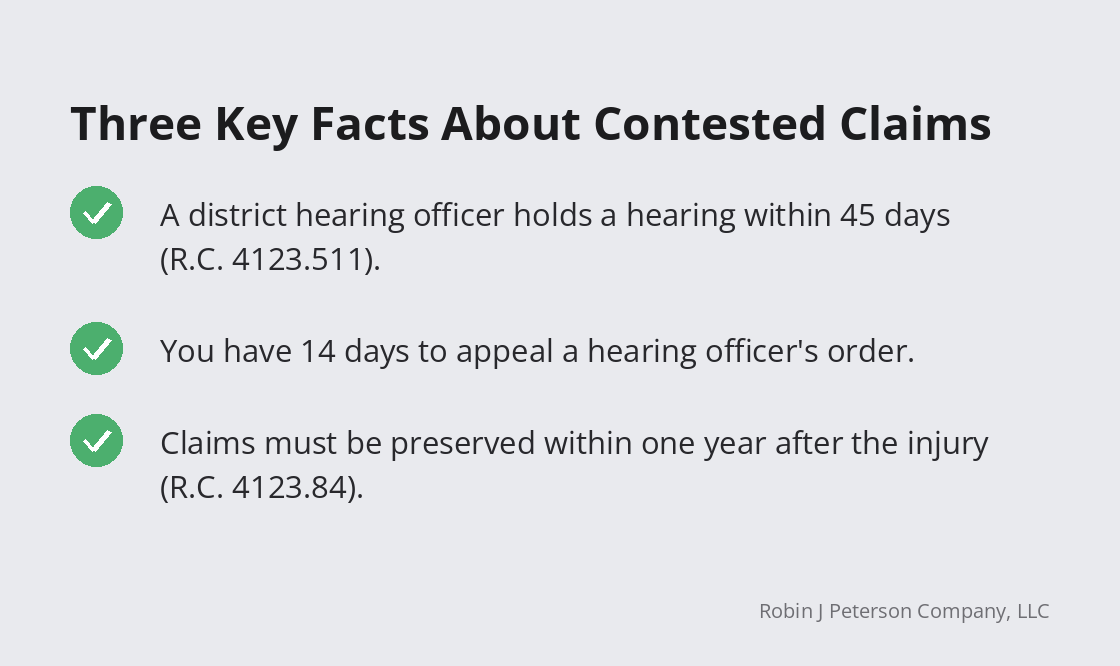
Report your injury to your supervisor right away and file your claim with the employer at the location shown on its posted notice. Ohio Revised Code Section 4123.84 provides that claims for the specific parts of the body injured are forever barred unless certain steps occur within one year after the injury. For self-insuring employers, the statute notes that treatment by a physician employed by the employer can satisfy that requirement but does not by itself recognize the claim as compensable.
Because that rule is narrow, do not rely on a visit to a company clinic as a substitute for filing. In addition to filing with your employer, make sure written notice listing every injured body part reaches the BWC or the Industrial Commission within the one-year window.
The Employer’s Thirty-Day Decision on Conditions
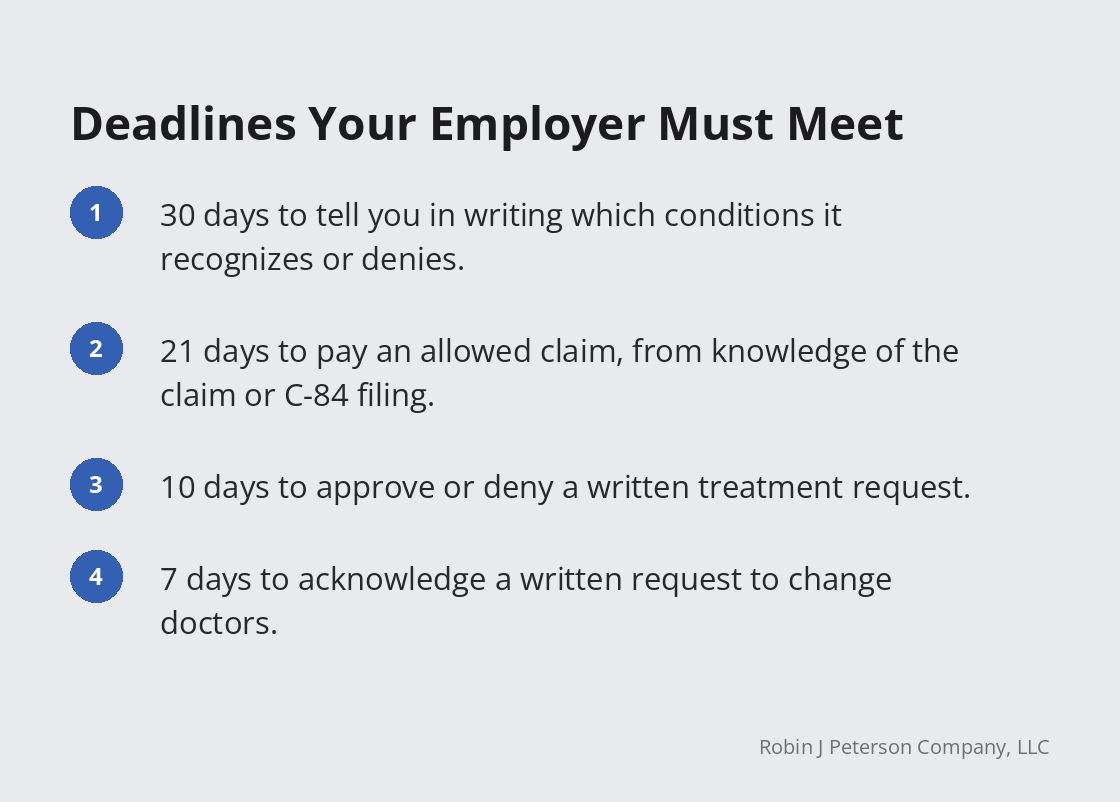
Under Rule 4123-19-03, a self-insuring employer must inform the claimant and the BWC in writing, within thirty days from the filing of the claim with the employer, which conditions it has recognized as related to the injury or occupational disease and which conditions, if any, it has denied. The same timeframe applies to medical-only claims.
The rule also requires the employer to pay compensation and benefits without waiting for a BWC or Industrial Commission order, unless it contests the claim. If the employer allows a claim without a hearing, it must pay the benefits and compensation no later than twenty-one days from learning of the claim or the claimant’s filing of the C-84 form, whichever is later.
Medical Treatment and Choosing Your Doctor
Rule 4123-19-03 requires a self-insuring employer to approve or deny a written request for treatment within ten days of receiving it. If the employer does not respond within ten days, it cannot deny the treatment request or contest payment of any bill for that treatment.
The employer must also acknowledge a written request to change physicians within seven days, and the rule states that the employer cannot impede your freedom to choose a treating physician for the allowed conditions in your claim. Within thirty days after receiving a medical bill, the employer must either pay it or notify the provider and you in writing of the reason for nonpayment, and that notice must tell you that you have the right to request a hearing before the Industrial Commission.
When a Self-Insured Employer Contests Your Claim
A self-insuring employer has a financial interest in how your claim is decided, and it may contest the claim itself, a specific condition, a treatment request, or a period of compensation. When that happens, the Industrial Commission’s hearing officers, not the employer, decide the dispute.
The hearing process moves quickly, so it helps to know the timelines and gather your medical evidence before the first hearing is scheduled.
The Industrial Commission Hearing Process
Ohio Revised Code Section 4123.511 provides that, in contested claims other than state fund claims, the Industrial Commission refers the claim to a district hearing officer. The district hearing officer must hold a hearing within forty-five days after the filing of the appeal and issue a decision within seven days after the hearing.
Any party may appeal the district hearing officer’s order within fourteen days after receiving it. A staff hearing officer then holds a hearing within forty-five days after that appeal is filed and issues a decision within seven days after the hearing. Missing a fourteen-day appeal deadline can leave an unfavorable order in place.
Getting Copies of Your Claim Records
Under Rule 4123-19-03, when you or your representative make a written request, the employer must make its records pertaining to the claim available for review at a reasonable time and place, not to exceed three business days. The employer must also provide copies of those records within three business days of a written request, with extensions of no more than fourteen days if you agree.
Reviewing the employer’s file before a hearing lets you see the medical reports, statements, and other documents it plans to rely on. The rule also requires the employer to provide the claimant with medical reports it receives from the treating physician and consulting physicians for the claimed injury.
Mistakes That Hurt Self-Insured Claims
One common mistake is assuming the company’s claims office works for you. The employer’s claims staff, or the outside company it hires, represents the employer’s interests, so be careful about recorded statements and keep your descriptions of the injury consistent with your medical records.
Other mistakes include relying on verbal approvals for treatment, failing to put requests in writing, and letting deadlines pass while waiting for the employer to act. Written requests start the employer’s clocks, and dated copies prove when those clocks began.
Final Thoughts
A self-insured employer in Ohio workers’ comp has real responsibilities to the workers it covers, including deadlines to decide which conditions it recognizes, respond to treatment requests, pay allowed benefits, and share claim records. When it contests a claim, Industrial Commission hearing officers decide the dispute through a hearing process with firm timelines.
Knowing those rules helps you file correctly, put every request in writing, and recognize when your employer is not meeting its obligations. The more organized your records are, the stronger your position will be if a dispute reaches a hearing.
If you were injured working for a self-insured employer, contact Robin J Peterson Company, LLC to speak with our team about your Ohio workers’ comp claim. We will review your claim, explain your options, and help you take the next step with confidence.