
Qualifying for workers compensation benefits requires meeting specific criteria set by Ohio’s system. Not every injury or illness automatically qualifies, and understanding the requirements upfront can save you time and frustration.
We at Robin J Peterson Company, LLC help injured workers navigate this process every day. This guide walks you through the eligibility requirements, what the Ohio Bureau of Workers Compensation evaluates, and the documentation you’ll need to support your claim.
Who Actually Qualifies for Workers Compensation in Ohio
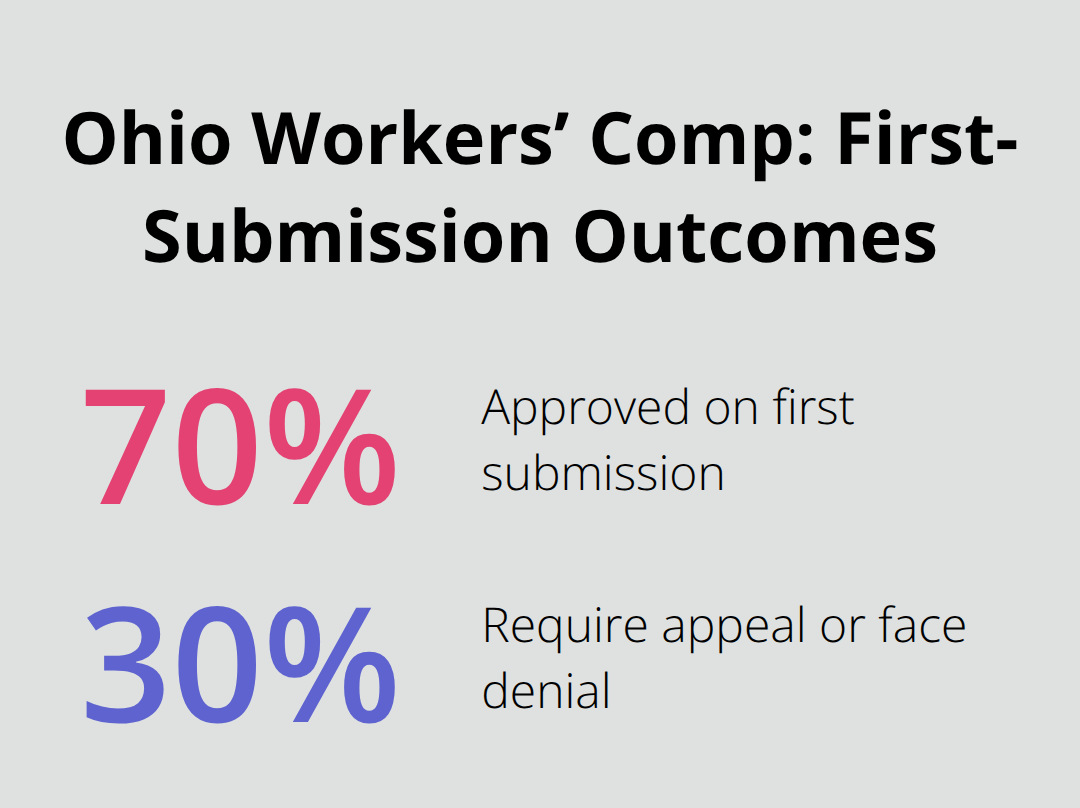
You must meet three hard requirements to qualify for workers compensation in Ohio. First, you need to be an employee of a covered employer. Second, your injury or illness must arise from work. Third, you must report it within the timeframe Ohio law requires. Missing any one of these eliminates your eligibility, regardless of how serious your injury is. The Ohio Bureau of Workers Compensation evaluates thousands of claims annually, and roughly 70% receive approval on the first submission, according to BWC data. The remaining 30% either face denial or require appeals, which is why understanding these requirements from the start matters.
Employment Status Makes or Breaks Your Claim
Your employment classification determines everything. You must qualify as an employee, not an independent contractor or self-employed individual. Many workers misunderstand this distinction. If you control your own schedule, provide your own tools, work for multiple companies simultaneously, and invoice for your services, you likely cannot qualify. However, if your employer sets your hours, provides equipment, supervises your work, and pays you through standard payroll, you probably meet the employment requirement. Sole proprietors and business owners cannot claim workers compensation for themselves, though they can cover their employees. Temporary workers and seasonal employees do qualify if they work for covered employers. Most employers in Ohio must carry workers compensation insurance or self-insure, with limited exceptions for certain agricultural operations and domestic workers.
The Work-Related Connection Cannot Be Vague
Your injury must occur during employment and arise from your job duties. This does not mean the injury must happen at your workplace. If you travel for work and suffer an injury during that travel, you likely qualify. If you slip in the company parking lot while heading to your shift, that counts as work-related. However, if you suffer an injury while commuting to work on your own time, that does not qualify. Occupational illnesses also count, but they require stronger documentation showing the workplace caused or significantly contributed to the condition.
Deadlines That Cannot Wait
You must report the injury to your employer within 30 days (though Ohio law allows exceptions if you had a valid reason for the delay). Filing a claim with the BWC requires submission within one year of when the injury occurred or when you should have known it was work-related. Missing these deadlines significantly reduces your chances of approval. The Ohio Bureau of Workers Compensation takes these timelines seriously, and delays often result in claim denials that prove difficult to overturn.
Understanding your employment status, the work-related nature of your injury, and the reporting deadlines positions you to move forward with confidence. The next section examines how the Ohio Bureau of Workers Compensation evaluates your claim once you submit it.
How the Ohio Bureau of Workers Compensation Processes Your Claim
The Ohio Bureau of Workers Compensation operates on a medical evidence standard that most injured workers underestimate. The BWC does not simply accept your word that an injury happened or that it prevents you from working. Instead, they assign a claims adjuster who reviews your medical documentation, your employment records, and the circumstances of your injury. This adjuster has roughly 30 days to make an initial determination, though complex cases often extend beyond that timeline.
Medical Evidence Determines Your Outcome
The BWC approves approximately 70% of claims on first submission, but that statistic masks a critical reality: claims with incomplete medical evidence or missing employment documentation face much higher denial rates. The agency prioritizes medical records that clearly link your injury to your work duties and establish the severity of your condition. Your physician must explicitly state that your condition arose from your work environment. Without this connection documented in writing, the BWC will reject your claim regardless of how obvious the link seems to you.
Types of Benefits the BWC Provides
Once approved, you receive multiple types of benefits depending on your situation. Temporary total disability payments replace 66.67% of your average weekly wage if your injury prevents you from working while you recover. Permanent partial disability awards provide a lump sum if you sustain lasting impairment even after treatment ends. Medical benefits cover all reasonable and necessary treatment related to your work injury, including doctor visits, physical therapy, surgery, and prescription medications. Vocational rehabilitation services help you return to work if your injury limits your ability to perform your previous job. Death benefits protect your family if a work injury proves fatal.
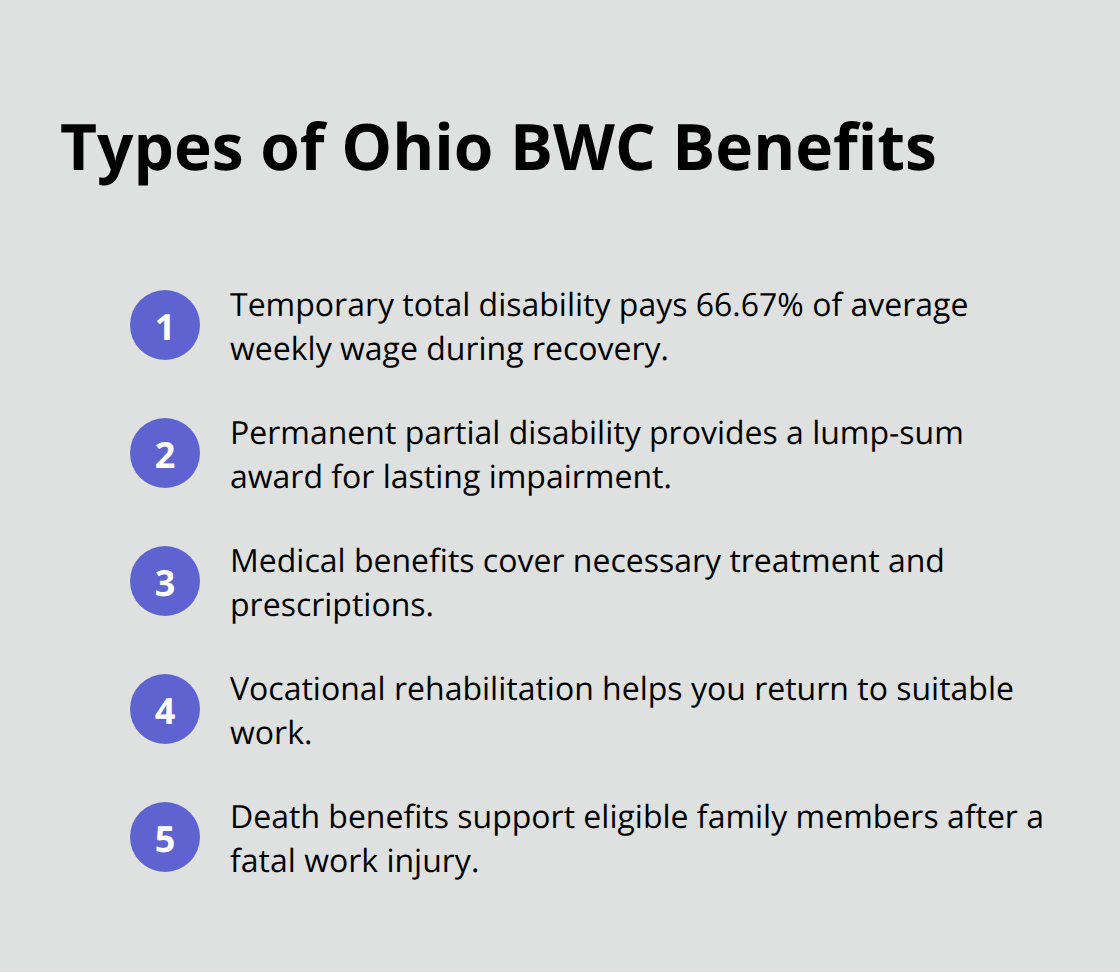
The BWC publishes specific payment schedules for different body parts and impairment levels, so your award amount depends on the medical evidence supporting your claim severity.
Why the BWC Denies Claims
Claims face denial for predictable reasons that you can actually prevent. Missing medical documentation tops the list, particularly when your physician fails to state that your condition arose from your work duties. The BWC rejects claims when workers report injuries months after they occur, especially without documentation explaining the delay. Self-inflicted injuries, injuries from horseplay unrelated to work, and conditions that existed before employment rarely qualify.
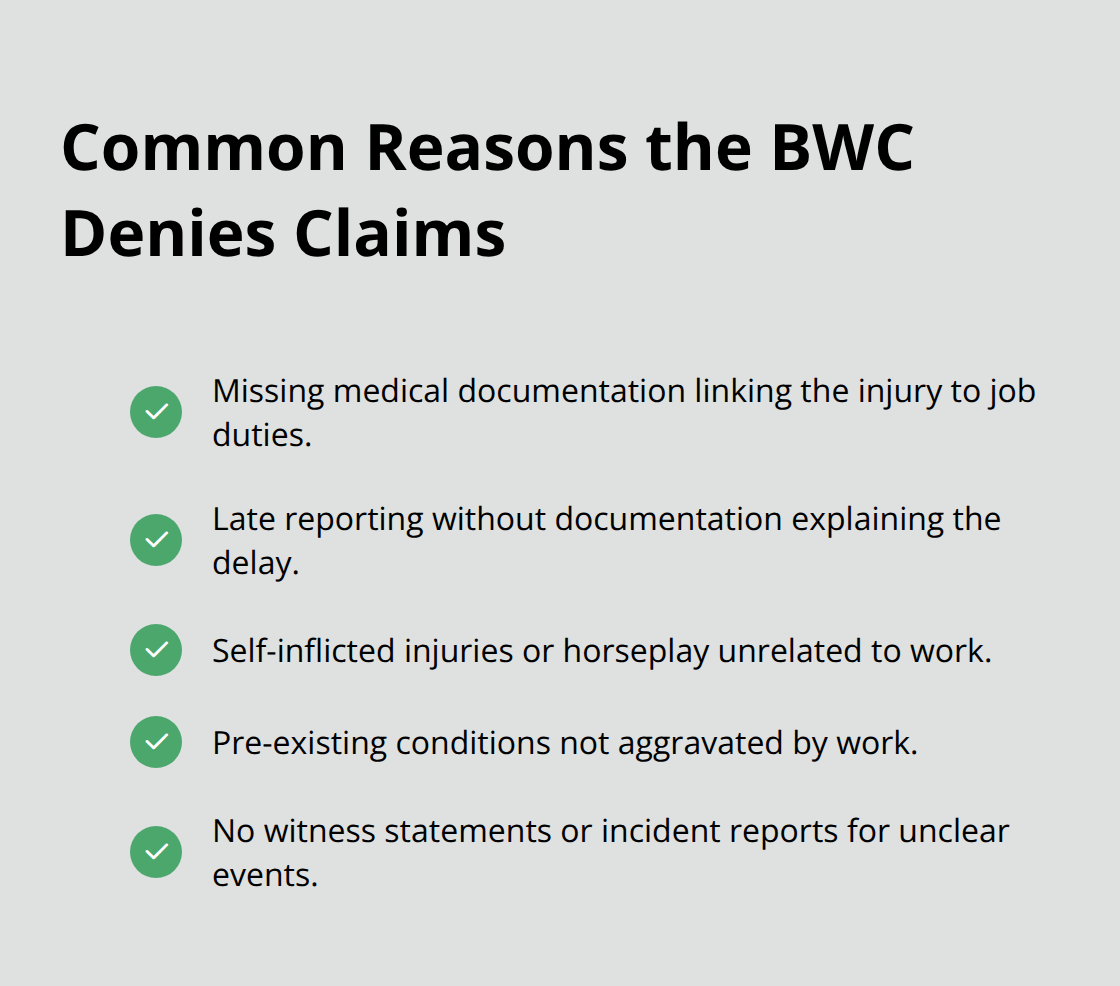
Lack of witness statements or incident reports weakens claims significantly when the injury circumstances seem unclear (particularly in cases where no supervisor or coworker observed the incident).
What Happens Next in Your Claim
The documentation you provide during the initial submission phase determines whether the BWC approves or denies your claim. This is why gathering the right evidence from day one matters so much. The next section walks you through exactly what documentation the BWC requires and how to organize it for maximum impact.
Documentation and Evidence Needed for Your Claim
The Ohio Bureau of Workers Compensation receives thousands of claims annually, and the difference between approval and denial often comes down to one simple fact: whether you submitted complete documentation. The BWC does not contact you asking for missing pieces. Instead, they review what you provided during the initial submission window and make their decision based on that alone. This means you must gather the right evidence before you file.
Medical Records That Connect Your Injury to Work
Your physician must explicitly document that your injury arose from your work duties, not just that you have an injury. A generic medical report stating you have a shoulder condition means nothing to the BWC if it does not connect that condition to your job tasks. Request your doctor write a statement that clearly links your injury to your workplace environment and the specific activities you perform. Without this written connection, the BWC will deny your claim regardless of how obvious the link seems to you or how severe your condition actually is.
Medical records should include your initial treatment notes, imaging results like X-rays or MRI scans, surgical reports if applicable, and all follow-up appointment documentation. Do not assume your doctor automatically sent these to the BWC. Contact your healthcare provider directly and request they submit your complete medical file to the Ohio Bureau of Workers Compensation, and obtain confirmation that they did so.
Wage Records and Employment Documentation
Wage records and employment documentation matter far more than injured workers realize because the BWC uses these figures to calculate your benefit amounts. Obtain your pay stubs from the 52 weeks before your injury occurred, which establishes your average weekly wage for temporary disability payments. If you worked fewer than 52 weeks, provide all available pay records from your employment. Your employer must also provide documentation of your employment status, job duties, and work schedule.
Witness Statements and Incident Reports
Witness statements carry significant weight when the injury circumstances lack clear documentation. If coworkers or supervisors observed your injury, you should get written statements from them within days of the incident, not weeks or months later. The Ohio Bureau of Workers Compensation views contemporaneous witness accounts as far more reliable than recollections provided long after an injury occurs. You should also gather incident reports immediately after your injury happens, even if your employer seems reluctant to document it. Request a copy for your records.
Final Thoughts
Qualifying workers compensation benefits in Ohio demands that you meet three non-negotiable criteria: you must work as an employee for a covered employer, your injury must arise from work, and you must report it within the required timeframe. The Ohio Bureau of Workers Compensation approves roughly 70% of claims on first submission, but that approval hinges entirely on complete medical documentation that explicitly connects your injury to your job duties, wage records that establish your benefit calculations, and witness statements or incident reports that support your claim. Missing any of these elements significantly increases your chances of denial.
You should start the process by gathering documentation immediately after your injury occurs. Contact your employer and request an incident report the same day, obtain written statements from anyone who witnessed what happened, and schedule a medical appointment where your physician documents the work-related nature of your condition in writing. Collect your pay stubs from the past 52 weeks and your employment records, then submit everything to the Ohio Bureau of Workers Compensation within one year of your injury (though reporting to your employer within 30 days positions you most favorably).
Navigating these requirements alone often leads to mistakes that result in denials, which is why we at Robin J Peterson Company, LLC represent injured workers throughout the Cleveland, Akron, and Canton areas who face complex claims or BWC denials. Our team fights to secure the benefits you deserve by handling the documentation, communicating with the BWC, and appealing denials when necessary. Contact us to discuss your specific situation and learn how we can help you move forward.