
A permanent partial disability claim in Ohio can feel overwhelming when you’re trying to understand your benefits and rights. At Robin J Peterson Company, LLC, we’ve helped countless workers navigate this complex process and get the compensation they deserve.
This guide walks you through what permanent partial disability Ohio means, how to file your claim, and the common obstacles you might face along the way.
What PPD Actually Means in Ohio
[Permanent partial disability in Ohio compensates you for lasting impairment from a work injury when you’ve stopped healing but haven’t fully recovered. The Ohio Bureau of Workers’ Compensation defines PPD as a permanent condition affecting your body’s ability to function normally, even after you’ve reached maximum medical improvement-the point where your healing has plateaued and further recovery is unlikely. This distinction matters because PPD is not about whether you can work; it’s about recognizing that your body has sustained permanent damage. You might return to your job, earn the same wage, and still qualify for PPD benefits if medical evidence shows lasting impairment.
How the Ohio Bureau of Workers’ Compensation Calculates Your Benefits
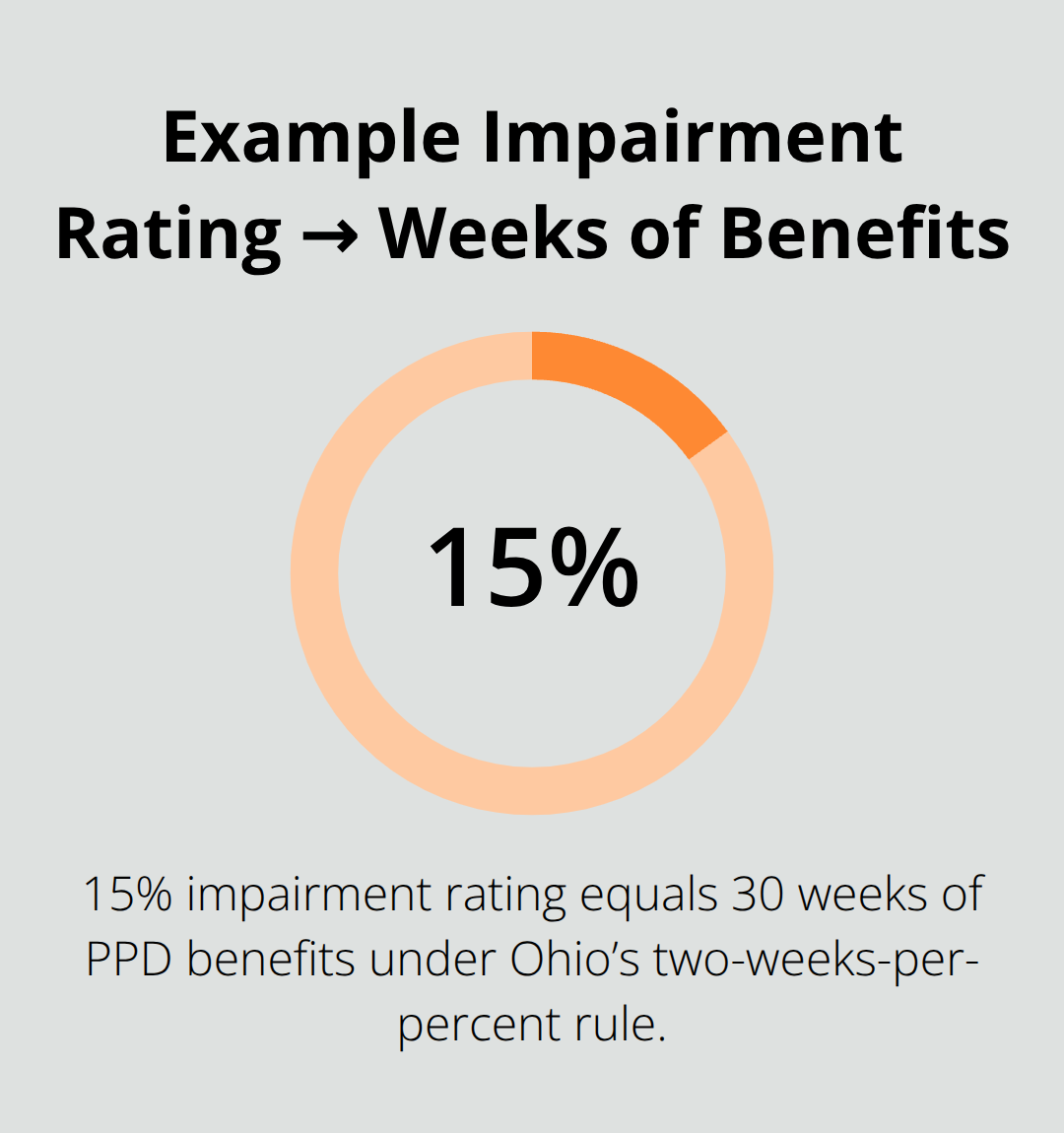
The impairment percentage, expressed as a portion of whole-person impairment, drives your benefit amount. A 15% impairment rating translates to 30 weeks of PPD benefits under Ohio’s two-weeks-per-percent calculation. The Ohio Bureau of Workers’ Compensation determines this percentage using objective medical evidence rather than your opinion about how injured you feel.
This standardized approach means two workers with similar injuries may receive different ratings based on the actual functional loss each person sustained.
Injuries That Actually Qualify
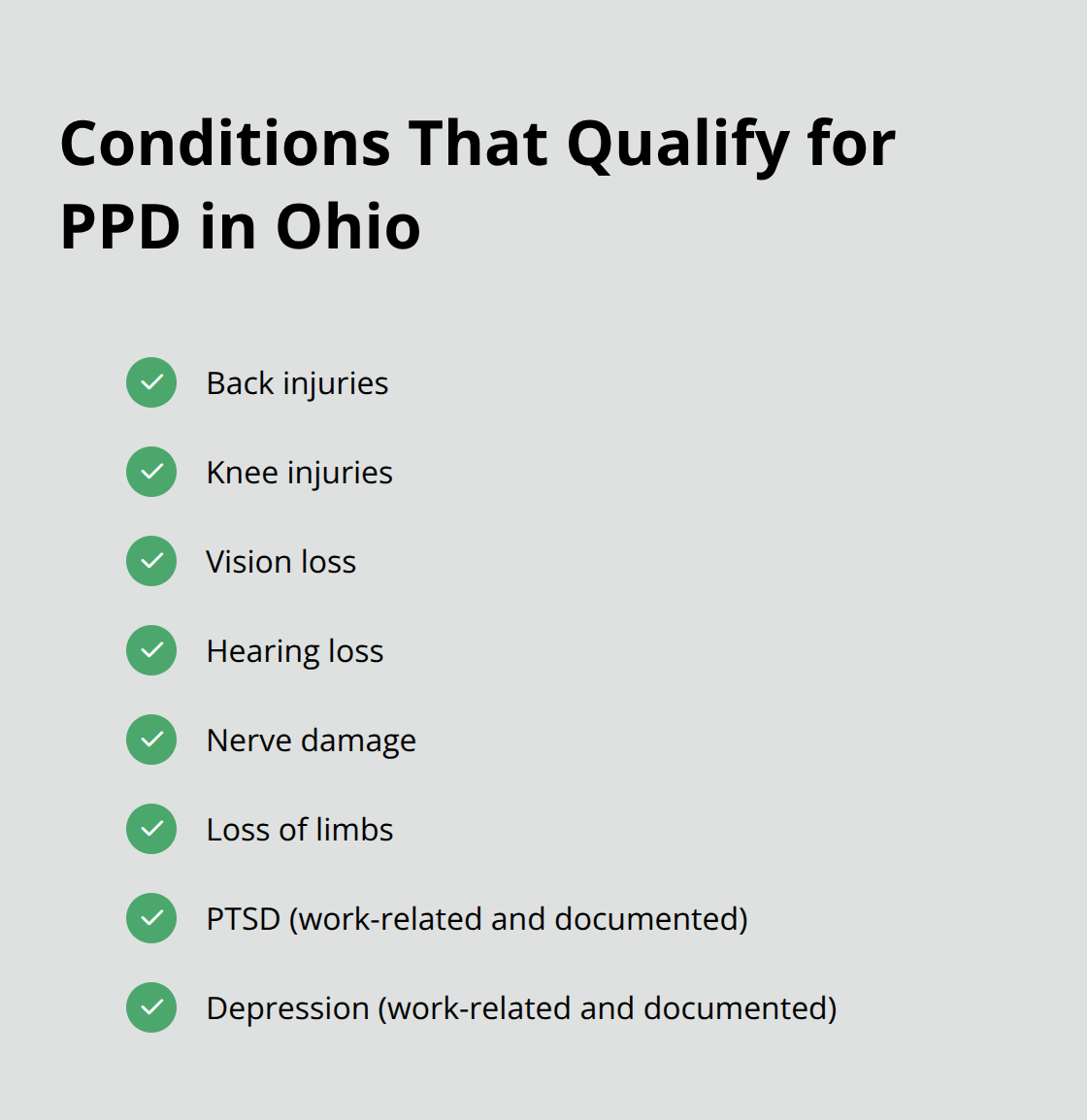
Back injuries, knee injuries, vision loss, hearing loss, nerve damage, and loss of limbs all qualify for PPD in Ohio. Less obvious but equally valid are psychological conditions like PTSD and depression when they’re properly documented as work-related impairments. The Ohio Bureau of Workers’ Compensation evaluates each condition against the American Medical Association’s Guides to the Evaluation of Permanent Impairment, which provides standardized ratings for different body parts and conditions.
A worker with a shoulder injury that limits overhead reaching receives a different impairment percentage than someone with the same injury but greater functional loss.
Medical Evidence Determines Your Rating
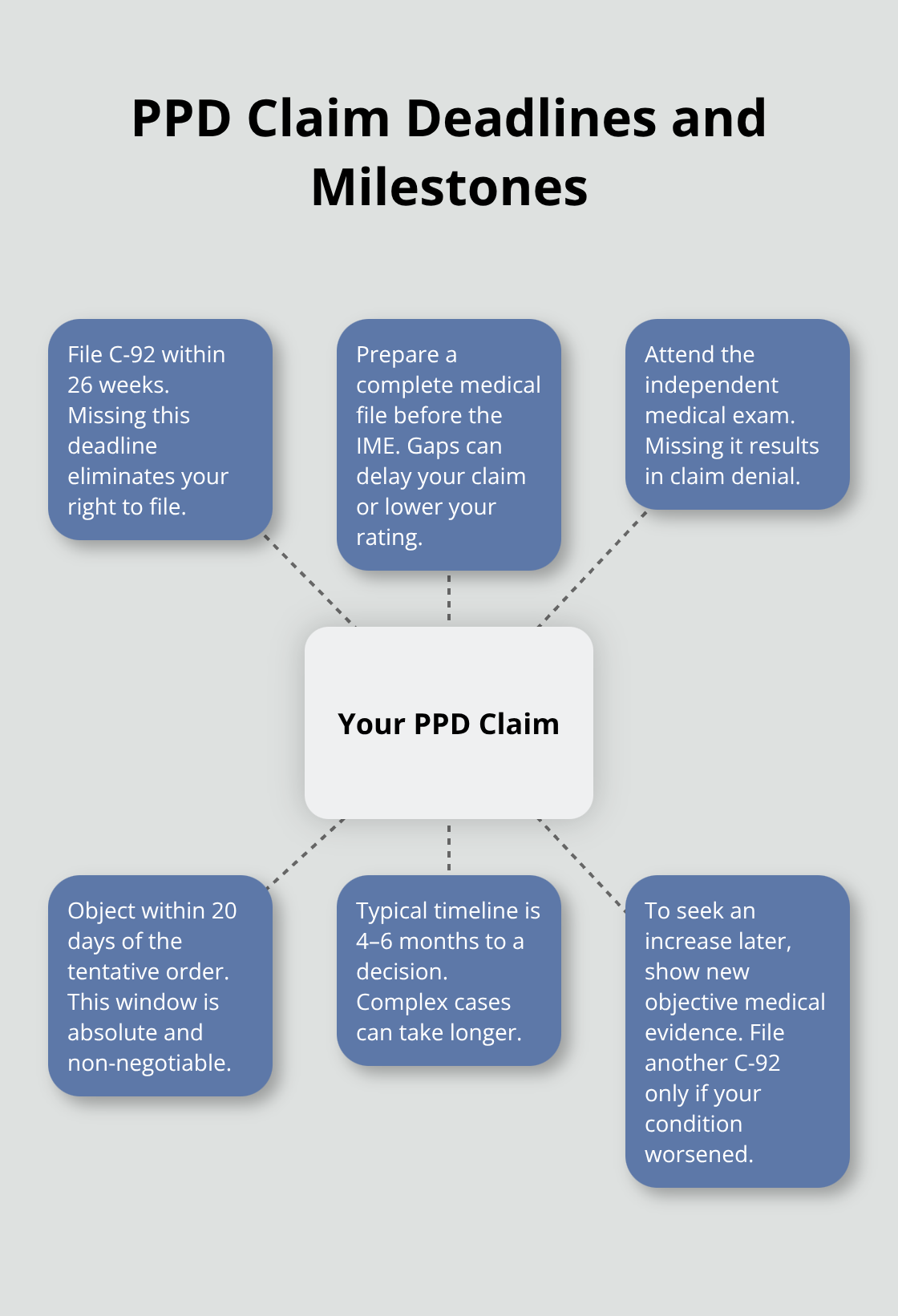
The medical evidence-imaging, testing, functional capacity evaluations, and physician notes-determines your specific rating. You cannot qualify for PPD without reaching maximum medical improvement first; filing too early wastes time and may result in denial. The 26-week filing deadline matters significantly: you have 26 weeks from your last temporary total disability payment or 26 weeks from the injury date if you never received wage replacement to file your Application for Determination of the Percentage of Permanent Partial Disability, known as the C-92 form, with the Ohio Bureau of Workers’ Compensation. Understanding this timeline sets you up for the claims process ahead.
How to File Your PPD Claim and What Happens Next
Submit Your C-92 Form Within the Filing Deadline
Form C-92, the Application for Determination of the Percentage of Permanent Partial Disability, starts your PPD claim with the Ohio Bureau of Workers’ Compensation. You must submit this form within 26 weeks of your last temporary total disability payment or 26 weeks from your injury date if you never received wage replacement. The C-92 is available as an online open form on the Ohio Bureau of Workers’ Compensation website, making submission straightforward. File your claim as soon as possible after your injury or final wage replacement payment, since missing this 26-week deadline eliminates your right to file.
Attach Complete Medical Documentation
Comprehensive medical documentation determines whether the Ohio Bureau of Workers’ Compensation approves your claim quickly or requests additional information. Attach imaging results, physician notes, functional capacity evaluations, and specialist reports that demonstrate your permanent impairment. Include records showing you’ve reached maximum medical improvement, since PPD cannot be awarded before this point. Incomplete documentation is the primary reason the Ohio Bureau of Workers’ Compensation requests additional information, delaying your claim by weeks or months.
Prepare for the Independent Medical Examination
The Ohio Bureau of Workers’ Compensation schedules you for an independent medical examination conducted by physicians selected by the agency. This examination is not optional, and missing it results in claim denial. The independent physician evaluates your condition against the American Medical Association’s Guides to the Evaluation of Permanent Impairment to assign an objective impairment percentage. Bring all relevant medical records to this exam and answer questions honestly about your functional limitations.
Respond to the Tentative Order Within 20 Days
After the independent exam, the Ohio Bureau of Workers’ Compensation issues a tentative order with your impairment rating. Both you and your employer have exactly 20 days to object to this rating. If neither party objects, the order becomes final. If you disagree with the rating, file your objection within the 20-day window; missing this deadline eliminates your right to challenge the determination.
Navigate the Industrial Commission Review Process
Once an objection is filed, the Industrial Commission of Ohio reviews the case and issues a final decision based on the medical evidence presented. Industrial Commission decisions are final and cannot be appealed further, making this stage critical. Workers represented by an attorney have substantially better outcomes in objection proceedings because legal representation ensures proper documentation, timely filing, and effective advocacy. The entire process from C-92 filing to Industrial Commission decision typically takes four to six months, though complex cases involving multiple medical opinions extend longer. If your condition worsens after the initial determination, you can file another C-92 to seek an increased rating, though you must demonstrate objective medical evidence of deterioration. Understanding these procedural steps and deadlines positions you to address disputes over your disability rating effectively.
Common Challenges in PPD Claims and How to Address Them
Incomplete Medical Documentation Stops Claims Cold
The gap between filing your C-92 form and receiving your final determination is where most PPD claims encounter real problems. The Ohio Bureau of Workers’ Compensation rejects or delays claims far more often due to incomplete medical records than any other reason. Missing functional capacity evaluations, outdated imaging, or physician notes that fail to document your maximum medical improvement status create immediate obstacles. The independent medical examiner relies entirely on what’s in your file, so gaps in documentation translate directly into lower impairment ratings or requests for additional exams that push your timeline back by weeks.
One critical mistake workers make is submitting their C-92 without specialist reports when their injury involves a body part requiring specialized assessment. A back injury needs orthopedic documentation; a hearing loss claim requires audiological testing; a psychological condition like PTSD demands psychiatric or psychological evaluation showing work-relatedness. The Ohio Bureau of Workers’ Compensation won’t accept vague statements from your primary care doctor about complex impairments. You need the specific medical evidence that the American Medical Association’s Guides to the Evaluation of Permanent Impairment actually references for rating purposes.
The 20-Day Objection Window Is Absolute
If your initial independent medical exam produces a rating you believe is too low, understand that the 20-day objection window is absolute and non-negotiable. Missing this deadline eliminates your right to challenge the determination entirely, and you cannot recover this right later. When you object, the Industrial Commission of Ohio will review only the medical evidence already submitted, so additional records submitted after your objection cannot be considered unless both parties agree. Your medical file must be complete and comprehensive before that tentative order arrives.
Insurance Carriers Use Direct Contact Against You
Your relationship with your employer and their insurance carrier during the PPD process requires clear boundaries and strategic communication. Insurance carriers routinely contact injured workers directly asking for statements or requesting medical releases, and anything you say can be used to support a lower impairment rating. Direct all communication from insurance carriers to your attorney rather than responding directly. Do not sign any additional medical releases or authorization forms without legal review, as carriers use these to obtain records that may contain information unrelated to your work injury.
Some insurance carriers pressure employers to dispute PPD determinations aggressively, even when medical evidence supports a higher rating, because reducing PPD benefits directly reduces their claim costs. The Industrial Commission decision is final and cannot be appealed, making the objection phase your only meaningful opportunity to present stronger evidence.
Requesting an Increase Requires New Medical Evidence
If you believe your impairment rating was determined incorrectly, filing another C-92 to request an increase is possible, but only if objective medical evidence shows your condition has worsened since the initial determination. Deterioration must be documented through new medical testing, imaging, or specialist evaluations, not simply your subjective statement that you feel worse. The entire claims process is adversarial by design, and workers without legal representation accept initial ratings at substantially higher rates than represented workers, according to patterns visible in Industrial Commission case outcomes.
Final Thoughts
Permanent partial disability in Ohio requires you to meet strict deadlines and procedural requirements that insurance carriers will exploit if you miss them. The 26-week filing deadline for your C-92 form is absolute, and missing it eliminates your right to PPD benefits entirely. Your medical documentation must be complete before the independent medical examination, since gaps in your file directly reduce your impairment rating, and the 20-day objection window after the tentative order arrives is your only opportunity to challenge an undervalued rating.
Insurance carriers contact injured workers directly, request medical releases, and pressure employers to dispute ratings because reducing benefits reduces their claim costs. Workers represented by an attorney achieve substantially better outcomes than those navigating the process alone because legal representation ensures your medical file is complete before submission, files objections within the 20-day window, and presents evidence effectively at the Industrial Commission level. The Industrial Commission decision that follows is final with no further appeals available, making these early phases of your claim the only moments when you can meaningfully protect your rights.
We at Robin J Peterson Company, LLC represent injured workers throughout Ohio’s workers’ compensation system and fight against the BWC and insurance carriers to secure the benefits you deserve. Contact us to discuss your permanent partial disability Ohio claim and learn how legal representation protects your rights when the stakes are this high.