
Work injuries happen fast, but understanding your Ohio workers compensation benefits shouldn’t be complicated. We at Robin J Peterson Company, LLC know that injured workers need clear answers about what they’re entitled to receive.
This guide walks you through the types of benefits available, how to file your claim, and why some claims get denied. You’ll have the information you need to protect your rights.
What Benefits Can You Actually Receive
Ohio’s workers compensation system provides three main categories of support when you get hurt on the job, and understanding what each covers makes a real difference in your recovery. Medical benefits pay for all treatment related to your work injury, including doctors’ visits, hospitalization, prescriptions, surgery, therapy, and medical equipment-with no out-of-pocket costs for approved care. This means you never pay a deductible or copay for work-related treatment through the Ohio Bureau of Workers’ Compensation. Wage replacement benefits step in when you cannot work, replacing approximately two-thirds of your average weekly wage according to the Ohio BWC. The amount and duration depend on your specific injury type and medical prognosis, not on what your employer thinks or wants.
Understanding Your Wage Replacement Options
Temporary Total Disability benefits apply when you cannot work at all due to your injury-this covers the period where you’re completely unable to perform your job while healing. Permanent Partial Disability benefits compensate you for lasting impairment that allows some work capability, with your disability rating determined by medical evidence and objective findings rather than subjective opinions. Permanent Total Disability benefits provide long-term or lifetime support when injuries prevent you from working at any substantial capacity, offering the most comprehensive wage protection available. The key difference is that TTD ends when you return to work or reach medical improvement, while PPD and PTD duration depend on your actual impairment level and demonstrated ability to work. You should document your medical condition thoroughly early on-medical evidence drives everything in Ohio’s system, and weak documentation at the start creates problems later.
Vocational Rehabilitation Gets You Back to Work
If your injury prevents you from returning to your previous job, vocational rehabilitation services help you transition to suitable new work through retraining and job placement assistance. These services are often overlooked by injured workers who assume they must accept whatever work they can find, but Ohio law specifically provides this support to help you move forward professionally. The focus is on placing you into work that matches your capabilities after the injury, not just any available position.
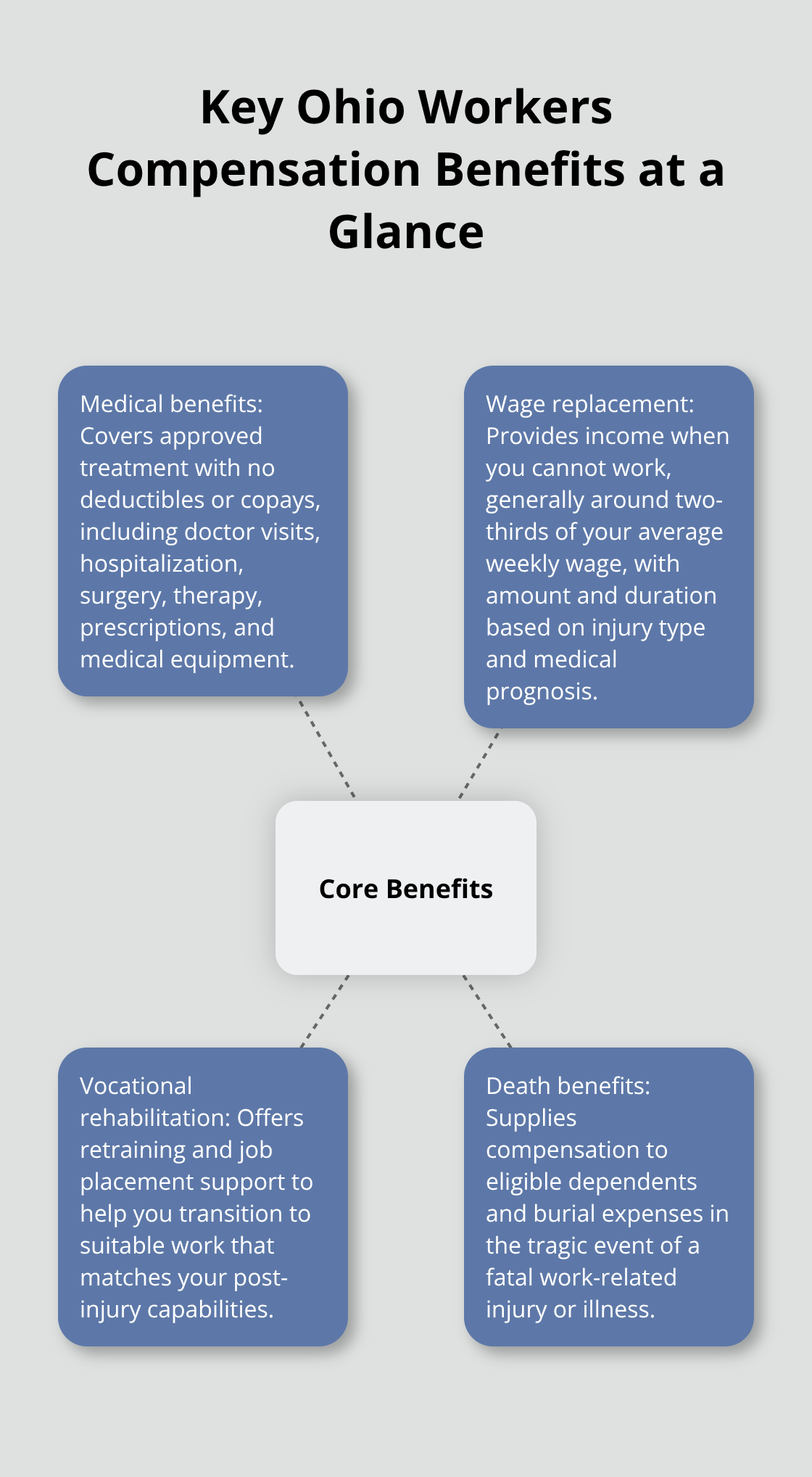
Death benefits also exist under Ohio law to provide compensation to eligible dependents and cover burial expenses when a workplace injury or illness proves fatal, though this represents the most serious outcome the system addresses.
Why Medical Evidence Matters Most
The Ohio Bureau of Workers’ Compensation relies heavily on medical documentation to determine your eligibility and benefit level. Weak or incomplete medical records early in your claim create obstacles that become difficult to overcome later. Strong medical evidence (including objective test results and detailed provider notes) supports your position throughout the entire claims process and appeals if necessary. When you file your claim, the medical documentation you provide becomes the foundation for every decision the BWC makes about your case.
How to File a Workers Compensation Claim in Ohio
Report Your Injury to Your Employer Immediately
You must report your injury to your employer without delay. Ohio law does not specify an exact deadline for reporting, but delays create problems fast. The longer you wait, the more the BWC questions whether the injury actually happened at work, and skepticism from the state agency makes everything harder. Report verbally if necessary, but follow up with written notification to your employer that documents the date, time, location, and nature of the injury. Keep a copy for yourself.
Your employer must then file a claim with the Ohio Bureau of Workers’ Compensation, and this is where most injured workers encounter their first real obstacle. Employers sometimes drag their feet filing claims, hoping the injury resolves on its own or the worker disappears. If your employer does not file within a reasonable timeframe, you can file directly with the BWC yourself at 30 W. Spring St., Columbus, OH 43215-2256, or start the process online through their portal. The BWC processes claims submitted directly by workers, though having your employer’s cooperation speeds things along.
Gather Documentation and Evidence Before Decisions Get Made
You must collect everything related to the injury immediately to protect your claim. Gather medical records from every provider you see, wage statements from your employer showing your average weekly wage (the BWC calculates benefits based on this figure), incident reports, witness statements if anyone saw the injury occur, and photographs of the workplace or equipment involved. Medical evidence drives everything in Ohio’s system, so be thorough with your healthcare providers and request copies of all notes, test results, and treatment records.
Any communications with your employer about the injury should also be preserved. The Industrial Commission of Ohio reviews claims and makes decisions on benefits, and weak documentation at this stage means fighting uphill during appeals. If your claim gets denied, you have a right to request reconsideration or a hearing before the Industrial Commission, but missing the deadline eliminates this option. The deadline for appealing a denial is tight, so mark your calendar when you receive a denial notice.
Navigate the BWC Process With Professional Guidance
An attorney experienced in Ohio workers’ compensation law can help you before filing or appealing, especially if your claim involves serious injury or if your employer disputes the work-related nature of your injury. An attorney helps you meet deadlines, organize medical evidence properly, and present your case effectively to the Industrial Commission if needed. The decisions you make during the filing stage directly affect your ability to win benefits later, which is why the next chapter addresses what happens when claims face denial.
Why Claims Get Denied in Ohio
The Ohio Bureau of Workers’ Compensation rejects thousands of claims every year, and most denials stem from preventable mistakes made during the filing stage. The three most common reasons the BWC rejects claims are timing failures, weak medical documentation, and disputes over whether the injury truly happened at work. Understanding these specific denial triggers protects your claim from the start because fixing problems after denial requires fighting through appeals, and appeals demand strict adherence to deadlines that cost workers their benefits when missed.
Reporting Delays Trigger Immediate Skepticism
Reporting delays create the first major problem. Ohio law does not specify an exact reporting deadline, which leaves injured workers confused about urgency, but the BWC interprets delays as suspicious. If you wait weeks or months to report an injury, the agency questions whether the injury actually occurred at work or whether you exaggerate a minor incident. The Industrial Commission of Ohio reviews these claims skeptically when reporting gaps exist, and skepticism from the state agency means your burden of proof increases dramatically.
Medical records that arrive months after the injury also trigger denial because the BWC assumes you would have sought immediate care if the injury was serious. Report your injury to your employer within days of it happening, not weeks. This establishes a clear timeline that the BWC cannot dispute.
Medical Evidence Must Meet Objective Standards
Insufficient medical evidence represents the second major denial trigger, and this is where most injured workers lose their claims unnecessarily. The BWC requires objective medical findings to support your disability claim, which means test results, imaging, physical examination notes from providers, and specific diagnostic conclusions matter far more than your own statements about pain or limitations. If your medical records contain only general statements like “patient reports pain” without objective testing or detailed clinical findings, the BWC rejects the claim because the evidence does not meet their standard.
Many injured workers see providers who fail to document thoroughly, and weak documentation at this stage becomes impossible to fix later. Request detailed notes from every provider you see, ask specifically for objective test results and measurements, and if a provider’s documentation seems incomplete, return for follow-up visits that generate more complete records.
Work-Related Nature Disputes Require Clear Documentation
Work-related nature disputes form the third denial category, and these occur when the BWC questions whether your injury actually happened during employment or arose from work duties. If you cannot clearly establish that the injury occurred at work, the BWC rejects the claim. Disputes often arise when injuries happen during breaks, commutes, or at workplace events not directly tied to job duties, though Ohio’s workers compensation covers injuries arising out of employment and in the course of employment.
Document exactly where you were, what you were doing, and how the injury occurred when you report it to your employer. Include witness names and contact information if anyone saw the injury happen. Written incident reports create a contemporaneous record that the BWC cannot easily dismiss later.
Appeals Require Immediate Action and Professional Help
If your claim faces denial, you have the right to request reconsideration or appeal before the Industrial Commission, but the deadline for filing an appeal is typically strict and varies based on the type of denial notice you receive. Missing this deadline eliminates your right to appeal entirely, so contact an attorney immediately upon receiving a denial notice.
An experienced Ohio workers compensation attorney ensures you meet all deadlines, organizes medical evidence properly, and presents your case effectively to the Industrial Commission if your initial claim gets rejected. An attorney helps you navigate the appeals process and fights for the benefits you deserve.
Final Thoughts
Ohio workers compensation benefits exist to protect you when injury strikes, but claiming what you deserve requires action and precision from the moment the injury happens. The system provides medical coverage, wage replacement, and vocational support, yet thousands of workers lose benefits annually through preventable mistakes during filing or appeals. Reporting delays, weak medical documentation, and unclear work-related injury claims form the three primary denial triggers, and each one stems from decisions you make in the first days after your injury occurs.
Your responsibility is straightforward: report immediately to your employer, gather complete medical evidence, and document everything about how and where the injury happened. The Ohio Bureau of Workers’ Compensation and Industrial Commission of Ohio will review your claim based on what you provide, and incomplete or delayed submissions work against you from the start. Medical evidence drives every decision in Ohio’s system, so prioritize thorough documentation with every healthcare provider you see.
Professional legal representation changes the outcome significantly when your claim faces complexity or denial. An attorney experienced in Ohio workers compensation law helps you meet strict deadlines, organize evidence properly, and present your case effectively to the Industrial Commission if appeals become necessary. Contact our firm to discuss your situation with an attorney who understands Ohio’s system and fights for the benefits you deserve.