
Knee injuries at work can derail your career and finances fast. Whether you suffered a sudden accident or developed pain from repetitive tasks, understanding your knee injury rights matters.
At Robin J Peterson Company, LLC, we help injured workers navigate Ohio’s workers’ compensation system. This guide walks you through your protections, common roadblocks, and the steps to claim what you deserve.
Types of Knee Injuries in the Workplace
Knee injuries at work fall into three distinct categories, and understanding which type you suffered matters for your claim. Each category follows different rules for compensation and requires different evidence to succeed.

Acute Traumatic Knee Injuries
Acute traumatic injuries happen suddenly-a fall from a ladder, a coworker colliding with you, or your knee twisting under heavy machinery. These injuries are straightforward to document because the accident occurred at a specific moment. The Bureau of Labor Statistics reports that over 95,000 nonfatal workplace injuries involving the knee occurred annually in recent years, with many stemming from falls and being struck by objects.
When you experience acute trauma, seek medical attention immediately and report the injury to your employer within the required timeframe. Ohio law gives you 30 days to report a workplace injury, though reporting sooner protects your claim significantly. Keep detailed records of exactly what happened, who witnessed it, and any photos of the scene or your injury.
Overuse and Degenerative Knee Conditions
Overuse and degenerative knee conditions present a trickier path to benefits. You cannot claim compensation for general wear and tear from normal job duties, but you can claim benefits if your specific work accelerated or caused degenerative changes. Construction workers, warehouse staff, and healthcare workers who spend hours on their feet face higher risks.
If your job involved repetitive kneeling, squatting, or standing for extended periods, and you developed knee osteoarthritis or meniscus tears faster than the general population, Ohio recognizes this as work-related. The key difference is proving causation-that your job duties directly contributed to your condition worsening. Medical documentation showing the timeline of your symptoms and how they correlate with your work activities strengthens your case considerably.
Unsafe Conditions Create Clear Liability
Injuries from unsafe working conditions are the strongest claims to pursue. This includes missing safety railings, inadequate lighting on stairs, wet floors without warning signs, faulty equipment, or lacking proper footwear requirements. Employers have a legal obligation to maintain reasonably safe workplaces under Ohio’s general duty clause.
If you can demonstrate that your employer knew about the hazardous condition and failed to correct it, your claim becomes substantially stronger. OSHA citations or prior complaints about the same condition are powerful evidence. You should document the unsafe condition with photos or video if possible, and gather statements from coworkers who experienced similar hazards. Claims involving documented unsafe conditions move through the system faster because the liability is clearer.
Understanding which category applies to your situation sets the foundation for what comes next-knowing your actual rights as an injured worker in Ohio.
Your Rights as an Injured Worker in Ohio
The Claims Process Starts Immediately
Ohio’s workers’ compensation system gives you specific protections from the moment you suffer a knee injury, but these rights only work if you know how to use them. The Ohio Bureau of Workers’ Compensation administers benefits for injured workers, and the process begins the moment you report your injury to your employer. You have 30 days to notify your employer in writing, though doing so immediately strengthens your position significantly. Your employer then has 10 days to file a report with the BWC, which officially starts your claim.
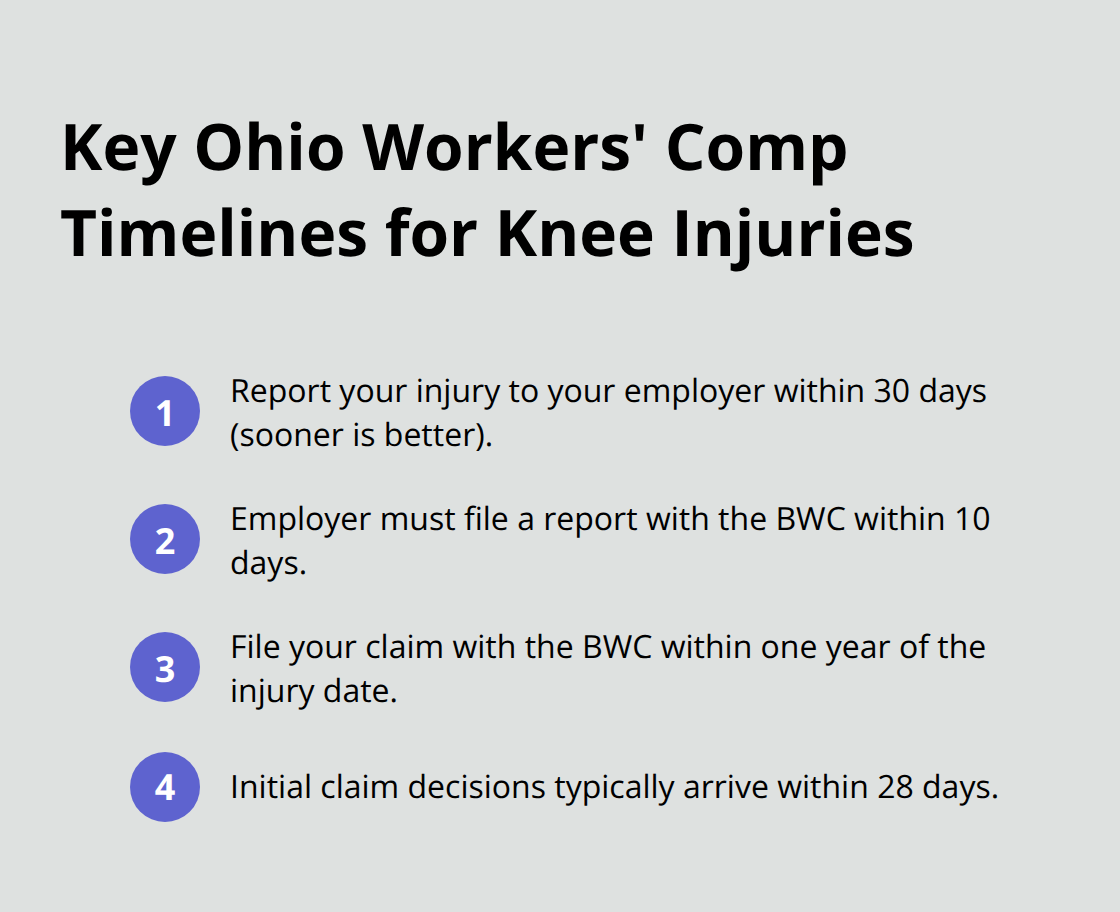
The BWC assigns your case a claims administrator who handles medical approvals, wage replacement, and benefit determinations. You must file your claim application form with the BWC within one year of your injury date, as waiting longer creates unnecessary complications. Include detailed medical records, witness statements, and documentation of how your knee injury prevents you from working your regular duties. The BWC processes initial claims within 28 days, though complex cases involving disputed causation take longer.
Your Right to Medical Control
You have the right to choose your own physician after the first visit, giving you control over your medical direction rather than accepting whoever your employer or insurance company selects. This matters because your chosen physician understands your specific situation and can advocate for appropriate treatment. You also have the right to ongoing medical treatment for your knee injury as long as it remains work-related, including physical therapy, imaging studies, and surgical procedures if medically necessary.
The BWC must approve your treatment before you receive it in most cases, but you can appeal denials through the Industrial Commission of Ohio. When insurers deny reasonable medical treatment, you have a path to challenge that decision and fight for the care you need.
Protection Against Retaliation
Ohio law explicitly prohibits employers from retaliating against you for filing a workers’ compensation claim, and this protection is ironclad. Your employer cannot fire you, demote you, reduce your hours, or cut your pay because you reported your injury or pursued benefits. If retaliation occurs within one year of your claim filing, the law presumes your employer acted unlawfully unless they prove otherwise. This legal shield protects your job security while you recover and navigate the claims process.
When employers or insurance companies push back against your legitimate rights, you need someone who understands Ohio’s workers’ compensation law inside and out. Robin J Peterson Company, LLC represents injured workers throughout Cleveland, Akron, and Canton, fighting for the benefits and protections you deserve.
Common Obstacles Workers Face When Claiming Benefits
The gap between filing a workers’ compensation claim and actually receiving benefits is where most injured workers encounter serious problems. The Ohio Bureau of Workers’ Compensation receives thousands of claims annually, and a significant portion face delays, denials, or disputes that prevent workers from getting paid while they recover. Insurance companies routinely reject claims based on technicalities rather than the actual merit of your injury, and employers frequently contest classifications that would require them to pay higher premiums.
Denials and Delays Stop Your Income
The system assumes you know the exact language, deadlines, and procedures to navigate it successfully, which puts you at a disadvantage without proper guidance. Insurers deny approximately 15 to 20 percent of initial workers’ compensation claims nationally, according to data from the National Academy of Social Insurance, and Ohio follows similar patterns. Many of these denials happen because workers fail to document their injuries properly, miss filing deadlines, or submit incomplete medical records that don’t clearly establish the work-related connection.

When your claim gets denied, you have the right to appeal through the Industrial Commission of Ohio, but the process requires detailed knowledge of what evidence matters and how to present it effectively. The longer your claim sits unresolved, the longer you go without wage replacement benefits, making financial pressure mount while you’re unable to work.
Employers Challenge Your Injury Classification
Employers sometimes challenge whether your knee injury actually occurred at work or whether it stems from a pre-existing condition unrelated to your job duties, forcing you to prove causation with medical records and witness testimony. Insurance companies also dispute injury classifications by arguing your condition falls outside compensable categories, which affects your benefit amount and available treatments. These disputes require you to present clear evidence that your work duties directly caused or accelerated your knee condition.
Procedural Mistakes Jeopardize Your Entire Claim
If your employer failed to report your injury to the BWC within the required timeframe, or if you missed the 30-day notification window, your claim faces immediate jeopardy. Missing even one deadline or submitting paperwork to the wrong office can result in claim dismissal, forcing you to start over from scratch. Documentation errors-such as incomplete medical records or vague descriptions of how your injury occurred-give insurers ammunition to deny your claim outright.
Why Many Workers Abandon Valid Claims
Many workers give up at the first denial because they don’t understand that rejection isn’t final and they possess legitimate appeal rights. The complexity of Ohio’s workers’ compensation system (combined with the financial stress of lost wages) pushes injured workers toward accepting unfair outcomes. When insurers or employers push back against your legitimate rights, having experienced representation matters significantly in fighting for the benefits you deserve.
Final Thoughts
Your knee injury rights in Ohio are substantial, but only if you act decisively when an injury occurs. You have the right to file a claim, receive medical treatment, choose your own physician, and work without fear of retaliation from your employer. The Ohio Bureau of Workers’ Compensation exists to protect you, and the Industrial Commission of Ohio stands ready to hear appeals when insurers or employers deny your legitimate benefits.
The claims process demands precision at every step. Missing a 30-day reporting deadline, failing to document your injury properly, or submitting incomplete medical records can derail an otherwise valid claim. Employers and insurance companies count on workers abandoning claims after initial denials, which is why understanding your appeal rights matters so much-you possess pathways to challenge unfair decisions and fight for what you deserve.
Many injured workers lose benefits they earned simply because they didn’t know the rules or how to navigate Ohio’s workers’ compensation system. Robin J Peterson Company, LLC represents injured workers throughout Cleveland, Akron, and Canton who are fighting for their knee injury rights. If your claim has been denied, delayed, or disputed, reaching out for experienced legal guidance protects your rights and increases your chances of securing the benefits you earned.