
Factory injuries happen fast, but understanding your workers’ compensation benefits doesn’t have to be complicated. At Robin J Peterson Company, LLC, we’ve helped injured workers navigate Ohio’s system and get the support they deserve.
This guide walks you through everything from filing your claim to maximizing your benefits. You’ll learn what’s covered, how the process works, and when to get legal help.
Understanding Ohio Workers’ Compensation Coverage
What Ohio Workers’ Compensation Actually Covers
Ohio’s workers’ compensation system covers injuries that occur during employment, and the state defines this broadly. According to Cornell Law School’s Legal Information Institute, workers’ compensation laws protect employees who suffer harm in the course of their employment, with benefits provided as fixed monetary awards designed to avoid litigation. In Ohio, this means if you’re injured while performing job duties, you’re generally eligible for benefits regardless of who caused the accident. The Ohio Bureau of Workers’ Compensation administers this system, handling claims from over 300,000 employers across the state. Factory injuries fall squarely within coverage when they happen on the job-whether from machinery, falls, chemical exposure, or acute trauma.
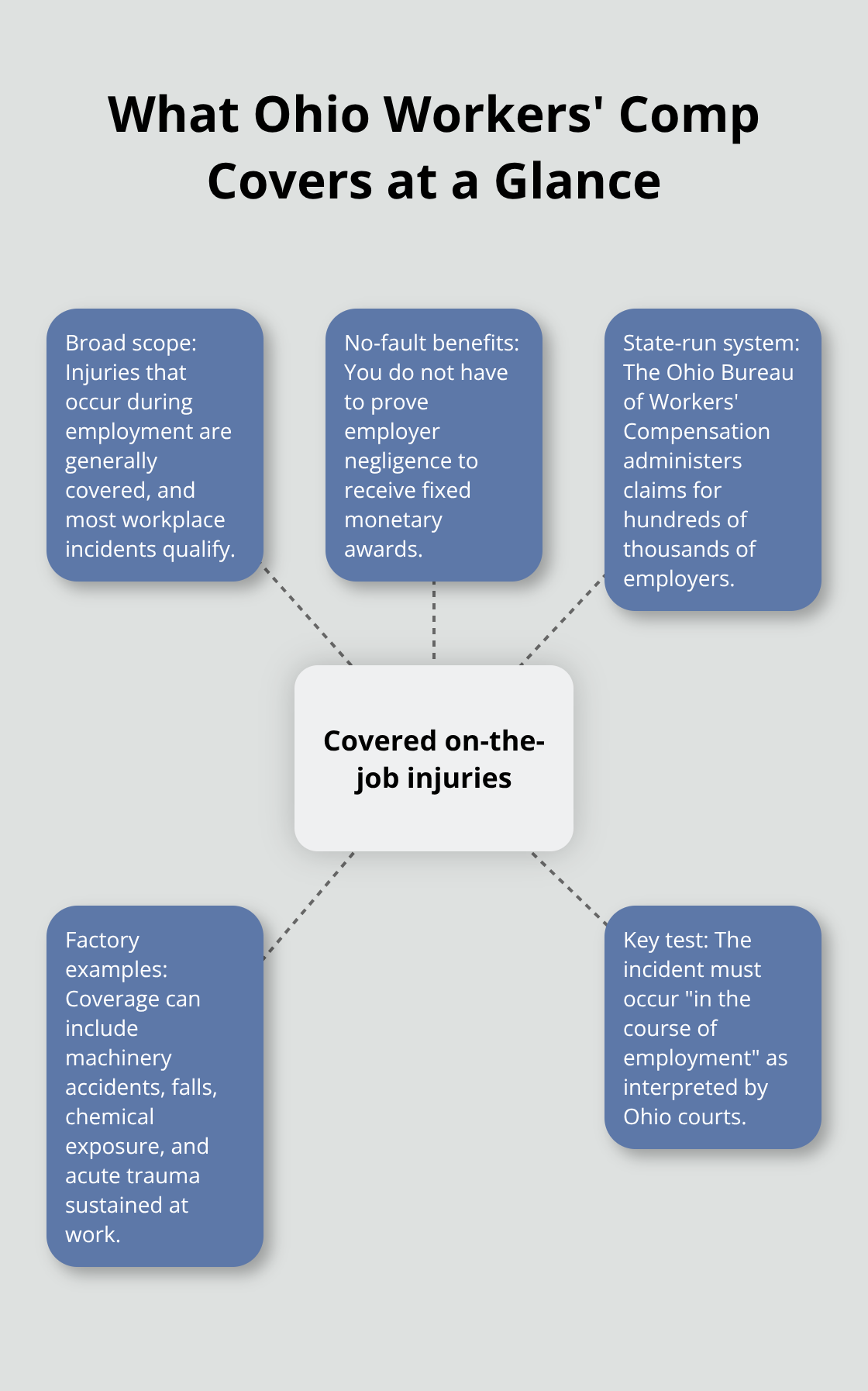
The key phrase is “in the course of employment,” which Ohio courts interpret to include most workplace incidents.
How the BWC Processes Your Claim
The Ohio Bureau of Workers’ Compensation operates as a state-run insurance system, not a private insurer. When you file a claim, the BWC investigates whether your injury meets Ohio’s definition of a compensable injury. The investigation examines the circumstances of your injury, your job duties at the time, and medical evidence supporting your claim. The BWC does not require you to prove fault; the system is no-fault, meaning you don’t need to show negligence to receive benefits. However, the BWC does deny claims when injuries occur outside the course of employment, such as during unauthorized breaks or off-site activities unrelated to your job. Understanding this distinction matters because the BWC’s initial decision isn’t always correct. If your claim gets denied, you have the right to challenge that decision through Ohio’s Industrial Commission, which hears appeals and can overturn BWC determinations.
Your Actual Rights as an Injured Worker
Ohio law grants injured workers specific rights that employers and the BWC must respect. You have the right to choose your own medical provider after the first 28 days of treatment, giving you control over your healthcare decisions. You also have the right to receive wage loss benefits if your injury prevents you from working, calculated based on your average weekly wage. Additionally, you’re protected from retaliation; employers cannot fire you or discriminate against you for filing a workers’ compensation claim.
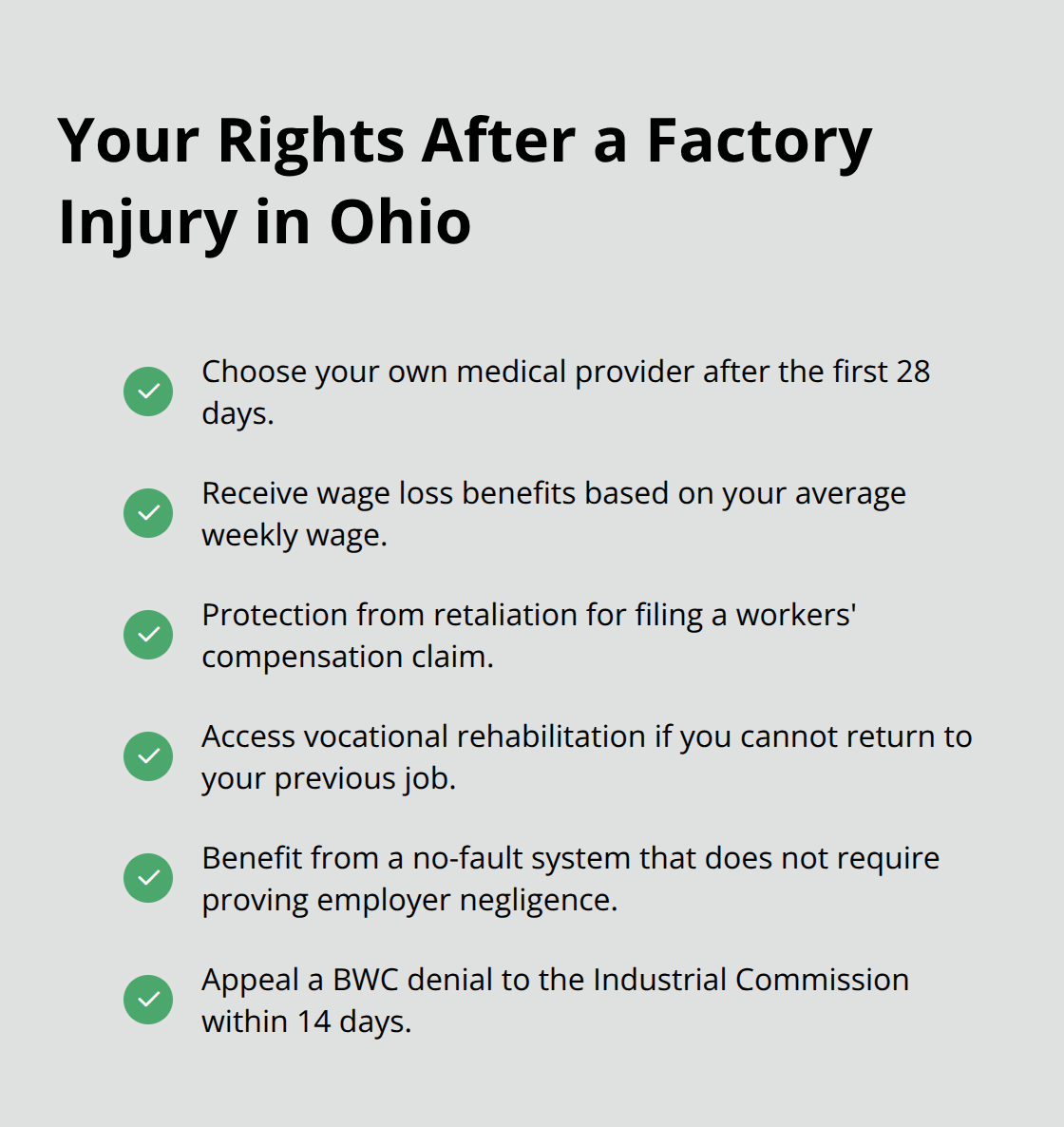
The law also guarantees you access to vocational rehabilitation services if your injury prevents you from returning to your previous job. These rights exist because Ohio recognizes that injured workers shouldn’t bear the financial burden of workplace accidents alone. Understanding these protections sets the foundation for what happens next-the actual process of filing your claim and navigating the system.
The Claims Process for Factory Injuries
Report Your Injury Immediately to Your Employer
Factory injuries happen fast, and your response must match that speed. You must report your injury to your employer as soon as possible, ideally within the same shift or within 24 hours. Ohio law doesn’t set a strict deadline for reporting, but delays can hurt your case-the BWC will question why you waited to file if significant time passes. Your employer is required to provide you with a claim form, officially called the First Report of Injury. Complete this form with specific details: the exact date and time of the injury, what you were doing when it happened, which body part was injured, and the names of any witnesses. Don’t minimize or vague your description; the BWC uses these details to determine whether your injury meets Ohio’s definition of a compensable injury.
Document Everything From Day One
Submit the form to your employer and keep a copy for yourself. The BWC typically receives the claim within a few days and assigns it a claim number, which becomes your reference for all future communication. From this point forward, track every medical visit, every treatment, and every communication with the BWC in writing. Many injured workers lose their cases because they fail to document the investigation process, so maintain a separate file with dates, names of people you spoke with, and what was discussed. This documentation protects you if disputes arise later.
Understand the BWC Investigation Phase
The BWC investigation phase determines whether your claim gets approved or denied, and this is where most claims face trouble. The BWC investigates by reviewing your medical records, interviewing your employer, and sometimes contacting witnesses or conducting surveillance. The investigation typically takes 30 to 60 days, though complex cases take longer. During this time, the BWC may ask you to attend a medical examination by a BWC-selected doctor-you must attend this appointment or risk claim denial.
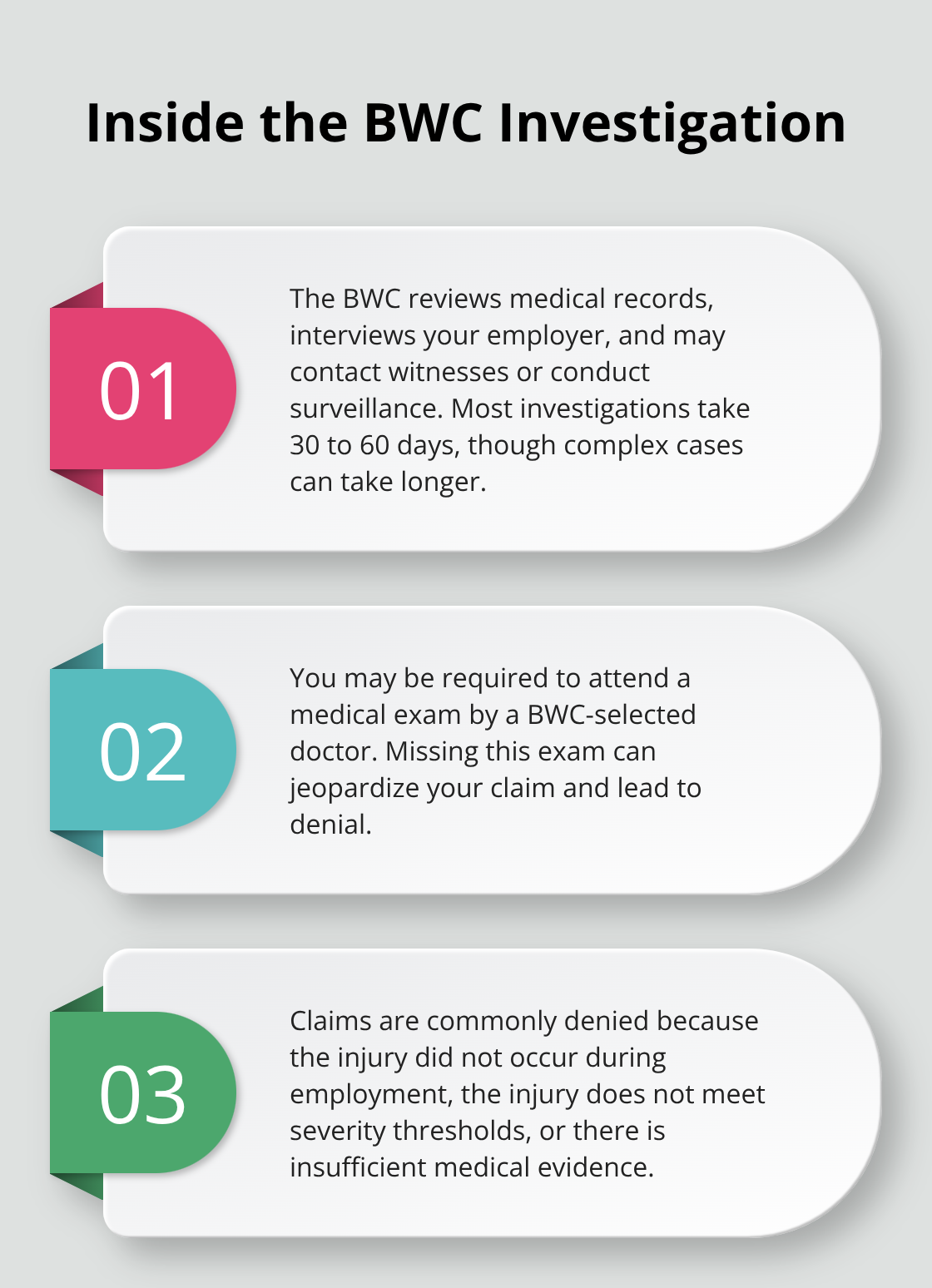
The BWC denies claims for three main reasons: the injury didn’t occur during employment, the injury isn’t severe enough to meet Ohio’s threshold, or insufficient medical evidence supports your claim.
Know Your Appeal Rights After Denial
If the BWC denies your claim, you have 14 days to request a hearing before the Industrial Commission of Ohio. This deadline is non-negotiable-miss it and you lose your appeal rights. At the hearing, you present your case to an administrative judge who can overturn the BWC’s denial. Many injured workers win on appeal because they provide stronger medical evidence or witness testimony the second time around. The Industrial Commission operates independently from the BWC, which means your case receives a fresh review. Understanding this appeal process matters because initial denials don’t end your claim-they simply move it to the next stage where you can fight back with better preparation and evidence.
Getting the Most From Your Ohio Workers’ Comp Claim
Your workers’ compensation claim provides three distinct types of benefits, and understanding how each one works prevents you from leaving money on the table.
Medical Treatment Coverage
Ohio law requires the BWC to pay for all reasonable and necessary medical care related to your injury. This includes doctor visits, surgeries, physical therapy, medications, and even mental health treatment if your injury causes PTSD or depression. The key word is reasonable-the BWC won’t pay for experimental treatments or procedures unrelated to your workplace injury, but standard orthopedic care, imaging, and rehabilitation fall under coverage.
You control your medical provider after the first 28 days, which means you can switch to a doctor who specializes in your specific injury rather than accepting whoever the BWC initially assigns. Document every medical appointment and keep copies of all treatment records because gaps in your medical timeline give the BWC ammunition to argue your injury isn’t serious.
Wage Loss and Temporary Disability Benefits
Wage loss benefits apply when your injury prevents you from working during recovery. Ohio calculates wage loss benefits at two-thirds of your average weekly wage, with specific caps that adjust annually based on state averages. If you earned $1,200 per week before injury, you’d receive approximately $800 per week in temporary disability benefits while unable to work.
This continues until you return to work, reach maximum medical improvement, or your benefits expire. The BWC sometimes disputes how much you actually earned, so provide tax returns and pay stubs from the 52 weeks before your injury to establish your true average weekly wage. Accurate wage documentation protects your claim from reduction or denial.
Vocational Rehabilitation and Return-to-Work Programs
Vocational rehabilitation services kick in when your injury prevents you from returning to your previous job. Ohio’s vocational rehabilitation program provides job training, educational programs, and work-readiness coaching to help you transition into new employment that accommodates your injury. If your factory job involved heavy machinery operation and your injury limits your ability to lift or stand for extended periods, vocational rehabilitation might fund training in equipment inspection, quality control, or administrative roles.
The BWC must approve vocational rehabilitation plans within specific timeframes, and you have the right to dispute denials through the Industrial Commission. These programs exist to restore your earning capacity, not to force you into lower-wage positions. Take advantage of this benefit fully-many injured workers overlook vocational services and miss opportunities to rebuild their careers in ways that work with their physical limitations.
Final Thoughts
Ohio’s workers’ compensation system protects you when factory injuries happen, but protection only works if you understand your rights and act quickly. Report your injury immediately, document everything, and challenge any denial through the Industrial Commission rather than accepting it without a fight. Factory injury benefits in Ohio cover medical care, wage loss, and vocational rehabilitation, yet many injured workers fail to receive what they deserve because they miss critical deadlines or don’t know their rights.
Legal representation becomes essential when the BWC denies your claim, your employer retaliates against you, or disputes arise over your benefits. The Industrial Commission process involves complex rules and evidence standards that favor workers with experienced guidance, and attempting appeals alone often results in lost cases that proper representation could have won. Your injury may prevent permanent return to work, or the BWC may incorrectly calculate your wages-both situations require legal help to resolve correctly.
We at Robin J Peterson Company, LLC represent injured workers throughout Ohio’s workers’ compensation system and fight to secure the benefits you’re entitled to. Contact Robin J Peterson Company, LLC for a consultation to review your specific situation and learn how we can help protect your rights and maximize your factory injury benefits in Ohio.