
A work injury in Ohio can feel overwhelming, especially when you’re navigating the BWC claim filing process for the first time. The system has specific rules, timelines, and requirements that determine whether you receive the support you need.
We at Robin J Peterson Company, LLC have helped countless injured workers understand their rights and move through this process successfully. This guide walks you through each stage, from filing your initial claim to reaching settlement.
Understanding Ohio BWC Claims
What Qualifies as a Work Injury in Ohio
Ohio’s Bureau of Workers’ Compensation covers injuries that occur during employment and arise out of the work itself. The injury must have a direct connection to your job duties. A fall while performing your regular responsibilities qualifies. A fall during a personal errand away from your work area typically does not. Ohio uses a strict causation standard, which is more stringent than many other states. Many injured workers mistakenly believe any accident at the workplace automatically qualifies for benefits, but the BWC requires proof that the injury resulted from work-related activities or conditions. Occupational diseases also qualify, though you must show that your job created a greater risk than the general public faces. Heart conditions, for example, rarely qualify unless you worked in a high-stress position where cardiac events are recognized as occupational hazards.
How Ohio’s System Differs from Other States
Ohio operates a state-fund workers’ compensation system, meaning the BWC itself acts as the insurer rather than private insurance companies. This creates important differences in how the BWC processes and appeals claims. Most states allow injured workers to sue their employers in civil court, but Ohio’s exclusive remedy law prevents this in nearly all situations. Instead, you rely entirely on the BWC system for recovery. The trade-off is that Ohio’s system is theoretically no-fault, meaning you don’t need to prove employer negligence to receive benefits. However, the BWC denies approximately 30 to 40 percent of claims annually, making your initial filing critical.
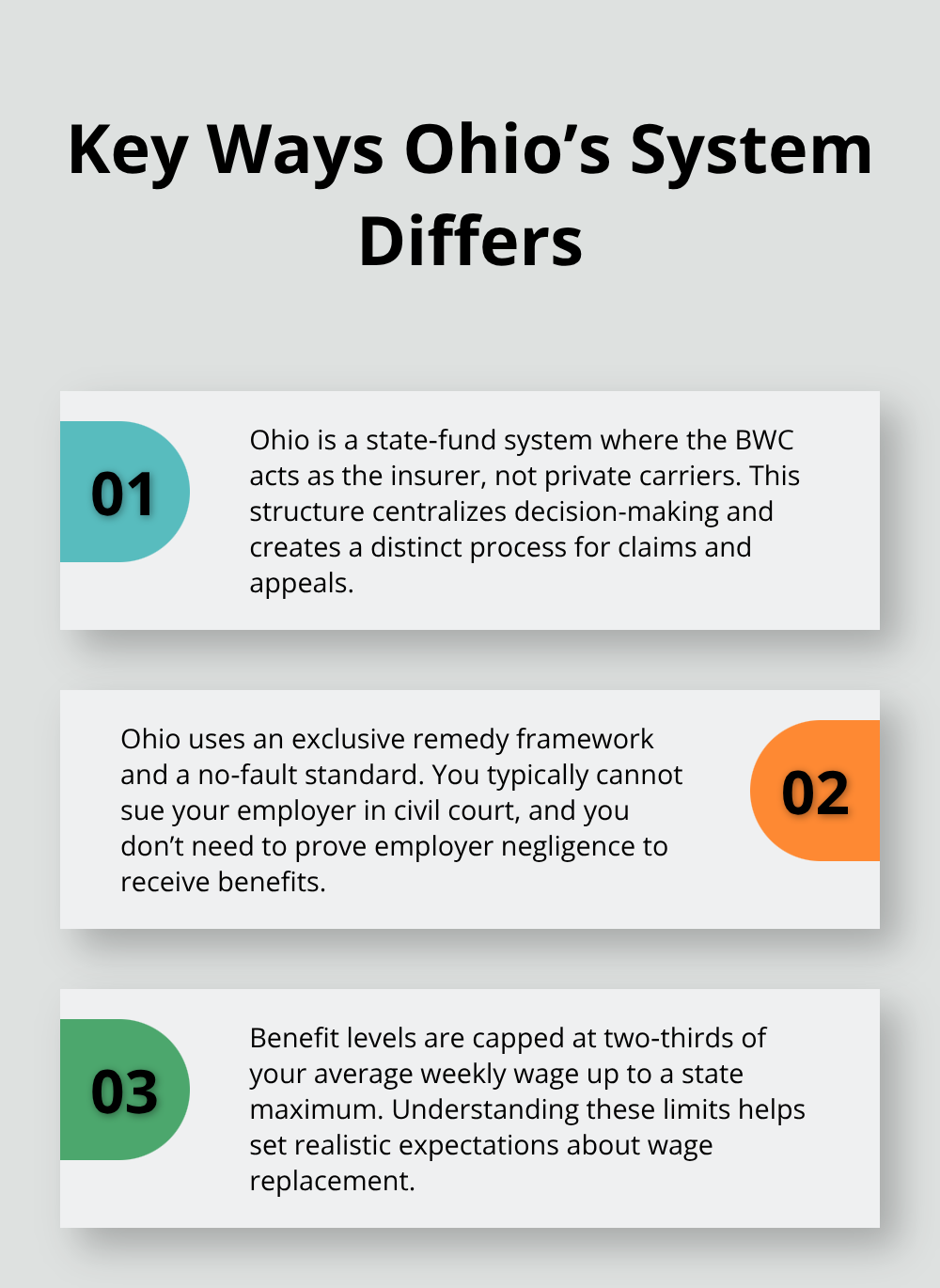
Some states offer more generous wage replacement rates or longer benefit periods, while Ohio provides two-thirds of your average weekly wage up to a state maximum. These limitations prevent unrealistic expectations about what the Ohio system will provide compared to what injured workers in other states might receive.
Understanding the BWC’s Role and Authority
The Ohio Bureau of Workers’ Compensation administers the state fund and makes decisions about claim eligibility and benefit amounts. The BWC investigates claims, reviews medical evidence, and determines whether injuries meet compensability standards. This agency holds significant power in your case because their initial decision shapes everything that follows. The Industrial Commission of Ohio serves as the appeals body when the BWC denies your claim or disputes your benefits. If you disagree with the BWC’s determination, the Industrial Commission reviews the evidence and can overturn the decision. Approximately 15 to 20 percent of appealed claims are reversed or modified by the Industrial Commission, which shows that initial BWC decisions are not always final. Legal representation throughout this process substantially improves your chances of favorable outcomes, particularly when navigating the technical requirements the BWC enforces.
Moving Forward with Your Claim
Understanding these foundational elements prepares you for the actual filing process. The next stage involves gathering the right documentation and submitting your claim within Ohio’s strict timelines.
How to File Your BWC Claim the Right Way
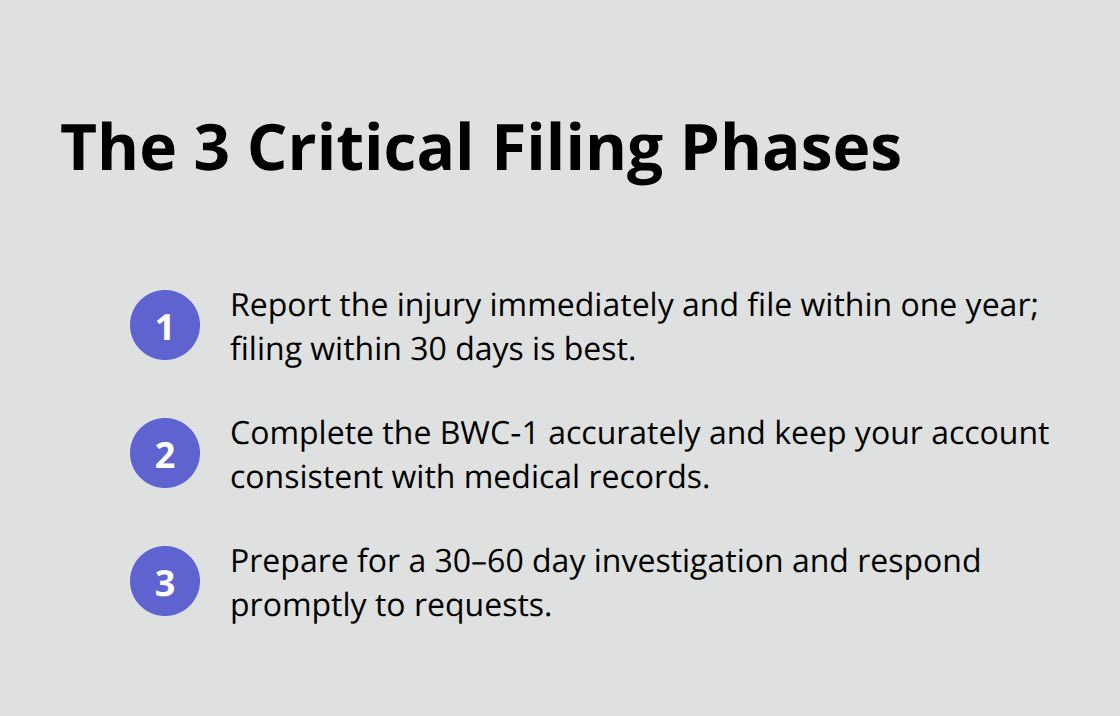
Filing your BWC claim involves three critical phases that determine whether the agency accepts your case and how quickly you receive benefits. Most injured workers make preventable mistakes during these stages because they don’t understand what documentation the BWC actually needs or how investigators evaluate claims.
Report Your Injury Immediately
The first phase starts immediately after your injury occurs. You must report the injury to your employer without unnecessary delay, though Ohio law gives you up to one year from the date of injury to file your claim with the BWC. However, waiting damages your case significantly because memories fade, witnesses become unavailable, and medical records grow incomplete. Filing within 30 days of your injury produces substantially better outcomes than waiting months.
Your employer is required to provide you with the BWC-1 form, which is the official claim form. This form asks for your injury details, the date it occurred, witnesses present, and medical care you received. Accuracy matters tremendously here because any inconsistencies between what you tell your employer and what appears in medical records will trigger deeper investigation.
Gather Strong Medical Documentation
Medical documentation forms the backbone of your entire claim because the BWC relies on objective evidence to establish causation. You need medical records from your initial treatment, diagnostic imaging results if applicable, and ongoing treatment notes showing your condition connects to the workplace injury. The BWC denies approximately 30 to 40 percent of claims annually, and inadequate medical documentation ranks among the top reasons for denial.
When you see a healthcare provider, explicitly state that your injury occurred at work and describe exactly what happened. Vague statements like general back pain without connecting it to a specific incident weaken your position considerably. Healthcare providers who document the work-related nature of your injury create evidence that the BWC cannot easily dismiss.
Understand the Investigation Phase
Once you submit the BWC-1 form to the agency, the investigation phase begins, typically lasting 30 to 60 days (though complex cases extend longer). During this period, the BWC’s investigator may contact your employer, review workplace conditions, examine your medical records, and potentially conduct surveillance if they suspect fraud. The investigator’s report heavily influences the BWC’s initial decision, so understanding what they examine helps you prepare.
Investigators specifically look for whether your injury occurred during work hours, whether your job duties contributed to the injury, and whether medical evidence supports your claim of workplace causation. If the BWC approves your claim, you begin receiving wage replacement benefits calculated at two-thirds of your average weekly wage up to the state maximum. If they deny it, you have the right to appeal to the Industrial Commission within one year of the denial date.
What Happens Next
The path forward depends entirely on the BWC’s initial decision. Understanding your options when the agency denies your claim or disputes your benefits requires knowledge of the appeals process and the specific grounds on which the Industrial Commission can overturn decisions.
Navigating Disputes and Appeals
The BWC denies approximately 30 to 40 percent of claims annually, and most denials stem from preventable documentation gaps rather than genuinely non-compensable injuries. Common rejection reasons include insufficient medical evidence linking your injury to work duties, missed filing deadlines, or the BWC’s determination that your condition resulted from a pre-existing issue unrelated to your employment. Many injured workers receive denials because their medical records lack explicit statements connecting the injury to workplace causation, even when the connection seems obvious to them.
Why the BWC Rejects Claims
The BWC investigator needs clear documentation showing that your job duties or workplace conditions directly caused the injury. Vague medical notes describing symptoms without mentioning work-relatedness give the BWC grounds to deny your claim, regardless of the injury’s actual origin. Additionally, some denials occur because workers fail to report injuries within the required timeframe or don’t provide sufficient detail about how the injury happened. Understanding these specific pitfalls helps you avoid them when filing your initial claim.
Filing an Appeal with the Industrial Commission
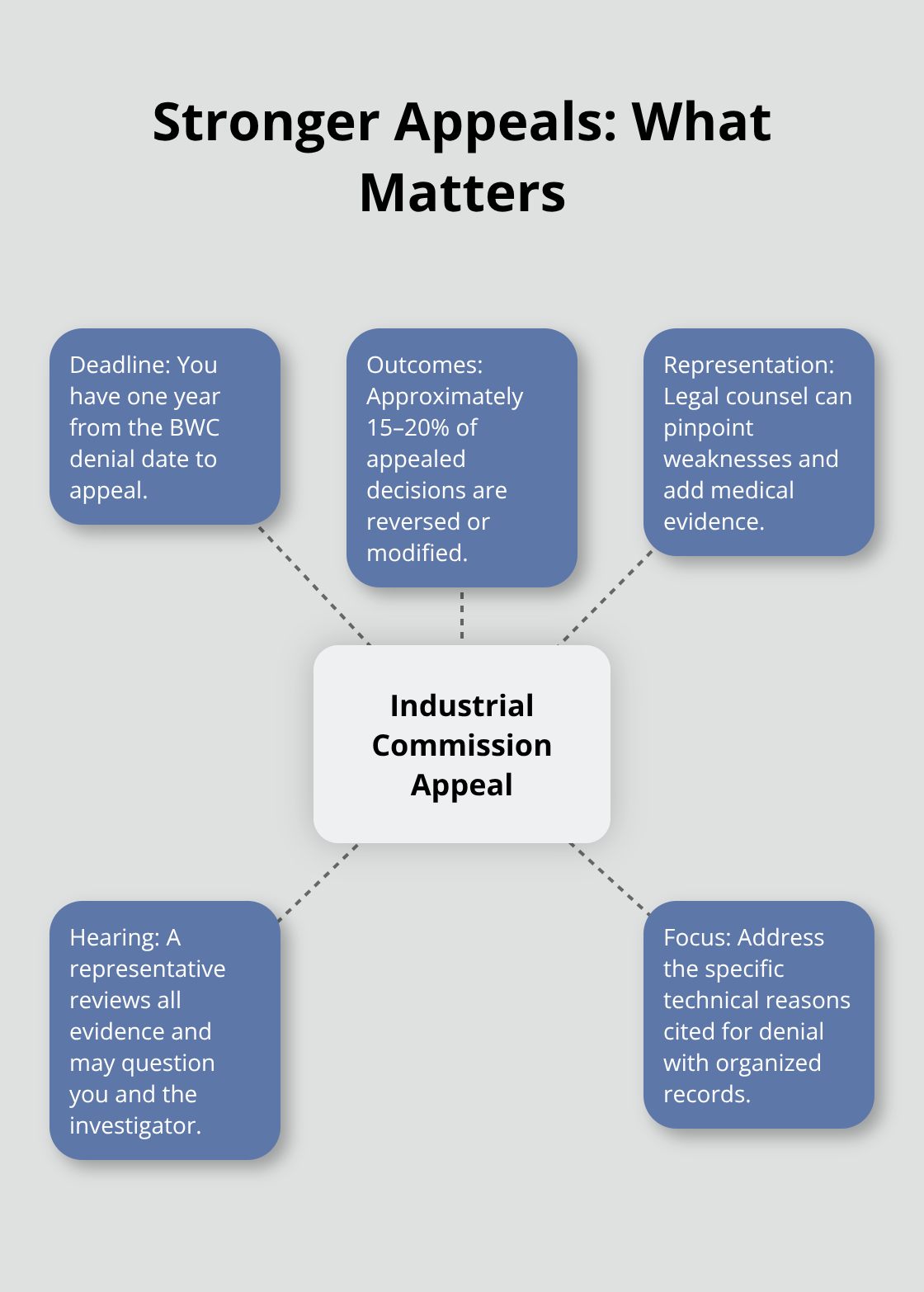
If the BWC denies your claim, you have one year from the denial date to appeal to the Industrial Commission of Ohio, which reverses or modifies approximately 15 to 20 percent of appealed decisions. Filing an appeal requires submitting a formal request with the Industrial Commission, though many injured workers strengthen their cases by obtaining legal representation before submitting paperwork.
An attorney reviews the BWC’s investigation report, identifies weaknesses in their reasoning, and gathers additional medical evidence or expert testimony to challenge the denial. The appeal process involves a hearing before an Industrial Commission representative who reviews all evidence and can question both you and the BWC’s investigator.
Presenting Your Case Effectively
During the hearing, presenting organized medical records and a clear timeline of your injury proves far more effective than emotional arguments about your suffering. Without proper legal guidance, many injured workers present weak appeals that fail to address the specific technical reasons the BWC cited for denial, resulting in another rejection. An experienced workers’ compensation attorney (particularly one with deep knowledge of Ohio’s system) can identify overlooked medical documentation and obtain physician statements that explicitly establish work-relatedness, substantially improving your appeal’s chances of success.
Final Thoughts
The BWC claim filing Ohio process typically spans three to six months from initial submission to settlement, though complex cases involving appeals can extend to a year or longer. Your timeline depends heavily on how thoroughly you document your injury, how quickly the BWC completes its investigation, and whether disputes arise that require Industrial Commission review. Most approved claims begin wage replacement benefits within 30 to 60 days of filing, while denied claims that proceed to appeal add several additional months to the overall timeline.
Ohio provides several resources to support injured workers beyond the BWC itself. The Ohio Bureau of Workers’ Compensation website offers claim status tracking, downloadable forms, and detailed information about benefit calculations and eligibility requirements. The Industrial Commission of Ohio maintains a public database of appeal decisions that can help you understand how similar cases have been resolved.
The most important next step involves taking action immediately after your injury occurs. Report the incident to your employer without delay, seek medical care and explicitly mention the workplace connection, and gather documentation of what happened. If the BWC denies your claim or disputes your benefits, don’t accept that decision passively-approximately 15 to 20 percent of appealed claims are reversed or modified, meaning many initial denials can be overturned with proper representation. We at Robin J Peterson Company, LLC represent injured workers throughout Ohio’s BWC claim filing process and appeals, and we fight to secure the benefits you deserve. Contact our law firm to discuss your situation with an experienced workers’ compensation attorney.