
Workers’ comp death benefits in Ohio exist for one of the hardest moments a family can face: losing a loved one because of a workplace injury or an occupational disease. In the middle of grief, families are suddenly asked to understand claim forms, deadlines, and legal terms like “dependent” and “apportionment.” Knowing who qualifies and how the process works can give you real control over a situation that otherwise feels overwhelming, and it can help you protect the support your family was counting on.
At Robin J Peterson Company, LLC, we help Ohio families understand their rights after a work-related death and pursue the benefits the law provides, so you can move forward with confidence. This guide explains what Ohio workers’ comp death benefits actually are, who the law treats as a dependent, how a claim moves through the Bureau of Workers’ Compensation, and the mistakes that can put a family’s claim at risk.
What Ohio Workers’ Comp Death Benefits Actually Are
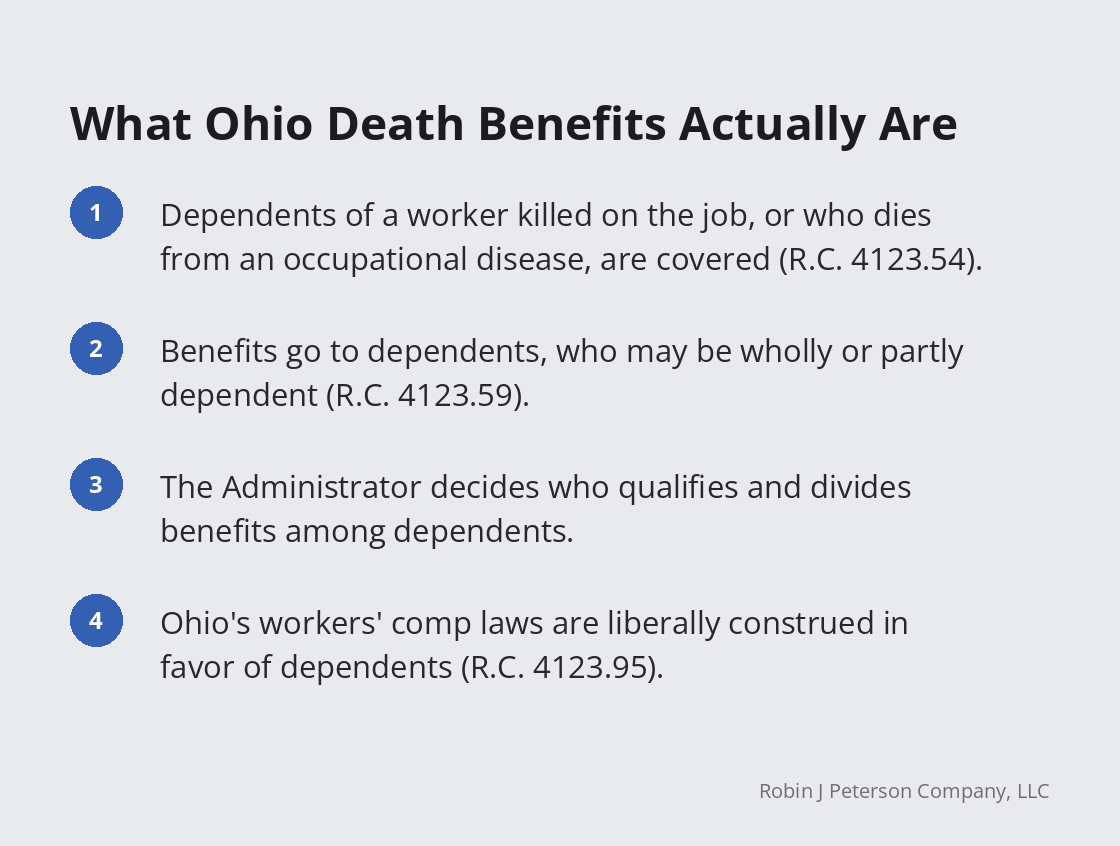
Ohio’s workers’ compensation system does not stop protecting a worker’s family when the worker passes away. Section 4123.54 of the Ohio Revised Code provides that the dependents of each employee who is killed, or who dies as the result of an occupational disease contracted in the course of employment, are entitled to receive the compensation provided by Ohio’s workers’ compensation law. In other words, death benefits are part of the same system that pays for medical care and lost wages after a nonfatal injury, and they are meant to replace some of the support the worker provided to the people who relied on them.
Deaths From Injuries and Occupational Diseases
Death benefits are not limited to sudden accidents such as a fall, a machinery incident, or a vehicle crash during work duties. The statute also covers deaths that result from an occupational disease contracted in the course of employment. That matters for families whose loved one developed a serious illness connected to workplace exposures over many years. In those cases, the family may need medical records and work history to show the link between the job and the condition that caused the death, and that evidence often takes time to gather.
Benefits Flow to Dependents
Ohio law focuses on dependency. Under Revised Code 4123.59, the people who receive death benefits are the worker’s dependents, and the law separates them into those who were wholly dependent on the worker and those who were only partly dependent. The Administrator of Workers’ Compensation decides who qualifies and, when there is more than one dependent, divides the benefits among them. This is why the first question in nearly every death claim is not about the accident itself but about the family’s relationship to the worker at the time of death.
When Benefits May Be Denied
Like other workers’ comp benefits, death benefits have limits. Section 4123.54 states that compensation is not available if the injury was purposely self-inflicted, or if the worker’s intoxication or use of a controlled substance not prescribed by a medical provider was the proximate cause of the injury. Employers and the bureau sometimes raise these issues after a fatal incident, so families should expect questions about what happened and should not assume a denial is final. Ohio law also directs that the workers’ compensation statutes be liberally construed in favor of employees and the dependents of deceased employees under Revised Code 4123.95.
How Ohio Decides Who Qualifies as a Dependent
The heart of a death claim is proving dependency. Ohio law creates presumptions for certain close family members and then requires a fact-based review for everyone else. Understanding which category your family falls into helps you know what evidence to gather and what questions the bureau is likely to ask.
Surviving Spouses
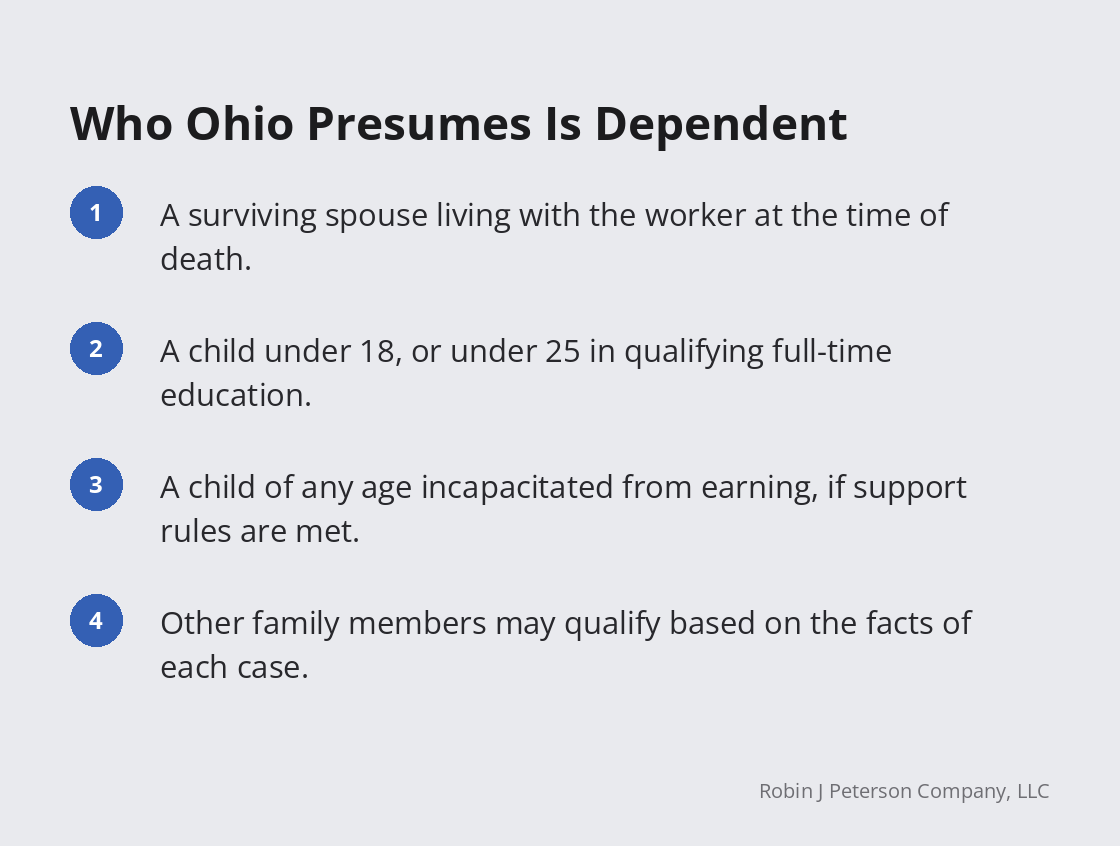
Revised Code 4123.59 presumes that a surviving spouse is wholly dependent on the deceased worker if the spouse was living with the worker at the time of death. The same presumption applies to a surviving spouse who was separated from the worker at the time of death because of the aggression of the worker. A spouse’s benefits generally continue until the spouse’s death or remarriage. If a dependent spouse remarries, the statute provides a final lump-sum payment and then ends further compensation to that spouse, so it is important to understand this rule before making major life decisions.
Children of the Deceased Worker
Children can also be presumed wholly dependent. The statute covers a child under eighteen, a child under twenty-five who is pursuing a full-time educational program while enrolled in an accredited educational institution and program, and a child of any age who is physically or mentally incapacitated from earning, when the child meets the statute’s support and living requirements. Benefits for a dependent child generally continue until the child reaches eighteen, reaches twenty-five while in qualifying full-time education, or is no longer incapacitated, depending on which rule applies to that child.
Other Family Members and Partial Dependency
Outside these presumptions, Ohio decides dependency based on the facts of each case as they existed at the time of the injury that resulted in death. The statute limits who can be considered a dependent to members of the worker’s family or people who stood in the relationship of surviving spouse, lineal descendant, ancestor, or brother or sister. A parent, adult child, or sibling who relied on the worker for part of their support may qualify as partly dependent. For partly dependent persons, the law allows benefits to continue for the period the administrator determines in each case, which makes clear documentation of the support the worker actually provided especially important.
Dividing Benefits Among Several Dependents
Many families include more than one dependent, such as a spouse and minor children. Revised Code 4123.59 directs the administrator to apportion the benefits among wholly dependent persons, and Revised Code 4123.60 allows the administrator to divide benefits among the dependents in a manner the administrator considers just and equitable. The person who receives payments must use them for the benefit of the dependents according to their claims on the decedent for support, as the administrator directs.
Mistakes That Can Derail a Death Benefits Claim
Families dealing with a sudden loss are rarely thinking about procedure, yet small procedural problems can delay or weaken a claim. Knowing the most common missteps can help you avoid them while you focus on your family.
Missing the One-Year Notice Requirement
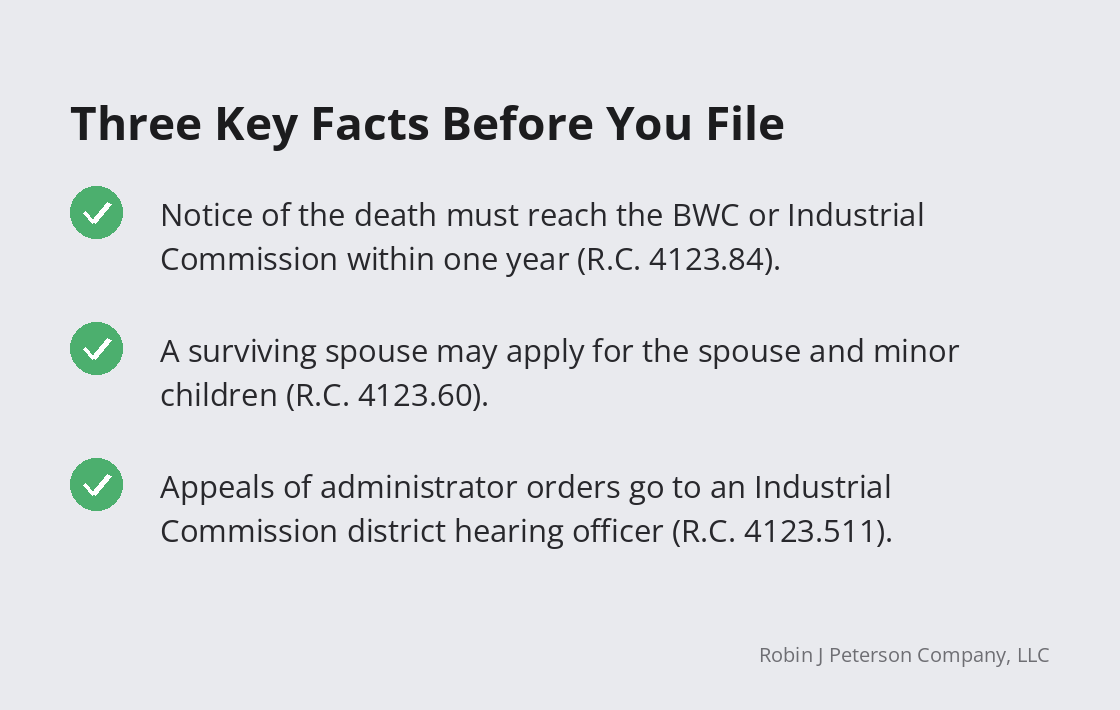
Ohio has a strict filing rule. Revised Code 4123.84 provides that claims for compensation or benefits are forever barred unless certain steps happen within one year after the injury or death, including written notice of the death to the Industrial Commission or the Bureau of Workers’ Compensation. A separate rule in Revised Code 4123.60 addresses compensation the worker could have received before death: those payments may be made only if an application was filed during the worker’s lifetime or within one year after the death. Waiting to see how things unfold can end a family’s claim entirely, so starting the process early is one of the most important steps you can take.
Not Knowing Who Should Apply
Ohio law addresses who files in common family situations. Under Revised Code 4123.60, when the dependents are a surviving spouse and one or more children, it is sufficient for the surviving spouse to apply on behalf of the spouse and the minor children. When all of the dependents are minors, a guardian or next friend of the minor dependents must apply. Families sometimes delay because they are unsure who is supposed to act, and that uncertainty can run into the filing deadline.
Overlooking Benefits the Worker Was Already Owed
If the worker had an active claim before passing away, there may be payments that had accrued but were not yet paid. Revised Code 4123.60 allows the administrator, after satisfactory proof, to award an unpaid balance of an existing award to the worker’s dependents. Families sometimes focus only on the new death claim and never ask about the worker’s existing claim. Reviewing the worker’s claim history is a simple step that can make sure nothing owed to the family is left behind.
Giving Up After an Unfavorable Order
A first decision is not always the last word. Orders issued by the administrator on death benefits under Revised Code 4123.59 are appealable through the procedures in sections 4123.511 to 4123.512, which include hearings before the Industrial Commission. Orders on accrued payments under Revised Code 4123.60 may be appealed under section 4123.511 but not to court under section 4123.512. Appeal deadlines are short, so families should act quickly and keep copies of every order and notice they receive.
Final Thoughts
Workers’ comp death benefits in Ohio can provide continuing support for a surviving spouse, children, and other family members who relied on a worker who died from a workplace injury or occupational disease. The process turns on dependency, careful documentation, and strict timing, including the one-year notice requirement that applies after a death.
No benefit can replace the person your family lost, but understanding the process can protect your family’s stability while you grieve. Having someone guide you through the paperwork, the hearings, and the deadlines lets you focus on each other instead of the bureaucracy.
If your family lost a loved one because of a work injury or occupational disease, contact Robin J Peterson Company, LLC to speak with our team about your family’s workers’ comp rights in Ohio. We will listen, explain your options, and help you take the next step with confidence.