
The coming and going rule in Ohio workers’ comp decides whether an injury that happens on the way to or from work is covered. Many injured workers assume that any crash on the drive in is a work injury, while others assume that nothing outside the plant gates could ever qualify. Neither assumption is quite right. Ohio courts start with a general rule that ordinary commutes are not covered, then look closely at the facts to decide whether an exception applies. Understanding how that analysis works gives you real control over your claim and helps you avoid giving up benefits you may be entitled to receive.
At Robin J Peterson Company, LLC, we help injured workers across Cleveland, Akron, Canton, and Independence protect their Ohio workers’ compensation rights so you can move forward with confidence. This guide explains what the coming and going rule actually means, how Ohio courts decide whether a travel injury is covered, and the mistakes that most often derail these claims.
What the Coming and Going Rule Actually Means in Ohio
Ohio workers’ compensation covers injuries connected to the job. Section 4123.01(C) of the Ohio Revised Code defines an injury as one received in the course of, and arising out of, the injured employee’s employment. Both parts of that definition must be met. The coming and going rule is a tool Ohio courts use to apply that definition to injuries that happen while an employee is traveling to or from work.
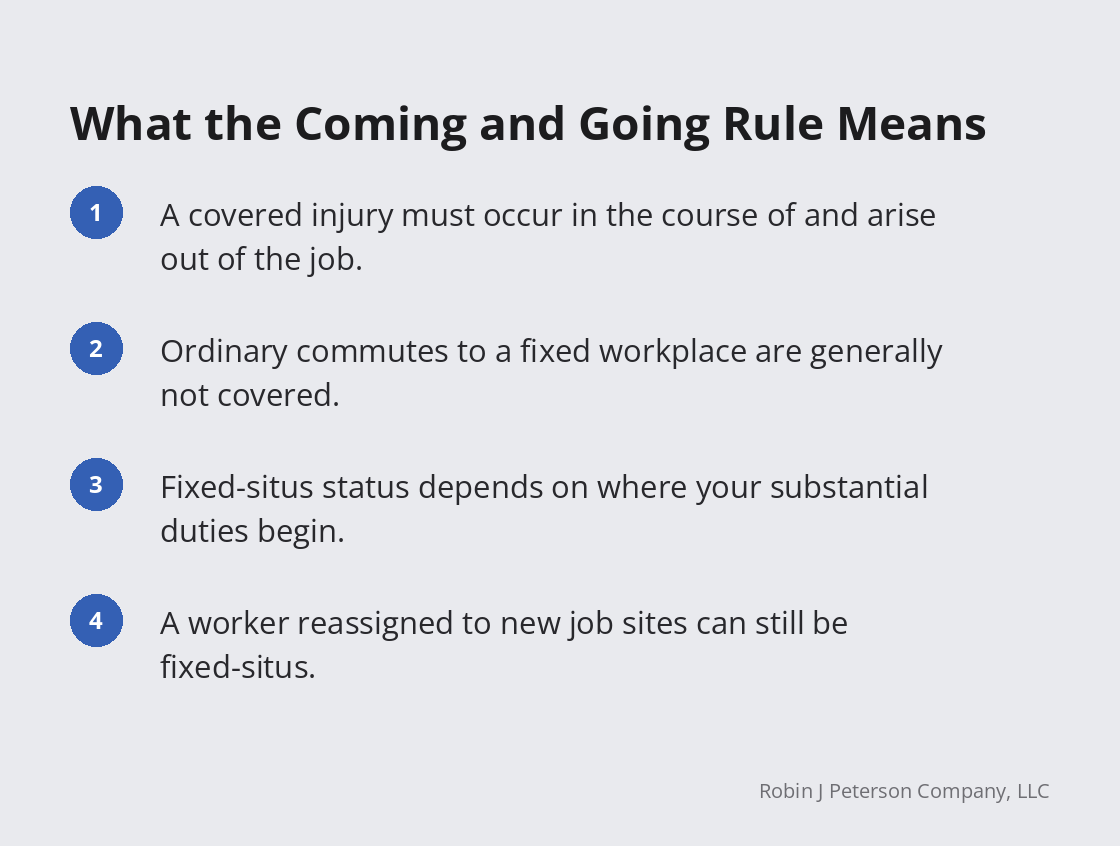
The rule is a starting point, not the final word. Whether a particular trip is covered depends on the type of job, the purpose of the travel, and the circumstances of the injury.
Why Ordinary Commutes Are Usually Not Covered
The Supreme Court of Ohio explained the general rule in Ruckman v. Cubby Drilling, Inc., 81 Ohio St.3d 117 (1998). As a general rule, an employee with a fixed place of employment who is injured while traveling to or from that workplace is not entitled to participate in the workers’ compensation fund, because the required causal connection between the injury and the employment does not exist.
The reasoning is that the workers’ compensation system was built to cover the hazards of the job itself, not the risks of everyday travel on streets and highways that the public shares. A typical drive from home to a factory, office, or store is usually treated as a personal trip rather than part of the work.
Who Counts as a Fixed-Situs Employee
The rule applies to fixed-situs employees, so the first question is whether you had a fixed place of employment. In Ruckman, the Court held that the focus is on whether the employee begins his or her substantial employment duties only after arriving at a specific and identifiable workplace designated by the employer. That focus stays the same even if the employee is reassigned to a different work site monthly, weekly, or even daily.
This means a construction worker or other tradesperson who reports to a different job site each week can still be treated as a fixed-situs employee for each site. The label depends on where the real work begins, not simply on whether the location changes.
Workers Without a Fixed Workplace
Some jobs are built around travel. Home health workers, service technicians, and others whose duties take them from place to place may not fit neatly into the fixed-situs category. In Friebel v. Visiting Nurse Assn. of Mid-Ohio, 2014-Ohio-4531, the Supreme Court of Ohio noted that whether a place of employment is fixed is a fact-specific inquiry that depends on the circumstances of the job.
Even so, the Court made clear that whether an employee is fixed-situs or not, the causal connection must still be established to show that the injury arose out of the employment. Travel that is part of the work can help a claim, but it does not remove the need to connect the injury to the job.
How Ohio Courts Decide Whether a Travel Injury Is Covered
When an injury happens during travel, Ohio courts look at both parts of the statutory definition. The analysis is detailed, and small facts about the trip can change the outcome.
The tests below are the ones that come up most often when the Bureau of Workers’ Compensation and the Industrial Commission review travel injury claims.
The In the Course of Requirement
The first part of the definition looks at the time, place, and circumstances of the injury. According to Friebel, this part limits benefits to employees who are hurt while engaged in a required employment duty or activity consistent with their contract for hire and logically related to the employer’s business.
Travel that is itself part of the job, such as driving between client locations or making a trip at the employer’s direction, is more likely to meet this requirement than an ordinary commute. In Ruckman, the Court found that the travel of workers who drove to remote drilling sites was in the course of their employment because of how the travel served the employer’s business.
The Totality of the Circumstances Test
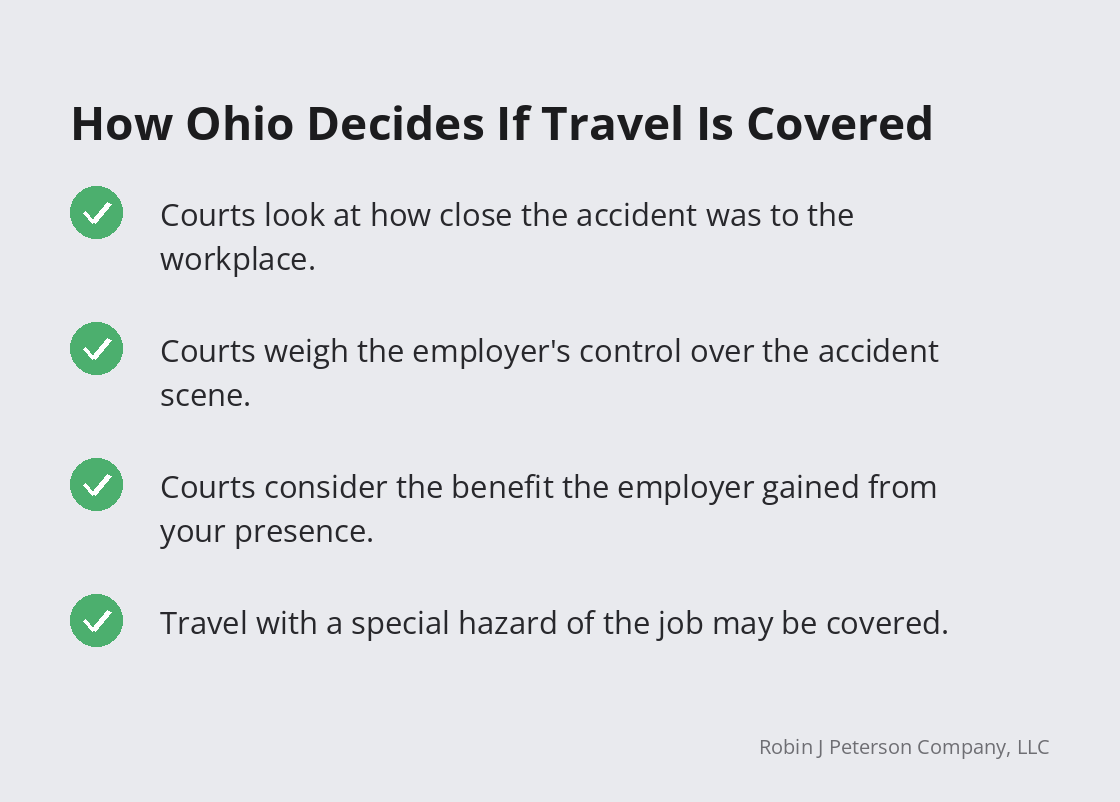
The second part, arising out of the employment, looks at the causal connection between the job and the injury. Ohio courts apply a totality of the circumstances test that considers the proximity of the scene of the accident to the place of employment, the degree of control the employer had over the scene, and the benefit the employer received from the employee’s presence at the scene.
These factors are not a checklist. The Supreme Court of Ohio has said the list is not exhaustive and that an employee may fail one or more of the factors and still establish the needed connection. For example, an accident in an area the employer controls, close to the workplace, may be viewed very differently from one that happens miles away on a public road.
The Special Hazard Exception
Ohio also recognizes a special hazard exception to the coming and going rule. In Ruckman, the Court held that a fixed-situs employee is entitled to benefits for injuries suffered while coming and going where the travel serves a function of the employer’s business and creates a risk that is distinctive in nature from, or quantitatively greater than, risks common to the public.
The workers in Ruckman were required to travel long distances to remote sites, which created risks beyond those of an ordinary commute. When a job requires unusual travel, such as long drives to temporary job sites, that requirement may support coverage even for a fixed-situs employee.
What Derails Commute and Travel Injury Claims
Travel injury claims are fact-driven, and the details of the trip matter. Many claims run into trouble not because the law is against the worker, but because important facts were never gathered or deadlines were missed.
The mistakes below come up often for injured workers who were hurt while traveling for or to their jobs.
Assuming Every Crash on the Way to Work Is Excluded
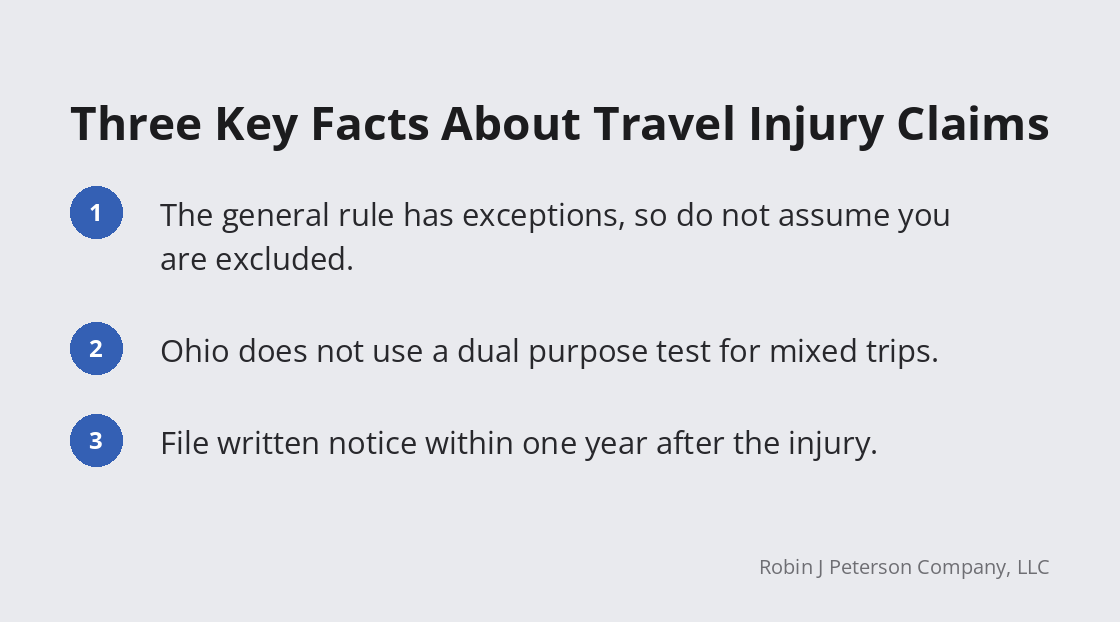
Some injured workers never file because they were told that injuries on the road are never covered. That is not how Ohio law works. The general rule has exceptions, and travel that serves the employer’s business, takes place in an area the employer controls, or involves a special hazard of the job may qualify.
Before giving up on a claim, it helps to write down why you were traveling, who directed the trip, where the injury happened, and what the employer gained from your presence there. Those facts are what the Bureau of Workers’ Compensation and the Industrial Commission will weigh.
Personal Errands and Mixed-Purpose Trips
Trips that combine work and personal purposes can be difficult. In Friebel, the Supreme Court of Ohio held that the doctrine of dual intent, or dual purpose, is not recognized in Ohio for determining eligibility for workers’ compensation benefits. Instead, the claim is analyzed under the same course-of-employment and arising-out-of tests that apply to other injuries.
This means a worker hurt during a trip that included a personal stop should not assume the claim is automatically covered or automatically barred. The specific facts of where the worker was, why, and at whose direction will determine the outcome.
Missing the One-Year Filing Deadline
Ohio sets a firm deadline for workers’ compensation claims. Under Section 4123.84 of the Ohio Revised Code, claims for compensation or benefits for the specific parts of the body injured are forever barred unless, within one year after the injury, written notice of the specific body parts claimed to be injured has been made to the Industrial Commission or the Bureau of Workers’ Compensation, or another event listed in the statute has occurred.
Travel injury claims are often denied at first, which makes it even more important to file on time and to respond quickly to any decision. To understand what happens if your claim is contested, see our guide to the Ohio Industrial Commission hearing process.
Final Thoughts
The coming and going rule in Ohio means that most ordinary commutes are not covered by workers’ compensation, but it does not shut the door on every travel injury. Ohio courts look at whether you had a fixed workplace, whether the trip was part of your job, the employer’s control over the location, and whether the travel created a special hazard. The details of your trip can make the difference.
If you were hurt while traveling for work or on your way to a job site and are not sure whether you are covered, contact Robin J Peterson Company, LLC to speak with our workers’ compensation team. We will review the facts of your injury, explain your rights under Ohio law, and help you take the next step with confidence.