
An occupational disease claim in Ohio workers’ comp works differently from a claim for a sudden accident, and that difference catches many workers off guard. When an illness develops slowly from dust, fumes, chemicals, or other conditions on the job, there is no single moment of injury to point to, and the symptoms may not appear until months or years after the exposure began. Ohio law still recognizes these illnesses, but it applies its own definition, its own schedule of listed diseases, and its own filing deadline. Knowing those rules gives you real control over your claim.
At Robin J Peterson Company, LLC, we help workers across Cleveland, Akron, Canton, and Independence protect their Ohio workers’ compensation rights so you can move forward with confidence. This guide explains what an occupational disease actually is under Ohio law, how these claims move through the system, and the mistakes that most often derail them.
What an Occupational Disease Actually Is Under Ohio Law
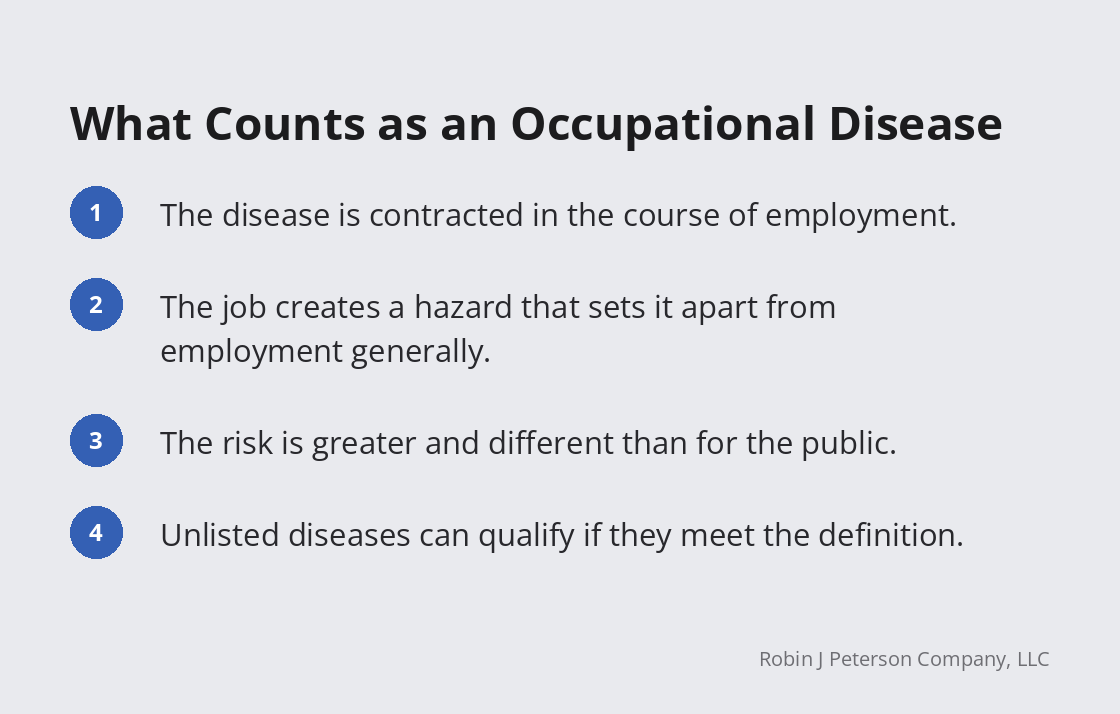
Ohio Revised Code Section 4123.01(F) defines an occupational disease as a disease contracted in the course of employment which, by its causes and the characteristics of its manifestation or the condition of the employment, results in a hazard that distinguishes the employment in character from employment generally. The same definition requires that the employment create a risk of contracting the disease in a greater degree and in a different manner than the public in general. In plain terms, the question is not simply whether you became sick while you held a job. The question is whether something about the work itself exposed you to a risk that ordinary members of the public do not face in the same way.
Illness Versus Injury
Ohio treats injuries and occupational diseases as separate categories. Section 4123.01(C) describes an injury as harm received in the course of, and arising out of, employment, often tied to a specific event such as a fall or a lifting incident. An occupational disease, by contrast, usually develops gradually through repeated exposure over time. Section 4123.68 states that every employee who is disabled because of the contraction of an occupational disease, and the dependent of an employee whose death is caused by one, is entitled to compensation under the workers’ compensation chapter, subject to the modifications for occupational diseases contained in that chapter. That means a work-related illness is not a lesser claim.
The Schedule of Listed Diseases
Section 4123.68 contains a schedule that pairs specific diseases with the work processes that cause them. The list includes lead, mercury, arsenic, and other chemical poisonings tied to industrial processes that use those substances, skin inflammation caused by contact with oils, cutting compounds, dust, fumes, or vapors, compressed air illness, berylliosis, silicosis, and coal miners’ pneumoconiosis, commonly called black lung disease. When your condition and your type of work match an entry on the schedule, the connection between the job and the illness is far easier to show.
Diseases That Are Not on the List
Many workers assume that if their illness is not named in the statute, they have no claim. That is not correct. Section 4123.68 states directly that a disease which meets the definition of an occupational disease is compensable even though it is not specifically listed in that section. An unlisted condition can still qualify, but the claim depends on showing that it satisfies the definition in Section 4123.01(F). That usually requires a clear work history, a description of the exposure, and a medical opinion that connects the illness to the particular hazards of your job rather than to everyday life.
How an Ohio Occupational Disease Claim Actually Moves Forward
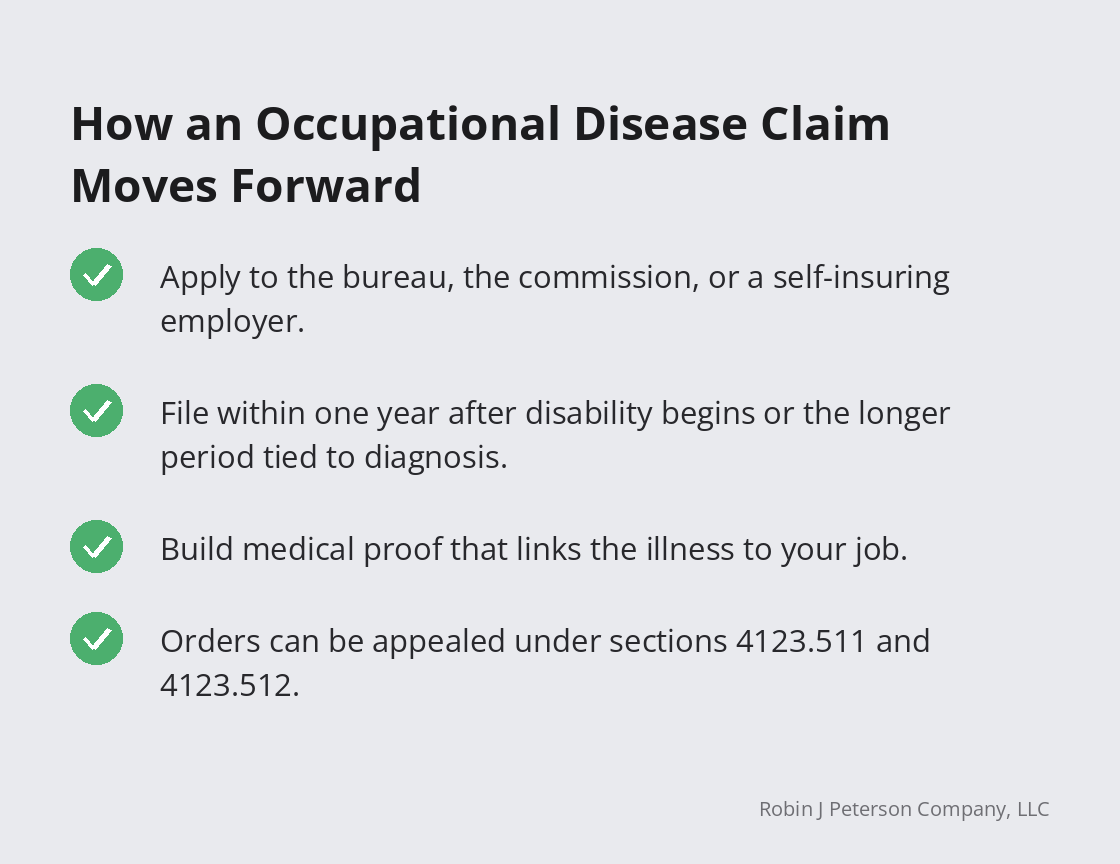
Once you suspect that your work made you sick, the claim follows the same general path as other Ohio workers’ compensation claims, with a few important differences. An application is made to the Ohio Bureau of Workers’ Compensation or the Industrial Commission, or to the employer if the employer is self-insuring. The claim is then reviewed, medical and employment information is gathered, and a decision is made on whether to allow it. Section 4123.68 provides that an order of the administrator issued under that section is appealable under Sections 4123.511 and 4123.512, so a denial is not necessarily the end of the road.
Filing Within the Deadline
Ohio Revised Code Section 4123.85 sets the time limit for these claims. It provides that claims for occupational disease, or for death resulting from occupational disease, are forever barred unless the application is made within one year after the disability due to the disease began, or within such longer period as does not exceed six months after diagnosis of the occupational disease by a licensed physician or certain other licensed practitioners named in the statute, or within one year after death occurs. Because the clock is tied to disability, diagnosis, and death rather than to the first day of exposure, the timing of each of those events matters. Writing down when you first missed work, when a provider first told you the condition was work-related, and when you received each diagnosis can make a real difference later.
Medical Proof of the Work Connection
The center of an occupational disease claim is medical evidence that ties the illness to the job. Your physician of record will need to understand what you did at work, what you were exposed to, how often, and for how long. For certain lung diseases, the statute requires more. Section 4123.68 directs the administrator, before awarding compensation for disability or death due to silicosis, asbestosis, coal miners’ pneumoconiosis, or berylliosis, to refer the claim for a medical examination and recommendation about the diagnosis, the extent of disability, and related medical questions. The statute also states that an employee shall submit to the examinations, including clinical and x-ray examinations, that the administrator requires. You can read more about how treating providers fit into a claim in our guide to choosing a doctor for Ohio workers’ comp.
Special Rules for Firefighters and Police Officers
Section 4123.68 gives certain public safety workers additional protection. For firefighters and police officers, a cardiovascular, pulmonary, or respiratory disease caused or induced by the cumulative effect of exposure to heat, smoke, toxic gases, chemical fumes, and other toxic substances in the performance of duty creates a presumption, which may be refuted by affirmative evidence, that the disease arose from the employment. The statute also creates a presumption for cancer contracted by a firefighter who has been assigned to at least six years of hazardous duty and was exposed to an agent classified by the International Agency for Research on Cancer as a group 1 or 2A carcinogen. That cancer presumption can be rebutted in situations listed in the statute, including evidence of significant outside exposure such as tobacco use or a firefighter who is seventy years of age or older, and it does not apply if more than fifteen years have passed since the firefighter was last assigned to hazardous duty.
What Derails Occupational Disease Claims
Occupational disease claims are often denied for reasons that have little to do with whether the worker is genuinely sick. Most problems come from timing, missing information, or gaps in the medical record. Understanding the most common pitfalls helps you avoid them.
Waiting Until the Illness Becomes Severe
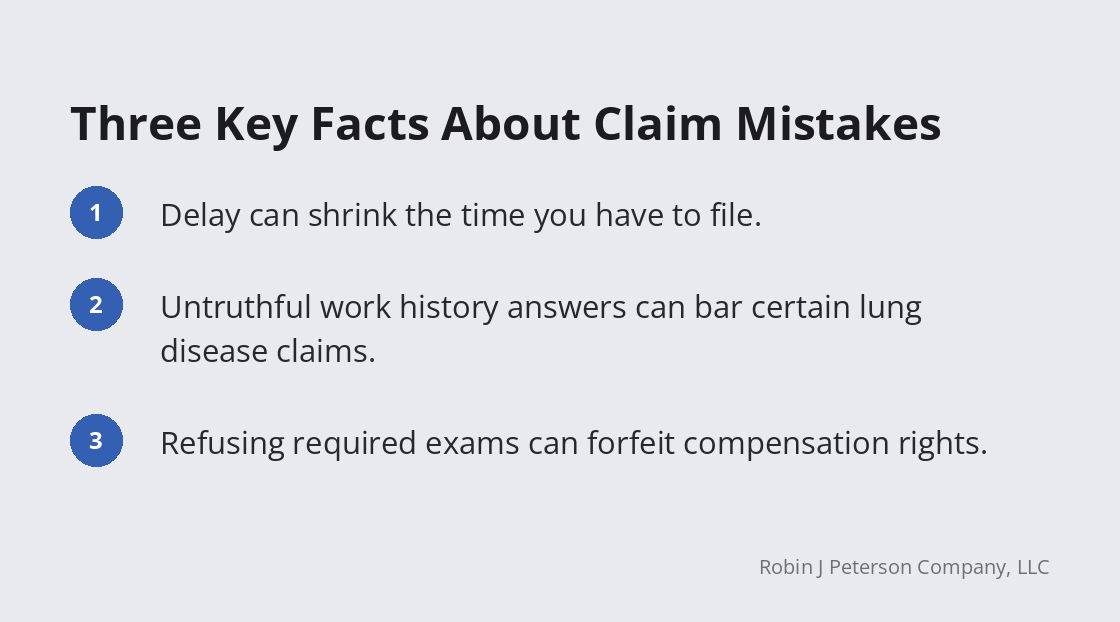
Because these conditions develop slowly, many workers keep working through symptoms and treat them as an ordinary part of aging or a bad season. By the time they seek a diagnosis, months of disability may already have passed. Section 4123.85 measures the filing period from events such as the start of disability and the date of diagnosis, so delay can shrink the time you have to act. If a doctor tells you that your condition may be linked to your work, treat that conversation as a signal to look into a claim promptly rather than waiting to see whether things improve.
Incomplete or Inaccurate Work History
A claim for a disease caused by exposure depends on a clear picture of where and how the exposure happened. For silicosis, asbestosis, and coal miners’ pneumoconiosis, Section 4123.68 states that the chapter does not entitle an employee or dependents to compensation, medical treatment, or funeral benefits if the employee failed to truthfully state the place, duration, and nature of previous employment when an employer asked about it during hiring. A similar rule applies to the firefighter and police officer presumption for heart and lung disease. Be accurate and complete whenever you describe your work history, and keep records of past jobs, job duties, and the materials you handled.
Skipping Required Examinations
For the lung diseases covered by special examination rules, Section 4123.68 provides that if an employee refuses to submit to the required examinations after notice from the administrator, all rights for compensation are forfeited. That is one of the harshest consequences in the statute, and it can be avoided entirely by attending scheduled examinations. If an examination notice seems unclear or you cannot attend on the date given, contact the bureau or your attorney right away rather than ignoring it. You may also find our article on psychological injury in Ohio workers’ comp helpful if a long illness has also affected your mental health.
Final Thoughts
An occupational disease claim in Ohio workers’ comp rests on three foundations: a disease that fits the definition in Section 4123.01(F) or the schedule in Section 4123.68, medical evidence that connects the illness to the particular hazards of your job, and an application filed within the time limits of Section 4123.85. Listed diseases are easier to prove, but unlisted conditions can qualify too, and firefighters and police officers may benefit from statutory presumptions.
Keep a written timeline of your symptoms, diagnoses, and missed work, along with a detailed history of your jobs and exposures. Those records are often what separates an allowed claim from a denied one.
If you believe your work has made you sick, contact Robin J Peterson Company, LLC to speak with our workers’ compensation team. We will review your work history and medical records, explain your rights under Ohio law, and help you take the next step with confidence.