
Choosing a doctor for an Ohio workers’ comp claim is one of the most important decisions you will make after a workplace injury, yet many injured workers never realize they have a choice. The doctor who directs your treatment shapes your medical care, documents your restrictions, and often provides the opinions that decide whether benefits are granted or denied. Ohio’s workers’ compensation rules give injured workers meaningful freedom to choose a provider, along with specific limits and procedures that depend on how your employer’s coverage is set up. Understanding those rules gives you real control over your recovery and your claim.
At Robin J Peterson Company, LLC, we help injured workers across Cleveland, Akron, Canton, and Independence protect their Ohio workers’ compensation rights so you can move forward with confidence. This guide explains how provider choice actually works, how to change doctors or respond to an employer exam, and the mistakes that can weaken your claim.
How Doctor Choice Actually Works in Ohio Workers’ Comp
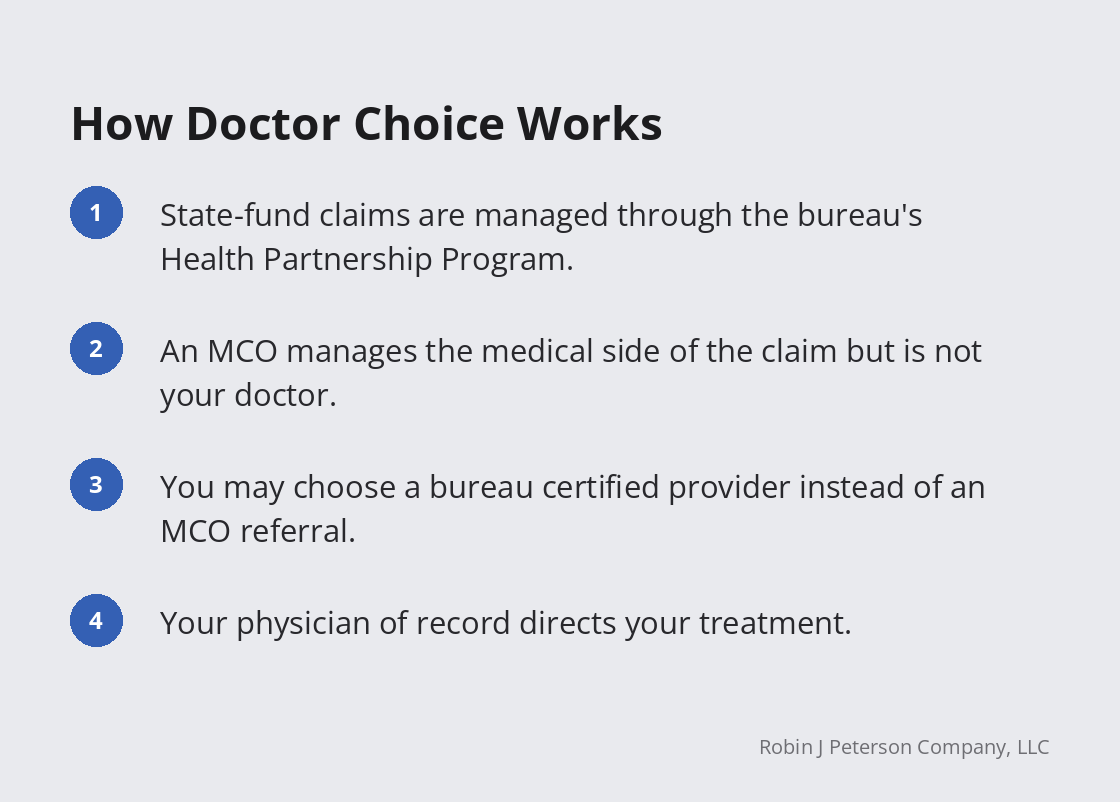
Ohio employers generally participate in the state insurance fund administered by the Ohio Bureau of Workers’ Compensation, while Ohio Revised Code Section 4123.35 allows employers that meet the administrator’s requirements to be granted the privilege of self-insuring. For state-fund employers, medical care is managed through the bureau’s Health Partnership Program, known as the HPP. Ohio Administrative Code Rule 4123-6-01 defines the HPP as the bureau’s comprehensive managed care program and defines a managed care organization, or MCO, as a vendor under contract with the bureau to provide medical management services. The MCO is not your doctor. Its role is to manage the medical side of the claim, while your chosen physician directs your treatment.
Your Right to Pick a Provider
Ohio Administrative Code Rule 4123-6-06.2, titled employee access to the HPP and employee choice of provider, provides that an injured worker may seek medical care for a work-related injury from a bureau certified provider or from a non-bureau certified provider, subject to limits in the rule. At the time of an injury, the injured worker may seek care directly from a provider or ask the MCO for help selecting one. If the MCO refers the worker to a provider or a list of providers, the rule states that the injured worker may, but is not required to, seek medical care from that provider. The choice belongs to you.
What a Physician of Record Does
The doctor who leads your care is called the physician of record. Rule 4123-6-01 defines the physician of record, or attending physician, as the authorized physician chosen by the employee to direct treatment. This doctor typically requests treatment, documents your work restrictions, and supports requests for benefits with medical evidence. Because the physician of record’s opinions carry so much weight, choosing a doctor who understands workplace injuries and the workers’ compensation process can make a real difference in how smoothly your claim moves forward.
Limits on Who You Can Choose
Some limits apply. Under Rule 4123-6-06.2, except in emergencies, injured workers may not seek care for work-related injuries from themselves or an immediate family member, and may not select themselves or an immediate family member as physician of record. If you first see a provider who is not bureau certified, the rule provides that ongoing treatment with that provider through the claim is generally limited unless the MCO determines that the treatment is not reasonably available from a comparable bureau certified provider and authorizes it. For most injured workers, choosing a bureau certified provider from the start avoids these complications.
Changing Doctors and Responding to Employer Exams
Your first choice of doctor does not have to be your last, and your employer has its own limited rights to request a medical examination. The rules differ depending on whether your employer is a state-fund employer, participates in a qualified health plan, or is self-insuring.
Changing Doctors in a Qualified Health Plan
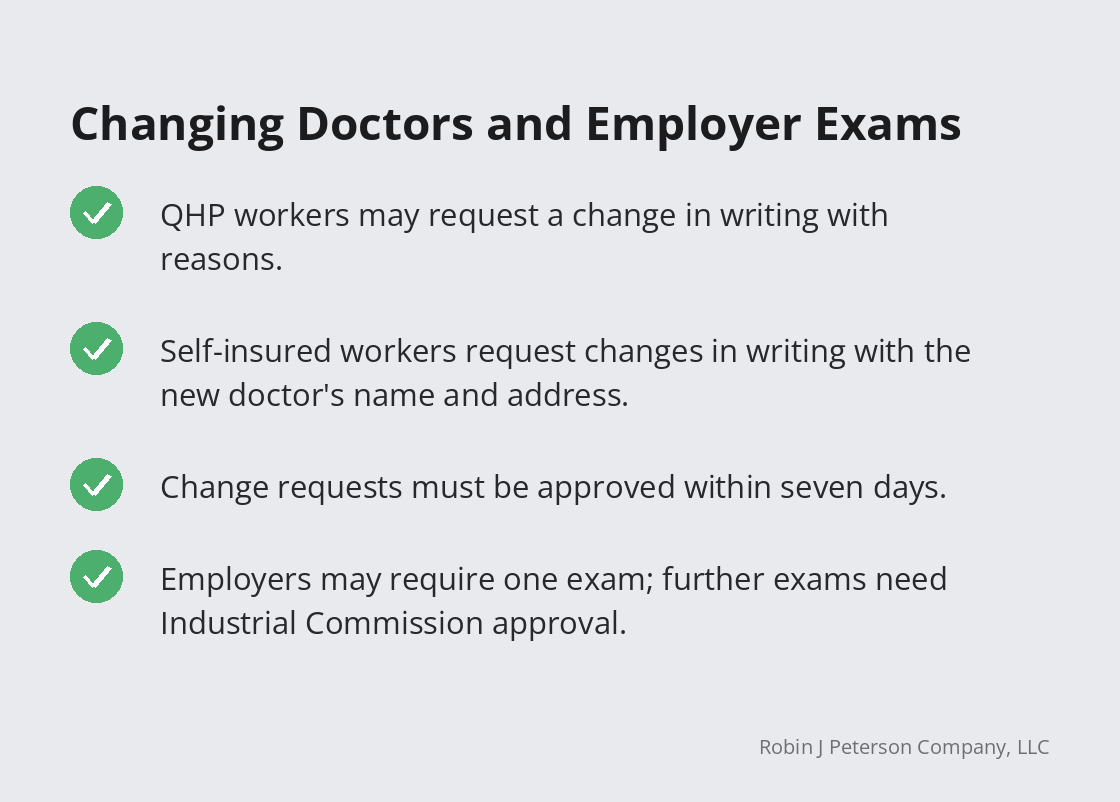
Some employers participate in a qualified health plan, or QHP, which Rule 4123-6-01 describes as an employer-sponsored health care plan certified with the bureau. Under Rule 4123-6-06.2, an injured worker in a QHP has freedom of choice of providers within the QHP’s network. A worker who is dissatisfied with a QHP provider may, after written notice to the QHP, request a change and select another provider within the QHP or any bureau certified provider. The request must contain the reasons for the change, and the rule requires the QHP to approve written requests within seven days of receipt.
Changing Doctors With a Self-Insuring Employer
Injured workers of self-insuring employers that do not use a QHP have free choice to select licensed physicians for treatment under Rule 4123-6-06.2, for claims with a date of injury on or after November 2, 1959. Emergency treatment does not count as an exercise of that choice. Once you go to a physician for non-emergency treatment, you are deemed to have made a choice of physician and must notify the employer of any change. A change of physician request must be made to the self-insuring employer in writing, must include the name and address of the new physician and the proposed treatment, and must be approved by the employer within seven days of receipt.
When Your Employer Requests an Exam
Ohio Revised Code Section 4123.651 allows the employer of an injured worker to require, without approval from the bureau or the Industrial Commission, that the worker be examined one time by a physician or certain other licensed practitioners of the employer’s choice. Any further requests for medical examinations must be made to the Industrial Commission, which will consider and rule on the request. The statute also provides that if, without good cause, an employee refuses to submit to a properly scheduled examination or refuses to release required medical records, the employee’s right to have the claim considered, or to receive compensation or benefits previously granted, is suspended during the period of refusal.
Mistakes That Can Weaken Your Claim
Provider choice is a right, but it comes with responsibilities. The mistakes below are the ones we see most often when injured workers in Northeast Ohio run into problems with their medical care and their claims.

Assuming the Company Doctor Is Required
Many workers assume they must treat with whatever clinic their employer or the MCO suggests. Rule 4123-6-06.2 says otherwise for state-fund employers: the injured worker may, but is not required to, seek care from a provider the MCO refers. Treating with a doctor you trust, who listens to your symptoms and documents them carefully, often leads to better care and clearer medical records. If you are unsure whether a provider is bureau certified, ask before you schedule follow-up treatment.
Ignoring an Employer Exam or Records Request
An examination requested by your employer can feel adversarial, but refusing it without good cause can suspend your claim under Section 4123.651. The same is true for refusing to sign a required medical release. Attend the exam, be honest and consistent about your symptoms and limitations, and make sure your own physician of record has fully documented your condition. If you believe a request is improper or excessive, speak with a lawyer rather than simply refusing.
Waiting Too Long to File and Treat
Medical care and the claim itself are closely connected. Ohio Revised Code Section 4123.84 provides that claims for the specific part or parts of the body injured are forever barred unless, within one year after the injury, written notice of those body parts has been made to the Industrial Commission or the bureau, or another event listed in the statute has occurred. Seeing a doctor promptly, describing every injured body part, and making sure the claim lists them accurately helps protect your rights. You can learn more about keeping a claim on track in our guide to the Ohio Industrial Commission hearing process.
Final Thoughts
Choosing a doctor for an Ohio workers’ comp claim is your right, not a formality. State-fund workers can choose a bureau certified provider rather than accepting a referral, QHP and self-insured workers can request a change of doctor in writing with a seven-day approval requirement, and employers are limited to one exam of their choosing without permission from the Industrial Commission. The physician you choose will shape both your recovery and the evidence in your claim, so it deserves careful thought.
Keep copies of your medical records, work restrictions, and any letters about exams or changes of physician. Those documents become the backbone of your claim if a dispute arises later.
If you have questions about choosing or changing your doctor after a workplace injury, contact Robin J Peterson Company, LLC to speak with our workers’ compensation team. We will review your claim, explain your rights under Ohio law, and help you take the next step with confidence.