
A pre-existing condition and Ohio workers’ comp claims cross paths more often than most injured workers expect. You may have had an old back problem, an arthritic knee, or a shoulder that bothered you now and then, and then a workplace accident made everything much worse. Many workers assume that a prior condition means they cannot receive benefits. Ohio law does not see it that way, and understanding how it treats aggravated conditions gives you real control over your claim.
At Robin J Peterson Company, LLC, we help injured workers across Cleveland, Akron, Canton, and Independence protect their Ohio workers’ compensation rights from the first report of injury through every step that follows. This guide explains how pre-existing conditions actually fit into an Ohio BWC claim, how to build the evidence a substantial aggravation requires, and the mistakes that most often weaken these claims, so you can move forward with confidence.
What a Pre-Existing Condition Claim Actually Means in Ohio
Very few adults arrive at work with a perfectly healthy body. Years of life, sports, earlier accidents, and simple aging leave their mark. Ohio’s workers’ compensation system recognizes this reality. The question is not whether you had a condition before the injury, but whether the work injury made that condition substantially worse.
Why an Old Condition Does Not Automatically End a Claim
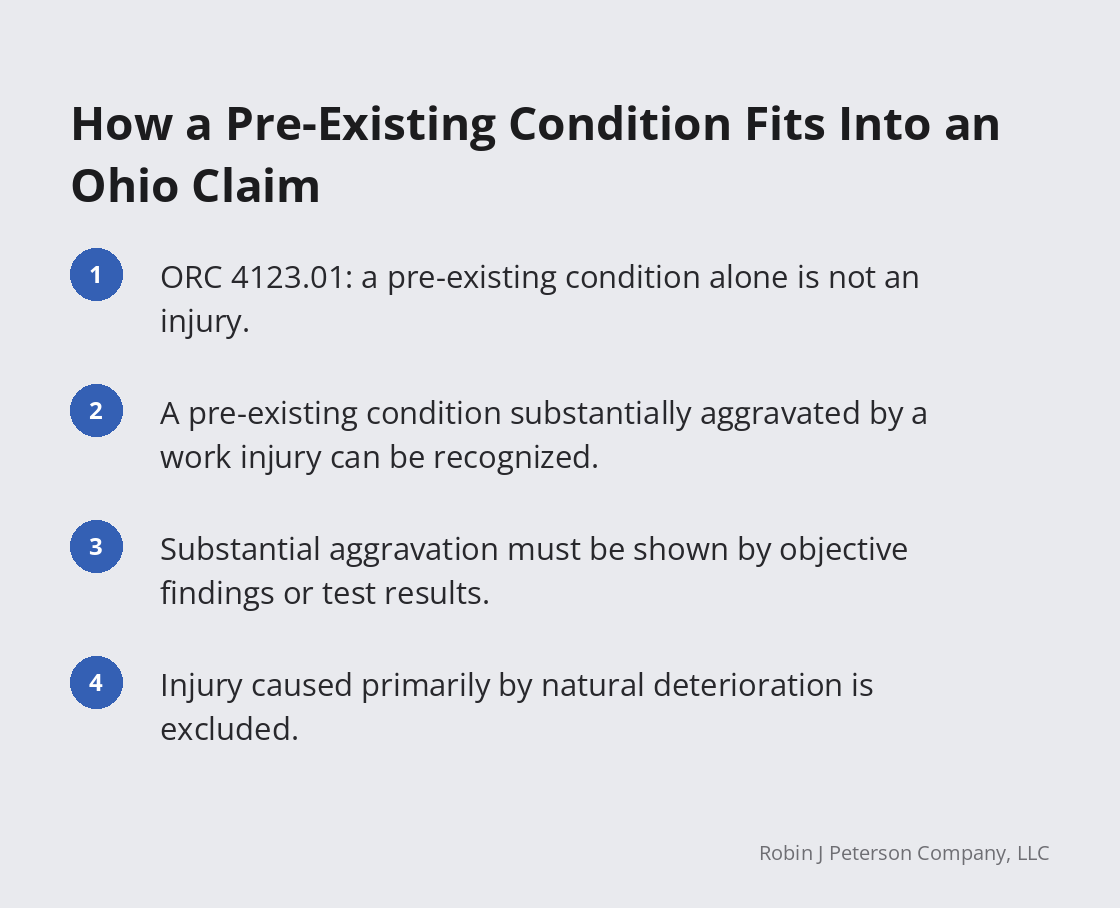
Ohio Revised Code 4123.01 defines an injury for workers’ compensation purposes as any injury received in the course of, and arising out of, the injured employee’s employment. The same section lists what is not considered an injury, and one of those exclusions is a condition that pre-existed an injury unless that pre-existing condition is substantially aggravated by the injury. Read carefully, the statute leaves the door open. A pre-existing condition by itself is not compensable, but a pre-existing condition that a workplace injury substantially aggravates can be recognized in a claim.
The Objective Evidence Requirement
The statute also explains how a substantial aggravation must be proven. Under ORC 4123.01, a substantial aggravation must be documented by objective diagnostic findings, objective clinical findings, or objective test results. Subjective complaints may be evidence of a substantial aggravation, but subjective complaints without objective findings or test results are insufficient on their own. In practical terms, this means imaging, examination findings, and test results that show a measurable change carry far more weight than a description of increased pain alone.
Natural Wear and Tear Versus a Work Injury
Ohio law draws a line between changes caused by work and changes caused by aging. ORC 4123.01 states that injury does not include injury or disability caused primarily by the natural deterioration of tissue, an organ, or part of the body. Employers and insurers sometimes rely on this exclusion when a worker has degenerative findings on an MRI or X-ray. The key distinction is cause. When the evidence shows that a specific workplace event substantially worsened an existing condition, the aggravation is tied to the work injury rather than to natural deterioration alone.
How to Build a Substantial Aggravation Claim With BWC
A strong aggravation claim is built on timing, clear medical documentation, and the right forms filed with the Ohio Bureau of Workers’ Compensation. Each step helps BWC and, if necessary, the Industrial Commission see the connection between the workplace injury and the worsened condition.
Reporting the Injury and Filing on Time
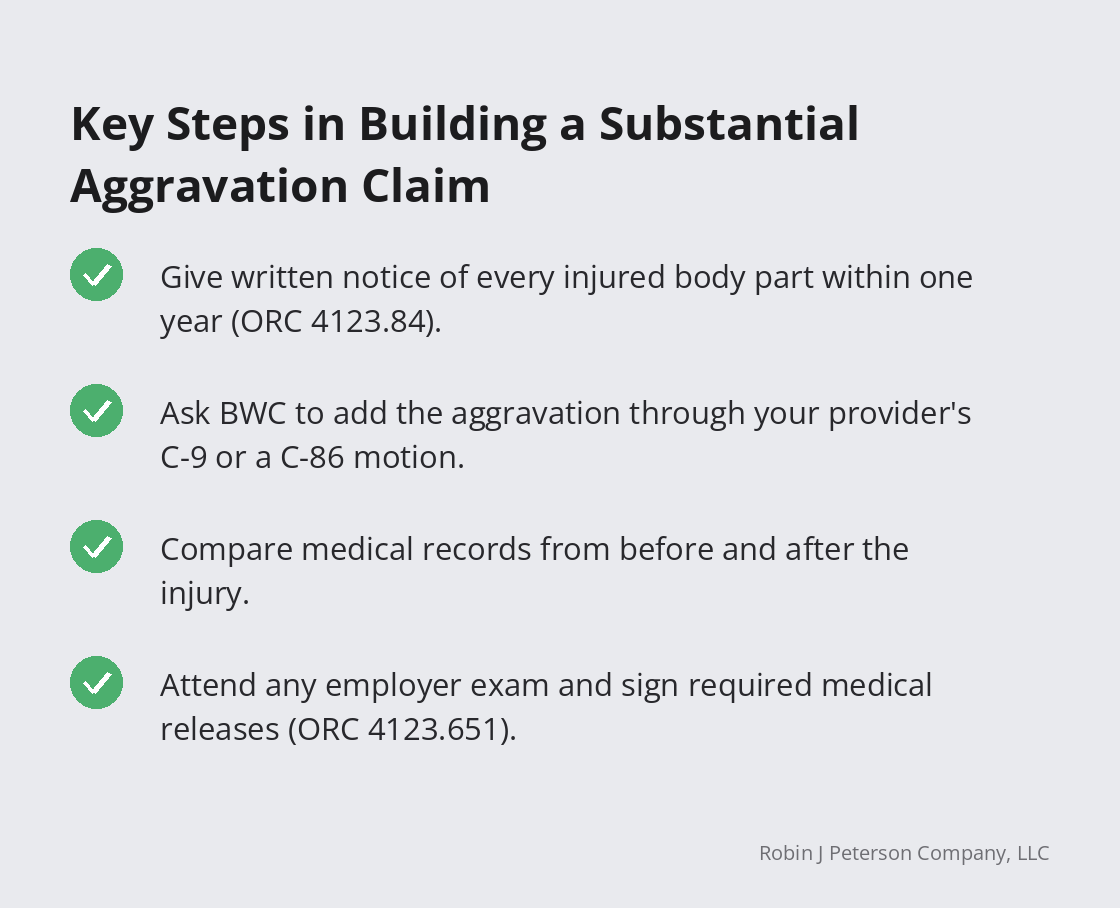
Ohio sets a firm outer deadline for injury claims. Under ORC 4123.84, claims for compensation or benefits for the specific part or parts of the body injured are forever barred unless, within one year after the injury, written notice of the specific part or parts of the body claimed to have been injured has been made to the Industrial Commission or BWC, or another event listed in the statute has occurred. Because the statute focuses on specific body parts, it is important to identify every area that was hurt, including any area where an old condition flared, as early as possible.
Asking BWC to Recognize the Aggravation
BWC allows specific conditions in a claim, so an aggravated condition may need to be specifically requested. Under BWC’s additional allowance policy, an additional condition may be recommended by a treating provider on a C-9 form or requested by the injured worker or the worker’s representative on a Motion, form C-86. BWC’s guidance for the C-86 explains that when a worker asks to add a pre-existing condition that a work injury aggravated, the request must identify it as an aggravation or substantial aggravation of the specific pre-existing condition, depending on the date of injury. For injuries on or after August 25, 2006, BWC states that the request must be supported by objective diagnostic findings, objective clinical findings, or objective test results showing that the condition substantially worsened because of the work injury.
Comparing Before-and-After Medical Records
The most persuasive aggravation claims show a clear contrast. Records from before the injury may show a condition that was stable, managed, or causing only occasional symptoms. Records after the injury may show new findings on imaging, reduced range of motion on examination, or test results that changed. When your treating provider explains that comparison in writing and connects the change to the workplace event, BWC has the kind of evidence the statute calls for.
Employer Medical Exams and Records Releases
Your employer also has the right to look at the medical picture. Under ORC 4123.651, the employer may require the claimant to be examined one time by a physician or certain other practitioners of the employer’s choice, and further requests for exams must be made to the Industrial Commission. The claimant must also provide a signed release for medical information related to the claim when the employer requests it. If, without good cause, an employee refuses a scheduled exam or a required release, the right to have the claim considered or to receive payment of benefits is suspended during the period of refusal. Cooperating with these steps keeps your claim moving.
Mistakes That Weaken Pre-Existing Condition Claims
Aggravation claims are often contested, and small missteps can give an employer or BWC reason to question the connection between your work injury and your worsened condition. Knowing what to avoid helps protect the benefits you are entitled to receive.
Hiding Your Medical History
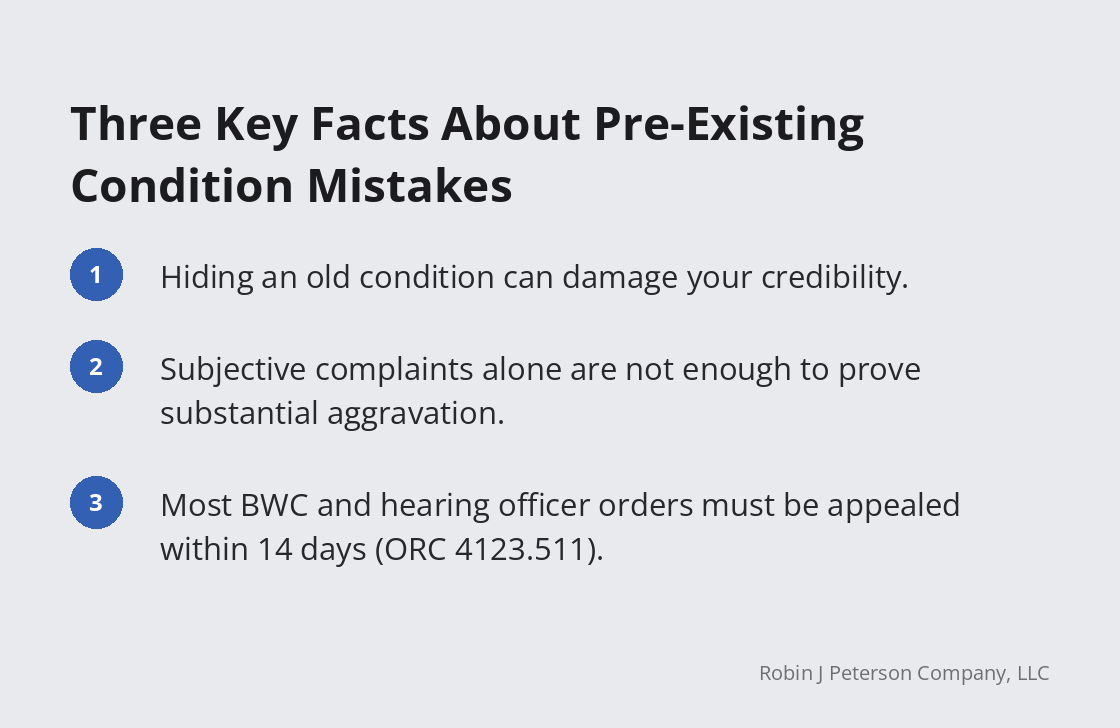
Some injured workers worry that mentioning an old injury will hurt their claim, so they leave it out when they talk to doctors or fill out forms. That approach usually backfires. Prior records often surface during the claim process, and an undisclosed history can damage your credibility. Being honest about the prior condition, and then showing how the work injury changed it, is what the substantial aggravation standard is designed to evaluate.
Relying Only on How You Feel
Your experience of increased pain matters, but Ohio law is clear that subjective complaints without objective findings are insufficient to establish a substantial aggravation. Keep your follow-up appointments, ask your provider whether imaging or testing is appropriate, and make sure examination findings are recorded in detail. The goal is a medical file that shows the change, not just one that describes it.
Waiting Too Long to Get Care
A gap between the workplace injury and your first medical visit gives the other side an opening to argue that something else caused the worsening. Prompt treatment creates a clear timeline that links the event at work to the change in your condition. Telling your provider exactly how the injury happened, and which body parts were affected, helps that record speak for itself.
Missing the Appeal Deadlines
If BWC or a hearing officer denies the aggravation, the time to respond is short. Under ORC 4123.511, a party may appeal a BWC order within fourteen days after receipt of the order, and orders of a district hearing officer and a staff hearing officer may likewise be appealed within fourteen days after receipt. Reading every order as soon as it arrives and acting quickly protects your right to have the issue heard.
Final Thoughts
A pre-existing condition does not have to stand between you and Ohio workers’ compensation benefits. When a workplace injury substantially aggravates an existing condition, Ohio law allows that aggravation to be recognized, as long as it is supported by objective medical evidence and requested through the proper process.
Prompt medical care, honest disclosure of your history, clear before-and-after records, and attention to every deadline are what turn a difficult aggravation claim into a well-supported one. With the right preparation, you can focus on recovery while your claim moves forward.
If a work injury made an old condition worse, contact Robin J Peterson Company, LLC to speak with our team serving Cleveland, Akron, Canton, and Independence. We’ll review your medical records, explain your options, and help you take the next step with a practical plan.