
The Ohio Bureau of Workers’ Compensation denies thousands of claims each year. Understanding the common BWC denial causes in Ohio helps you protect your rights and strengthen your case.
At Robin J Peterson Company, LLC, we’ve seen how quickly a denial can derail your recovery. This guide walks you through the main reasons claims get rejected and what you can do about it.
Why the BWC Denies Claims in Ohio
Report Your Injury on Time to Build Credibility
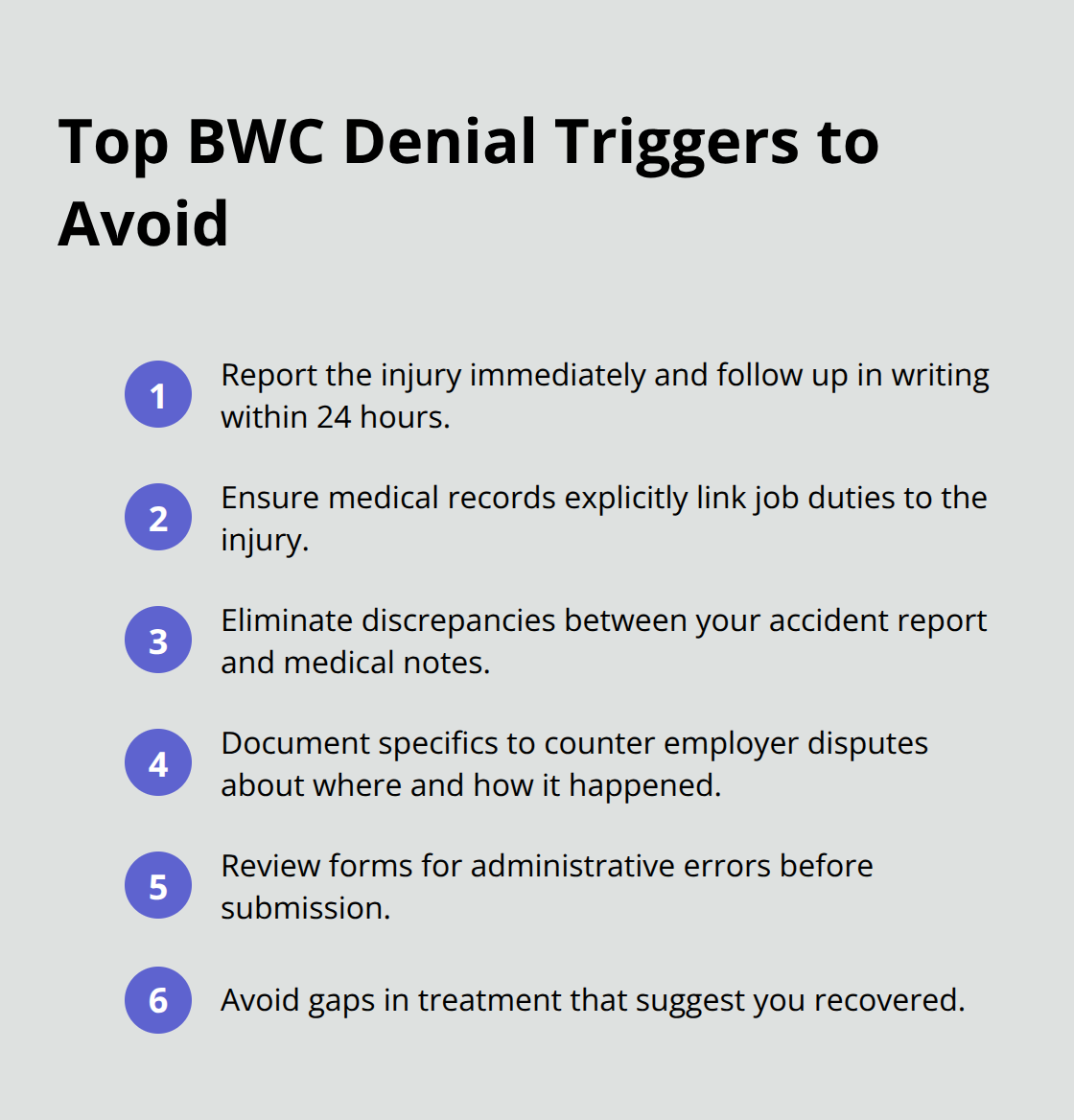
Timing determines whether your claim survives the initial review. The First Report of Injury must reach the BWC within one year of the injury or diagnosis, but the Ohio Bureau of Workers’ Compensation flags delays beyond 30 days as suspicious. When you report on the day of injury and follow up in writing within 24 hours, you create an auditable record that protects you. Many workers assume a verbal report to their supervisor satisfies the requirement, but the BWC treats written documentation as the standard. If your employer later claims they never received notice, you have proof. Delayed reporting also invites questions about whether the injury was truly work-related or whether you sought treatment elsewhere first. The BWC has 28 days to approve or deny your claim after filing, so every day you wait to report costs you momentum in building your case.
Medical Records Must Explicitly State Work Causation
Insufficient medical evidence ranks as the single most common denial reason the Ohio Bureau of Workers’ Compensation cites. Your doctor’s notes cannot simply state you have a shoulder strain; they must explicitly connect your job duties to the injury. Discrepancies between your accident report and medical records give the BWC an easy reason to deny. When you seek treatment, tell your healthcare provider exactly what happened at work, which tasks you performed, and how the incident occurred. Request that your provider document this causation directly in their report. The 17-day deadline for medical records to arrive at the BWC is hard-late submissions trigger automatic denial. Gaps in treatment also undermine your case; if you stop seeing your doctor for weeks after an injury, the BWC assumes you recovered and questions whether the injury was serious.
Address Employer Disputes With Documentation and Witnesses
Employers sometimes contest whether the injury happened at work or during non-work activity. Surveillance video, witness statements, and detailed incident documentation become your strongest defenses. If a coworker saw what happened, obtain their statement in writing immediately. Inconsistencies between your account and your employer’s account give the BWC reason to deny. The more specific you are about the time, location, and job duties involved, the harder it is for the employer to dispute the facts. Administrative errors on your initial report (misspelled names, incorrect dates, missing signatures) can also trigger a denial, so review every form before submission. These preventable mistakes often determine whether the BWC approves or rejects your claim before any substantive review occurs.
When a Pre-Existing Condition Complicates Your BWC Claim
Pre-Existing Conditions Don’t Automatically Disqualify You
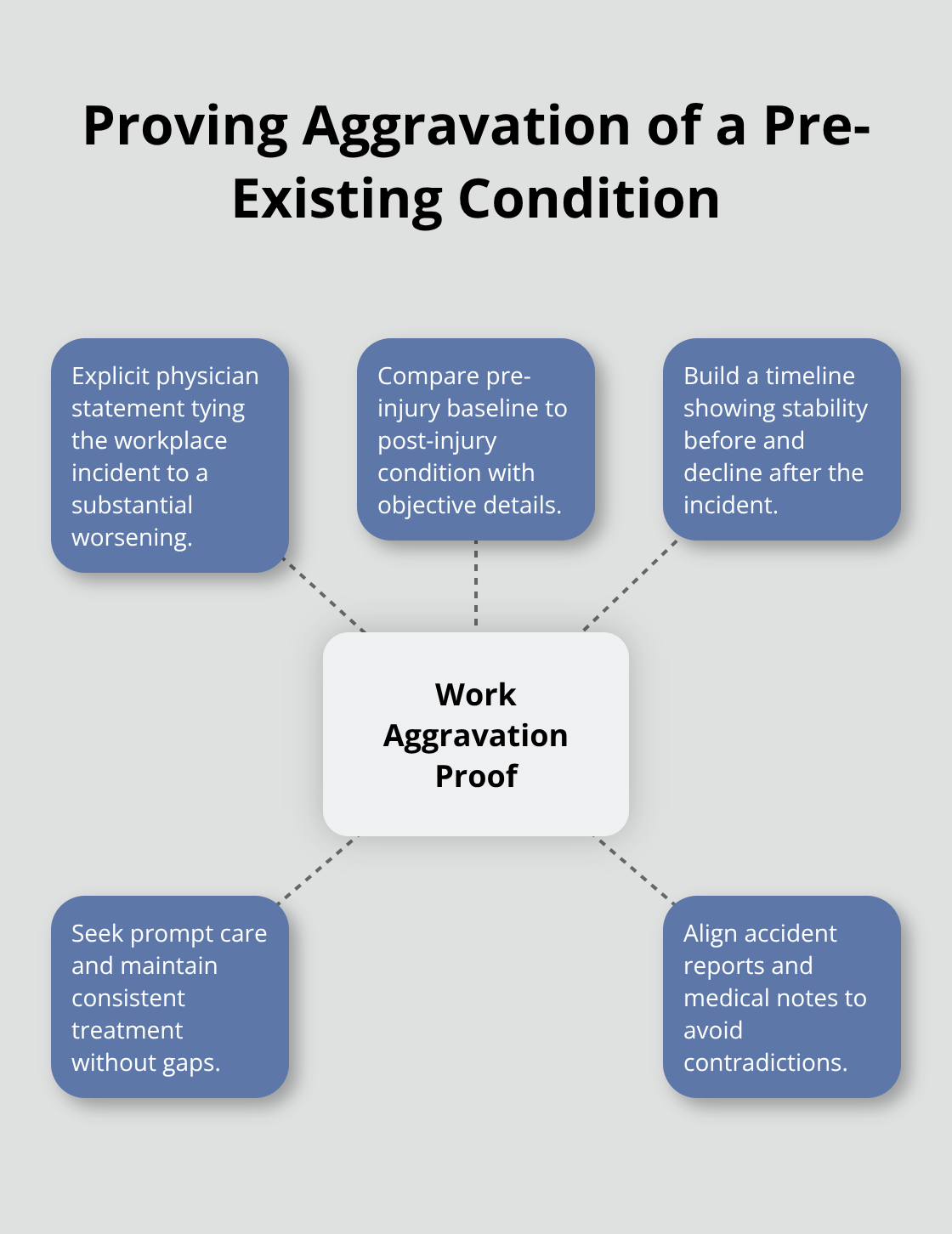
The Ohio Bureau of Workers’ Compensation does not automatically deny claims involving pre-existing conditions. What matters is whether your workplace injury aggravated or accelerated an existing problem. The distinction is critical: a pre-existing condition alone does not disqualify you, but you must prove the work incident made it significantly worse. The BWC requires clear medical documentation showing that your job duties caused the worsening, not merely that you have an underlying condition. For example, if you had a shoulder problem before your current job and a fall at work intensified the pain and limited your range of motion, your physician must state explicitly that the workplace incident was a substantial contributing factor to the deterioration.
Medical Documentation Must Show Clear Causation
Generic medical notes that acknowledge a prior condition without addressing causation will trigger a denial. Your treating doctor needs to compare your pre-injury baseline to your post-injury condition and explain the causal link in clinical terms that the BWC can evaluate. The physician should state directly that the workplace injury caused or substantially worsened the pre-existing condition, not that the condition simply exists. This distinction separates approved claims from rejected ones. When your doctor provides vague language or fails to connect the work incident to the aggravation, the BWC interprets the gap as insufficient evidence and denies the claim.
Build a Timeline Showing Stability Before and Decline After
Building this evidence requires a timeline that contrasts your stability before the incident with your decline afterward. Pull your prior medical records and request your current provider document how your condition worsened since the workplace injury. If you received treatment years ago for the same area but remained stable until the work incident, this history strengthens your claim significantly. The BWC also scrutinizes whether you delayed seeking treatment after the injury, as gaps in medical care suggest the condition was not serious or work-related. Seek immediate medical attention and maintain consistent follow-up appointments to establish a clear cause-and-effect relationship.
Consistent Treatment Protects Your Claim
Gaps in your medical care undermine your case and give the BWC an easy reason to deny. When you stop seeing your doctor for weeks after an injury, the BWC assumes you recovered and questions whether the injury was serious. Attend all recommended appointments and keep detailed records of each visit. If your provider recommends follow-up care, complete it promptly. This consistency demonstrates that the aggravation is real and ongoing, not a temporary setback that resolved on its own. Your benefits are typically based on a percentage of your Average Weekly Wage according to Ohio law, and the severity of the aggravation influences the compensation level.
Prepare for the Appeal With Complete Medical Evidence
If you face denial on pre-existing condition grounds, gather your full medical history and have your physician submit a detailed work-causation statement. The Industrial Commission of Ohio evaluates these nuanced cases carefully, but only when the evidence is complete and compelling. An attorney who understands how the Industrial Commission assesses pre-existing condition claims can help you navigate the appeal process and present your case effectively. When the aggravation is obvious and well-documented, the BWC approves these claims regularly, but weak documentation leads to denial even when the injury is genuine. The next section covers what happens when the BWC denies your claim and how you can fight back within the critical 14-day appeal window.
What to Do After the BWC Denies Your Claim
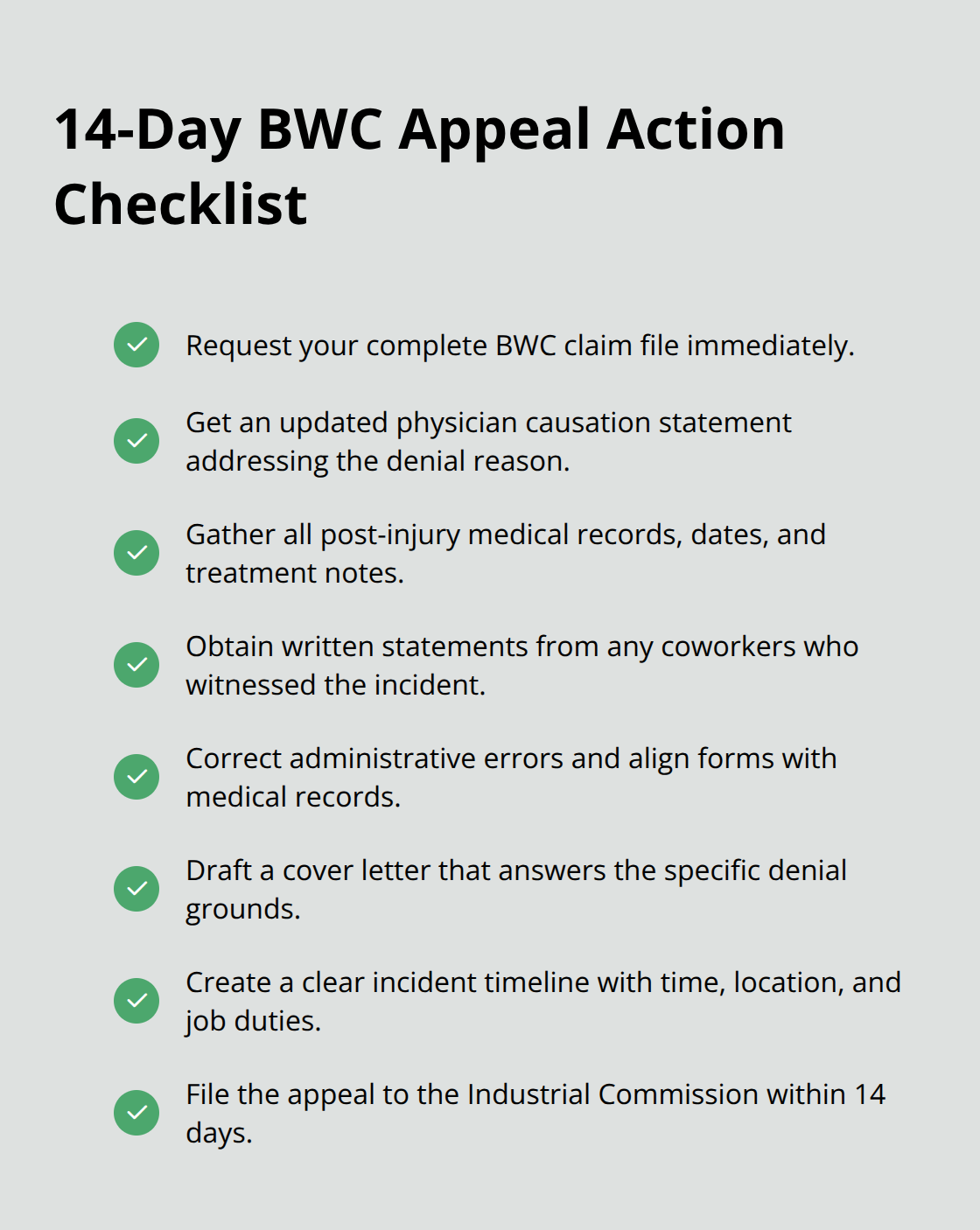
A BWC denial is not the end of your case-it is the beginning of your appeal. The Industrial Commission of Ohio gives you exactly 14 days from the denial date to file an appeal, and this deadline is absolute. Missing it permanently closes your right to challenge the decision. The moment you receive a denial letter, photograph or scan it and note the date on your calendar. Those 14 days represent your most critical window. During this time, you need to gather every piece of evidence that strengthens your case, identify gaps in your original submission, and decide whether legal representation makes sense for your situation. The BWC denies claims for preventable reasons-missing medical documentation, weak causation statements, administrative errors-and many of these gaps can be corrected on appeal if you act fast.
Request Your Complete Claim File Immediately
Start by requesting your complete claim file from the BWC right away. This file shows exactly what evidence the BWC reviewed when it denied you, which means you can see what was missing or unconvincing. Contact the Ohio Bureau of Workers’ Compensation directly or visit a local service office to request this file; the BWC must provide it within a reasonable timeframe. Once you have it, you understand precisely what the BWC found insufficient and what you need to add to your appeal.
Strengthen Your Medical Evidence and Causation
Ask your treating physician to review the denial reason and submit an updated statement that addresses the specific deficiency. If the BWC said there was insufficient evidence of work causation, your doctor needs to write a clear statement explaining how your job duties caused or aggravated the injury. If the denial cited a pre-existing condition, your physician should document how the workplace incident worsened your baseline condition with specific clinical details. Obtain written statements from any coworkers who witnessed the incident; their accounts carry weight at the Industrial Commission level, especially when the employer disputes the facts. Gather all medical records from every provider you saw after the injury, including dates, diagnoses, and treatment notes. The more complete your medical timeline, the harder it is for the BWC to claim insufficient evidence. If you delayed seeking treatment after the injury, have your physician explain why the delay occurred and why it does not undermine the work-related connection.
Correct Administrative Errors and Inconsistencies
Administrative errors on your initial forms should be corrected on appeal; even small mistakes like wrong dates or incomplete fields can justify a denial, and fixing them removes this objection entirely. Review every form you submitted and compare it to what the BWC received. Discrepancies between your accident report and medical records give the BWC an easy reason to deny, so align these accounts carefully before resubmission.
Work With an Attorney Experienced in Industrial Commission Appeals
An attorney experienced in Ohio workers’ compensation law changes the outcome significantly. The Industrial Commission of Ohio process involves written submissions and sometimes formal hearings, and the procedural rules differ from the initial BWC claim process. An experienced attorney knows how to present evidence in the format the Industrial Commission expects, which arguments the Commission finds persuasive, and how to counter the employer’s or BWC’s position effectively. Attorneys also have relationships with medical experts who can review your case and provide causation opinions that the Commission respects. If your injury prevents you from returning to work or requires ongoing medical treatment, legal representation is not optional-it is essential. The Industrial Commission evaluates these cases on the strength of evidence and argument, not on the seriousness of your injury, so weak presentation of a genuine claim leads to denial even when the facts support you.
Structure Your Appeal Submission for Maximum Impact
Your appeal to the Industrial Commission must address the specific reason the BWC gave for the denial. If the denial letter said you lacked medical evidence, your appeal should include a cover letter explaining what new or clarifying medical evidence you are submitting and why it proves work causation. If the denial cited a pre-existing condition, your submission should include a timeline comparing your pre-injury baseline to your post-injury condition, with your physician’s statement explaining the aggravation directly. Do not simply resubmit the same materials; the Industrial Commission needs to see that you understood the deficiency and corrected it. Include a detailed written account of the incident if you have not already done so, with specific information about the time, location, job duties, and how the injury occurred. If witnesses exist, include their statements in the submission. The Industrial Commission reviews all materials you provide, so completeness matters enormously. Many appeals succeed because the claimant submitted thorough evidence the second time around, not because the original decision was legally wrong.
Final Thoughts
BWC denial causes in Ohio stem from three preventable mistakes: delayed injury reporting, weak medical evidence linking your injury to work, and administrative errors on your forms. Pre-existing conditions add complexity, but they do not automatically disqualify you if your physician documents how the workplace incident aggravated your baseline condition. The difference between approval and denial often comes down to documentation quality and timing, not the severity of your injury.
Proper documentation and timely reporting protect you against denial. Report your injury the day it happens, follow up in writing within 24 hours, and ensure your medical provider explicitly connects your job duties to your symptoms. Attend all recommended medical appointments without gaps, and gather written statements from coworkers who witnessed the incident (these steps cost nothing but time and attention, yet they prevent the vast majority of denials that workers face).
If the BWC denies your claim, you have 14 days to appeal to the Industrial Commission of Ohio-this deadline is absolute and non-negotiable. We at Robin J Peterson Company, LLC represent injured workers throughout the Cleveland, Akron, and Canton areas who face denials and need to appeal. Contact us for a consultation to review your options and determine whether legal representation makes sense for your situation.