
Office injuries happen more often than many workers realize, and understanding your office worker compensation rights is the first step toward protecting yourself. At Robin J Peterson Company, LLC, we help injured workers navigate claims that employers often try to minimize or deny.
Whether you slipped on a wet floor, suffered an equipment accident, or faced employer resistance to your claim, Ohio’s workers’ compensation system has specific rules you need to know. This guide walks you through your rights and the practical steps to move forward.
What Counts as a Workplace Injury in an Office
Contact Incidents and Falls
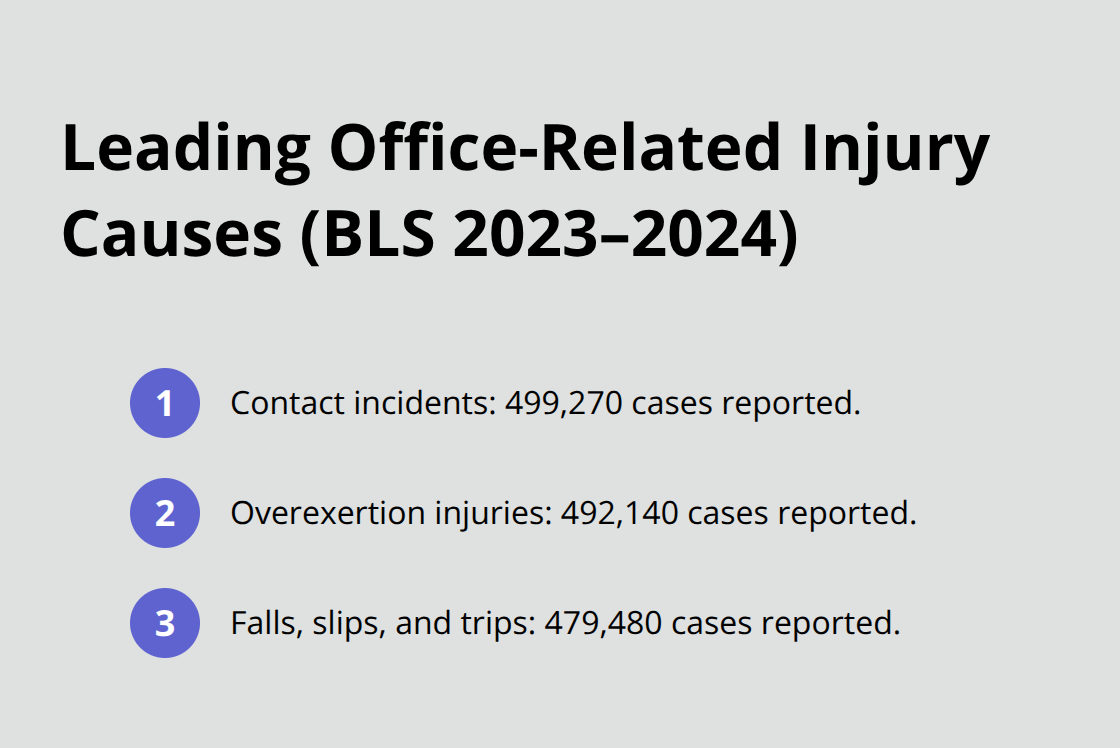
Contact incidents rank as the leading cause of nonfatal workplace injuries requiring days away from work, with 499,270 cases reported in 2023-2024 according to the U.S. Bureau of Labor Statistics. For office workers, this means slips and falls on wet floors, collisions with colleagues, or strikes from falling objects all qualify for workers’ compensation claims. Overexertion injuries came in second with 492,140 cases, and falls, slips, and trips placed third with 479,480 cases. The critical distinction is whether the injury occurred during work activities or arose from work conditions. If you slipped on a spill near the copy machine, tripped on a loose carpet in the hallway, or fell from an unstable chair while reaching for files, these injuries meet the standard for compensation eligibility.
What Qualifies for Coverage
The injury does not need to be dramatic or involve machinery. Even minor incidents that result in time away from work qualify for compensation. What matters is that the incident happened at work and caused a measurable injury. Employers frequently dispute office injury claims by arguing the worker was careless or that the injury occurred outside work conditions.
This resistance happens because office injuries often lack the obvious machinery or hazards found in manufacturing settings, making denials easier to justify.
When Claims Face Denial
If you injured yourself during horseplay, a fight, or while violating company policy, your claim will be denied. Similarly, injuries sustained while commuting to or from work fall outside coverage, and psychological injuries stemming purely from workplace stress face strict scrutiny. The practical reality is that documentation determines whether your claim survives employer pushback. Photographs of the hazard, witness statements from coworkers, medical records showing treatment immediately after the incident, and written reports filed with your employer create the evidence trail that prevents denials. Workers who fail to document conditions thoroughly or wait too long before reporting injuries to their employer and medical providers often see claims denied.
Equipment and Environmental Hazards
Office environments contain legitimate hazards beyond slips and falls. Faulty office chairs, malfunctioning equipment, electrical hazards, or temperature extremes that cause injury all qualify for compensation. A chair with a broken base that collapses and injures your back, a desk lamp with exposed wiring that causes electrical burns, or prolonged exposure to extreme temperatures in poorly regulated office spaces establish clear workplace injury claims. The key is proving the hazard existed and caused the injury. Save maintenance requests you submitted, keep photographs of damaged equipment, and obtain written confirmation from your employer acknowledging the problem (these documents prevent employers from claiming they were unaware of the danger).
Understanding what qualifies as a workplace injury sets the foundation for your claim, but knowing Ohio’s specific workers’ compensation system determines whether you actually receive benefits.
Understanding Ohio’s Workers’ Compensation System
How the Ohio BWC Operates
Ohio’s workers’ compensation system operates through the Ohio Bureau of Workers’ Compensation, which manages claims and benefits for injured workers across the state. Unlike federal systems such as OWCP that serve specific worker groups, Ohio’s BWC covers most private-sector employees and public employees in participating subdivisions. The system moves claims through a structured process: an employer reports your injury, the BWC reviews medical evidence and incident details, and a decision follows within specific timeframes. Speed matters less than accuracy in documentation. Workers who file incomplete claims or fail to provide witness statements and medical records early in the process face significant delays. The BWC operates on a no-fault principle, meaning you do not need to prove employer negligence to receive benefits-only that the injury arose from work conditions. This distinction separates Ohio’s system from personal injury lawsuits, where fault becomes central.
Your Rights and Employer Obligations
Your employer cannot retaliate against you for filing a claim, and the BWC prohibits wage deductions or termination based on injury reporting. However, employers frequently test these boundaries by reducing hours, reassigning duties to undesirable positions, or creating hostile work environments after claims are filed. Retaliation often occurs subtly, making documentation of employer actions critical for potential legal remedies beyond workers’ compensation. You have the right to choose your own medical provider unless your employer has established a managed care organization, in which case you may be required to use that network initially.
Filing Your Claim Strategically
File your claim as soon as possible after injury; Ohio allows claims to be filed up to two years after the injury date, but delays weaken your position because memory fades and evidence disappears. The BWC will request medical reports establishing the injury’s work-relatedness and severity. Provide your physician with specific details about how the injury occurred at work, not just general descriptions.
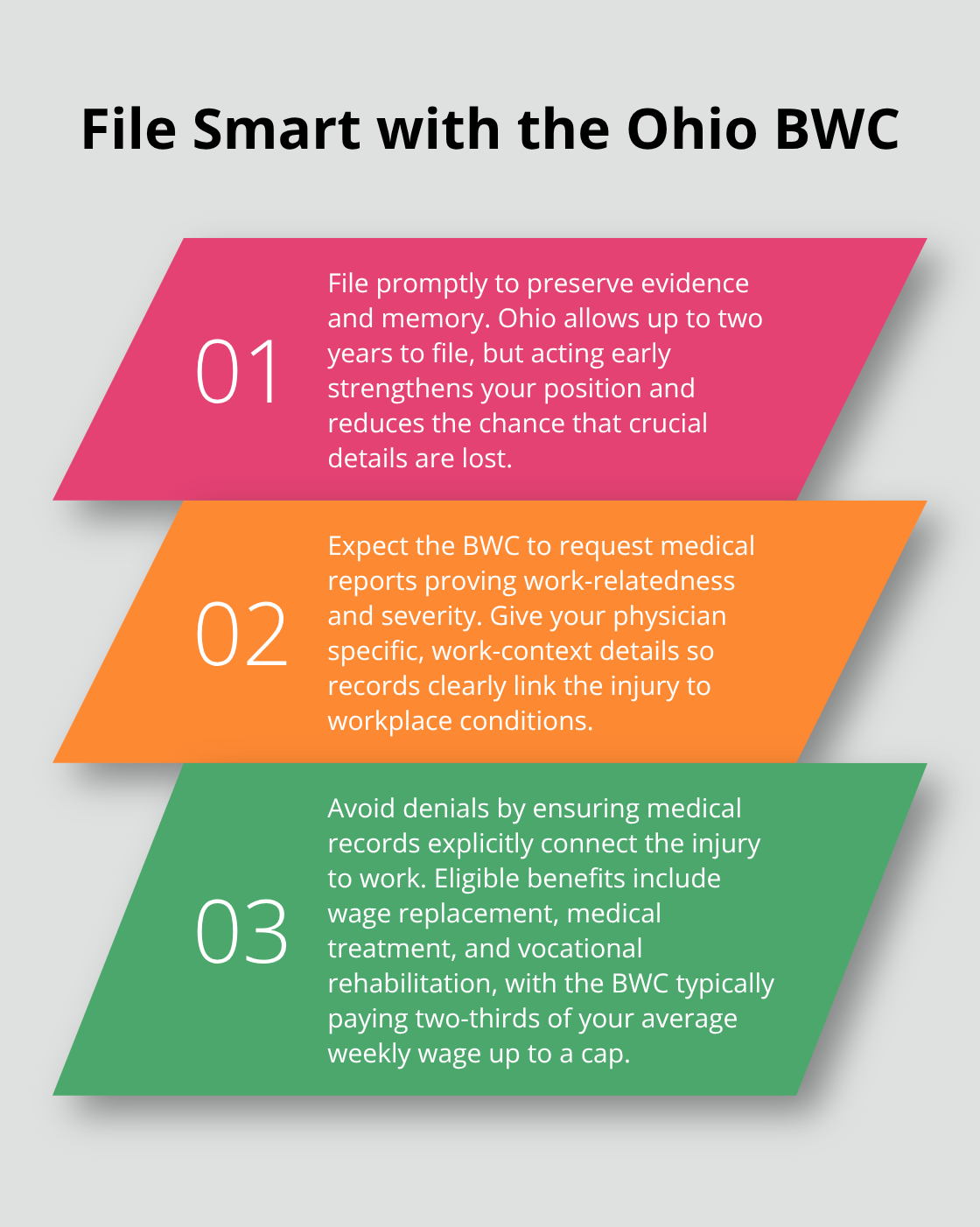
Many claims face denial because medical records fail to explicitly connect the injury to workplace conditions. Your rights include receiving wage replacement benefits if you miss work, coverage for reasonable medical treatment related to the injury, and vocational rehabilitation if you cannot return to your previous job. The BWC typically pays two-thirds of your average weekly wage during recovery, up to a maximum determined annually.
Navigating Denials and Appeals
If your claim is denied, you have the right to request reconsideration or file an appeal with the Industrial Commission of Ohio. The appeals process requires presenting new evidence or identifying errors in the initial decision, not simply disagreeing with the outcome. Many workers lose appeals because they fail to obtain medical testimony or expert documentation supporting their position. Understanding these rights means acting strategically from the moment injury occurs, not passively waiting for the system to work in your favor. When employers deny claims or the BWC rejects your initial filing, the next phase of your claim requires understanding what challenges you will face and how to overcome them.
Why Employers Deny Office Claims and How to Fight Back
The Reality of Employer Resistance
Employers deny office injury claims at alarming rates because office injuries lack the visible severity of machinery accidents or construction site injuries. The Ohio Bureau of Workers’ Compensation data shows contact incidents and falls rank among the leading workplace injuries, yet office workers face skepticism when reporting these incidents to their employers. Employers argue that slips on wet floors result from carelessness rather than workplace hazards, that falls from chairs reflect poor balance rather than faulty equipment, or that minor injuries do not warrant compensation. This pushback starts immediately after you report the injury, not during the formal claim process. Your employer controls the initial narrative by deciding what information appears in the incident report filed with the BWC. If your employer documents your slip-and-fall as a minor incident caused by your own inattention rather than a legitimate workplace hazard, that framing influences the BWC adjuster’s decision.
Photograph and Document the Scene
Photographs taken immediately after the incident prove the hazard existed before your injury occurred. If you slipped on a wet floor near the copy machine, photograph that exact spot, the wet surface, and any lack of warning signs or wet floor mats. Obtain written statements from coworkers who witnessed the incident or observed the hazard beforehand, not weeks later when memories fade. File a written incident report with your employer documenting specific details: the exact time, the precise location, what you were doing when injured, how the injury occurred, and the names of witnesses.
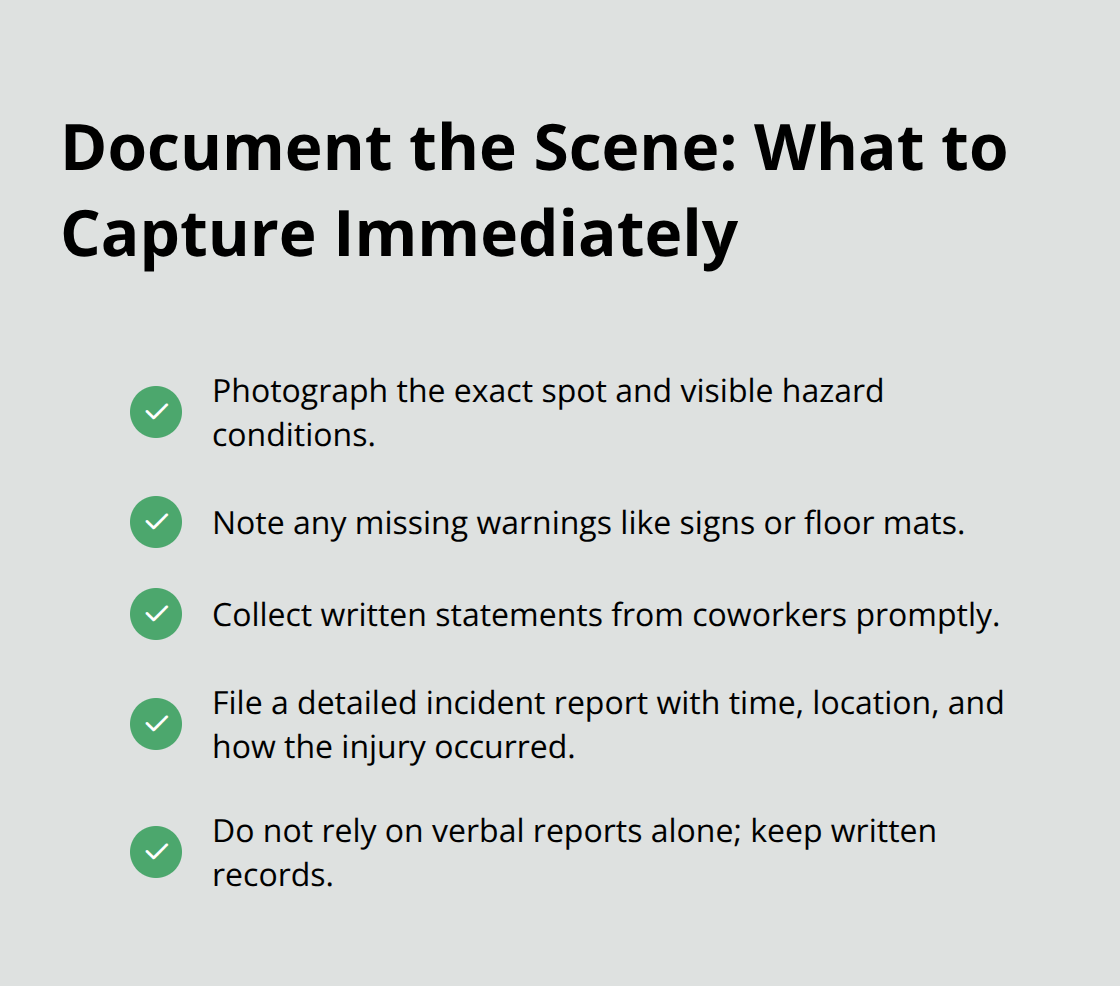
Do not rely on verbal reports that disappear from the record.
Medical Records Must Establish Work Connection
Medical documentation determines whether your claim survives employer denial because physicians’ statements either connect your injury to workplace conditions or fail to do so. When you see your doctor, explicitly state that the injury occurred at work and describe the workplace hazard that caused it. Many office workers describe their injury in general terms, allowing physicians to document the injury without establishing its workplace origin. A medical record stating you suffered a back strain provides no evidence of work-relatedness. A medical record stating you suffered a back strain after falling from a malfunctioning office chair that collapsed beneath you creates an undeniable work connection. Request a copy of your medical records and verify they include the workplace hazard description. If your doctor’s notes omit workplace details, contact the office and request an addendum clarifying how the injury arose from work conditions.
Build Your Evidence for Appeals
During the appeals process, if the BWC denies your initial claim, you must present evidence the adjuster overlooked or new information supporting work-relatedness. Medical testimony from your treating physician stating the injury’s mechanism matches the workplace incident you reported carries significant weight in appeals. Witness statements from coworkers corroborating your account of what happened and what caused the injury overcome employer claims that you were careless or injured yourself outside work. Many workers lose appeals because they gather this evidence too late, after the BWC has already made an initial decision. Obtain witness statements within days of your injury, not months later. Request written confirmation from your employer acknowledging any hazardous conditions you reported before the injury occurred, such as a maintenance request for a broken chair or a report of a slippery floor. These documents prove the hazard existed and the employer knew about it.
Final Thoughts
Office worker compensation rights protect you when workplace injuries occur, but claiming those rights requires immediate action and thorough documentation. Employers resist claims, the BWC scrutinizes office injuries more heavily than manufacturing accidents, and delays in gathering evidence weaken your position significantly. Understanding Ohio’s workers’ compensation process, documenting hazards immediately, and obtaining medical records that explicitly connect your injury to workplace conditions separates workers who receive benefits from those whose claims face denial.
The practical reality is that office injuries are legitimate workplace injuries deserving compensation. Contact incidents, falls, and equipment accidents happen in offices regularly, yet office workers face greater skepticism than workers in other industries. This skepticism makes legal representation valuable when employers deny claims or the BWC rejects your initial filing, as an attorney experienced in Ohio workers’ compensation law knows how to present evidence effectively and challenge employer narratives.
At Robin J Peterson Company, LLC, we represent injured office workers throughout the Cleveland, Akron, and Canton areas who face claim denials or employer resistance. If your claim has been denied or you need guidance filing your initial claim, contact our office to discuss your situation. Do not accept a denial without understanding your options for appeal and reconsideration.