
A Northeast Ohio BWC claim can feel overwhelming when you’re injured and unsure what comes next. We at Robin J Peterson Company, LLC created this guide to walk you through every step of the process.
From filing your initial claim to handling disputes, you’ll find practical answers here. This resource covers what you need to know to protect your benefits.
Understanding BWC Claims in Northeast Ohio
What the Ohio BWC Actually Does
The Ohio Bureau of Workers’ Compensation is a state agency that manages workplace injury claims across Northeast Ohio and the entire state. It operates differently than private insurance companies. The BWC doesn’t profit from denying claims-it’s a government entity funded through employer premiums and designed to process claims systematically. This matters because the agency has clear rules, timelines, and procedures that apply equally to all claimants. When you file with the BWC, you work within a regulated system where decisions follow documented criteria rather than subjective judgment. The BWC processed over 900,000 claims statewide in recent years, which means the system handles massive volume and follows established protocols. Understanding how the agency operates helps you prepare stronger documentation and avoid common pitfalls that lead to denials.
How the BWC Evaluates Your Claim
The BWC has 30 days from your filing date to accept or deny your claim. During this window, the agency requests medical documentation from treating physicians and emergency room records to establish whether your injury is work-related and caused your diagnosed condition. Missing or incomplete medical records rank among the top reasons valid claims get rejected. The agency reviews whether you were an employee at the time of injury (not an independent contractor) and whether the injury occurred within the scope of your job duties. These three factors-employment status, scope of employment, and medical causation-form the foundation of every decision.
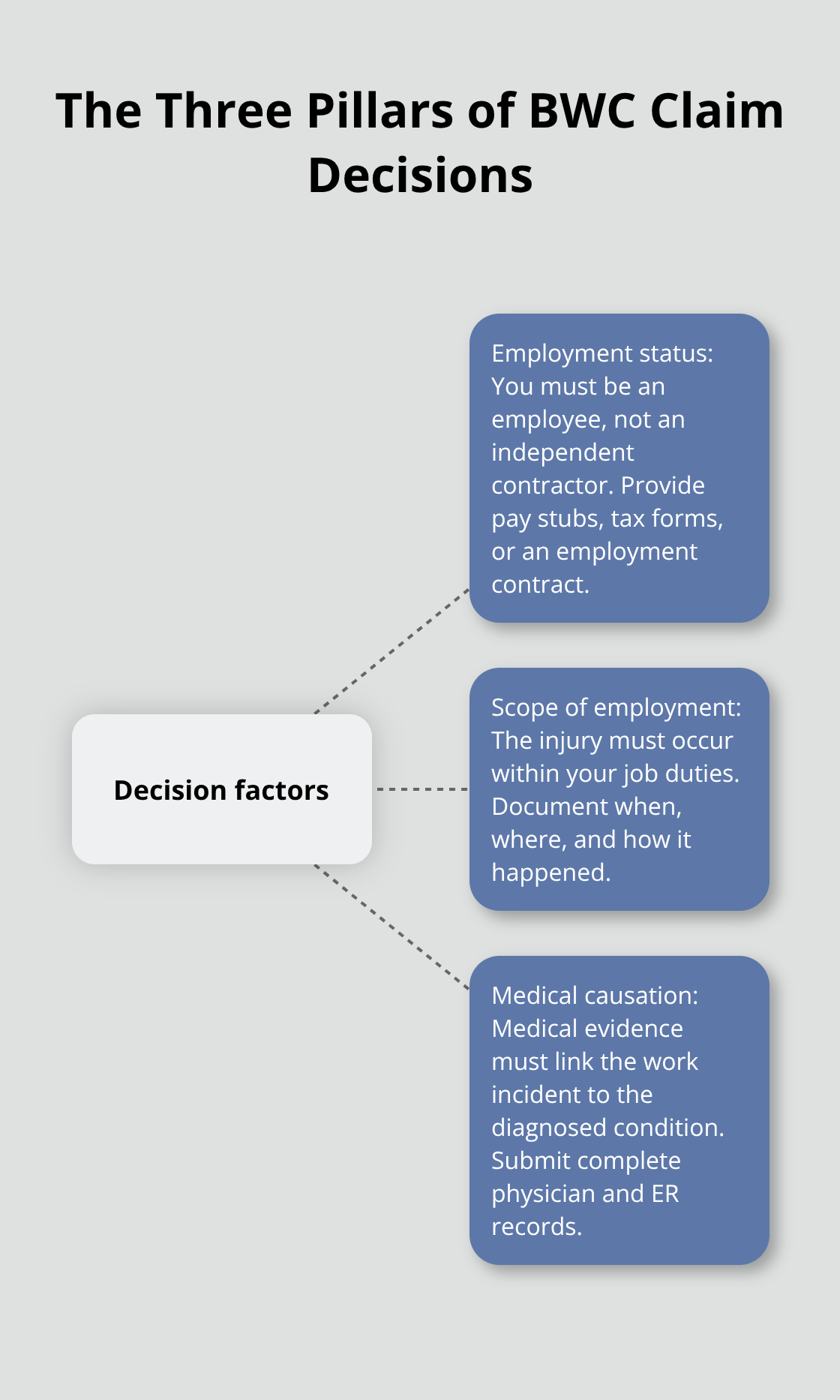
If the BWC finds gaps in any area, it denies the claim rather than requesting additional evidence. This is why documentation quality matters more than you might expect.
What Injured Workers Actually Receive
Accepted claims cover lost wages during recovery, medical treatment expenses, and potential lump-sum settlements depending on the injury’s severity and permanence. The specific amount of lost wage replacement varies based on your earnings history and the type of injury you sustained. Medical coverage includes hospital care, surgical procedures, physical therapy, and ongoing treatment directly related to your workplace injury. Northeast Ohio workers receive the same benefit structure as injured workers throughout Ohio, though the local BWC service office at your nearest location handles claim administration and can provide face-to-face assistance. The benefits exist to replace income you’ve lost and cover treatment you need, but only if your claim is accepted. This is why the initial filing and appeal process are so critical-denials block access to all these protections. When claims face rejection, the path forward requires understanding exactly what went wrong and how to challenge that decision.
Filing Your BWC Claim the Right Way
Start Your Claim Immediately Online
The BWC’s online filing system moves fast, and you need to move faster. Head to the Ohio BWC website and select the Start online application option to initiate your claim immediately after your workplace injury. Speed matters because the 30-day evaluation window starts from your filing date, not from when you realize you’re injured. The online portal walks you through basic information about yourself, your employer, and the injury itself.
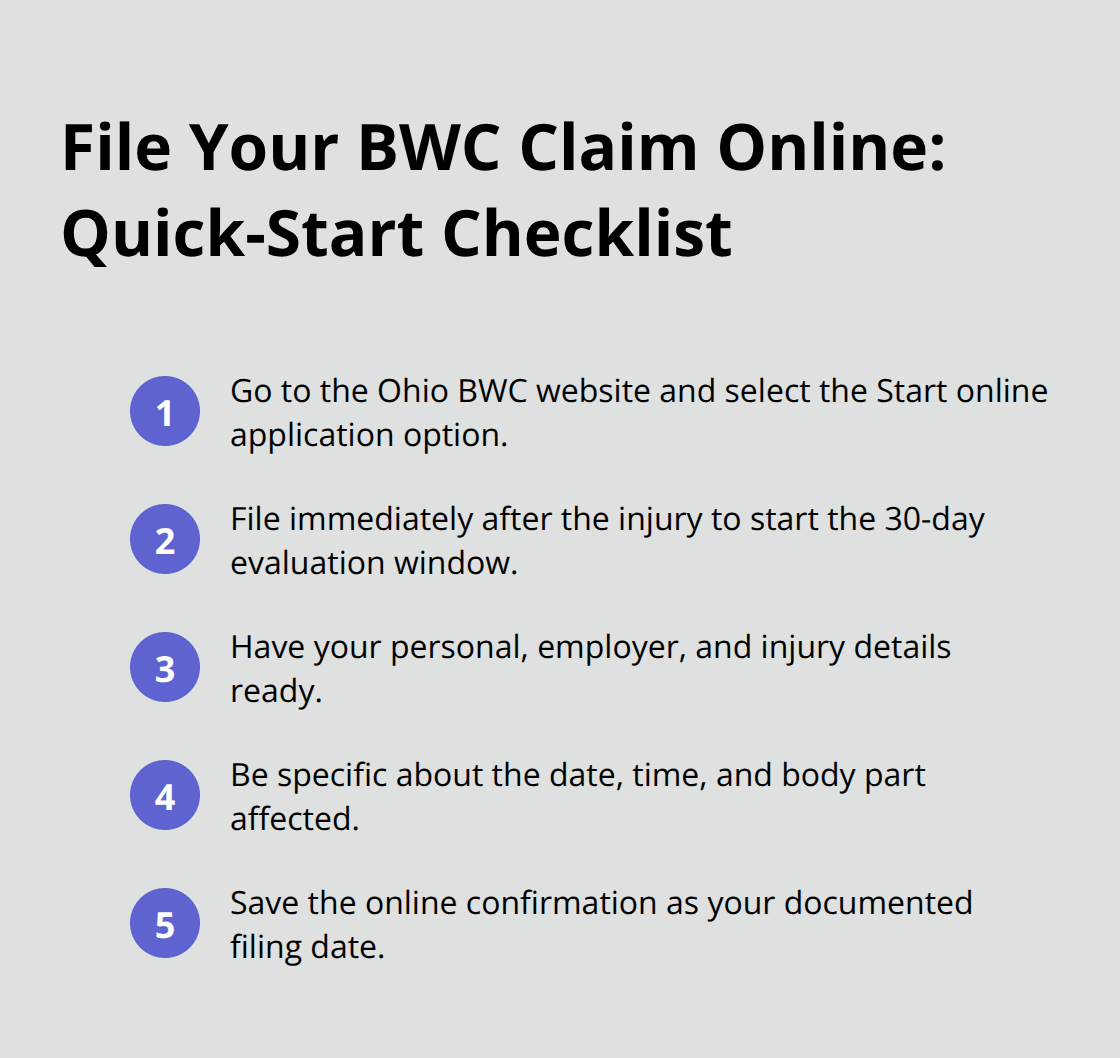
You’ll describe what happened, when it happened, and which body part was affected. Be specific about the date and time of your injury, not vague approximations. The system asks for your employer’s details, so have that information ready before you start. If you file online, you receive immediate confirmation, which gives you a documented filing date that protects your rights.
Why Speed Matters More Than You Think
Many injured workers delay filing because they hope the injury improves on its own, but waiting weakens your case. The sooner you file, the sooner the BWC begins its evaluation, and the sooner you can access medical benefits if your claim is accepted. The agency doesn’t extend timelines for workers who file late, and delays create documentation gaps that lead to denials.
Gather Medical Evidence That Proves Your Case
Documentation determines whether the BWC accepts or denies your claim, and most denials stem from incomplete medical records rather than ineligible injuries. You need medical evidence proving three specific things: that you were an employee at the time of injury, that the injury occurred during work, and that the injury caused your diagnosed condition.
Obtain written reports from your treating physician that explicitly connect your workplace injury to your current diagnosis and treatment plan. If you visited an emergency room, request those records immediately because the BWC specifically asks for ER documentation during its evaluation. Don’t assume your doctor will automatically send records to the BWC; contact the medical office yourself and request they send everything directly to the agency at 30 W. Spring St., Columbus, OH 43215-2256.
Prove Your Employment Status
Gather documentation proving your employment status, such as pay stubs, tax forms, or an employment contract, because independent contractor classification is a frequent denial reason. Keep copies of everything you submit because you’ll need this evidence if you appeal a denial. The single biggest mistake injured workers make is submitting incomplete applications and hoping the BWC requests missing documents.
The agency doesn’t work that way. It reviews what you provide within 30 days and denies the claim if critical information is missing. If you’re uncertain whether your records are sufficient, consult with an attorney before filing rather than after receiving a denial. An experienced workers’ compensation attorney can identify weaknesses in your documentation and help you strengthen your application before the BWC makes its decision.
What Happens When the BWC Denies Your Claim
The BWC denies valid claims regularly, and the reasons often have nothing to do with whether your injury actually happened at work. Common denial triggers include incomplete medical documentation, unclear employment status, or missing evidence linking your injury to your diagnosis. The agency has 30 days to make its decision, and if critical documents are absent, the BWC denies rather than requests additional records. This harsh reality means the burden falls entirely on you to prove your case during that initial 30-day window. If documentation gaps exist, the claim gets rejected. Many injured workers receive denials for reasons they could have fixed before filing if they’d sought guidance from an experienced workers’ compensation attorney beforehand. The difference between an accepted claim and a denial often comes down to how thoroughly you prepared your submission, not whether you actually deserve benefits.
The 14-Day Appeal Window Is Non-Negotiable
Once the BWC denies your claim, you have exactly 14 days from the denial letter date to appeal to the Industrial Commission of Ohio. This deadline is absolute. Missing it means you lose all eligibility for lost wages, medical expenses, and any other benefits, regardless of whether your injury was legitimate. Many injured workers don’t realize this deadline exists until it has passed. The appeal must be filed within those 14 days, or your right to challenge the decision vanishes permanently.
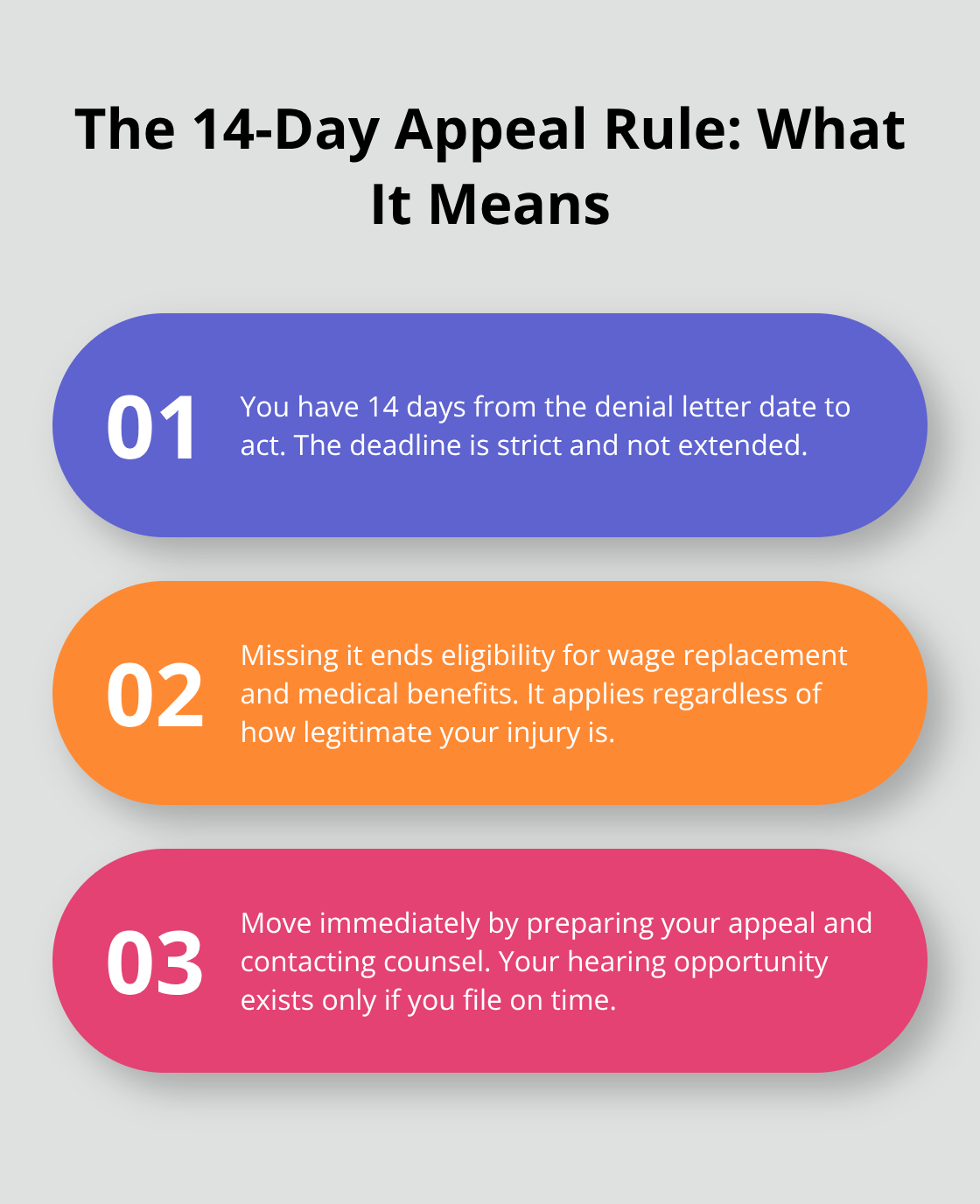
This is why immediate action matters more than taking time to consider your options. If you receive a denial letter, contact an attorney the same day rather than waiting a week. Countless valid claims become unrecoverable because workers miss the appeal deadline while trying to navigate the process alone. The Industrial Commission hearing is your opportunity to present evidence and challenge the BWC’s decision, but only if you file your appeal on time.
Building Your Case for the Industrial Commission Hearing
At the Industrial Commission hearing, you must prove three specific elements: that you were an employee (not an independent contractor), that your injury occurred within the scope of employment, and that the injury caused your diagnosed condition. The burden of proof rests with you, not the BWC. You’ll need objective medical evidence, employment documentation, and testimony about what happened. Treating physicians’ written reports are critical because the hearing officer weighs medical evidence heavily. Gather any photographs of the accident scene, witness statements, safety records, or other documentation that supports your version of events. If your employment status was questioned, prepare tax forms, pay stubs, and employment contracts proving you were an employee. The hearing process is formal, and presenting disorganized evidence or incomplete documentation leads to the same outcome as the initial denial.
Why Legal Representation Matters
Experienced workers’ compensation attorneys know exactly what evidence the Industrial Commission requires and how to present it effectively. They handle procedural requirements that injured workers typically miss, such as proper evidence submission deadlines and hearing preparation timelines. An attorney can identify weaknesses in your case before the hearing and strengthen your presentation. They also manage communication with the Industrial Commission and ensure all documents reach the right office on time. Workers who represent themselves often fail to meet technical requirements that result in dismissal, even when their underlying claim has merit.
Final Thoughts
A Northeast Ohio BWC claim requires speed, documentation, and persistence to succeed. The process hinges on three elements the agency evaluates: your employment status, whether your injury occurred at work, and whether medical evidence connects your injury to your diagnosis. Filing immediately through the online portal protects your rights and starts the 30-day evaluation clock, while gathering complete medical records and employment documentation before submission strengthens your position significantly.
If the BWC denies your claim, the 14-day appeal deadline is absolute and missing it eliminates your access to benefits permanently. Contact an attorney immediately upon receiving a denial letter, as the Industrial Commission hearing gives you a formal opportunity to present evidence and challenge the agency’s decision (but only if you file your appeal on time). The Ohio Industrial Commission Ombuds Office provides impartial assistance, the BWC’s Help Center answers common questions, and nearby service offices offer face-to-face support when you need it.
Injured workers in Northeast Ohio don’t have to navigate this system alone. Robin J Peterson Company, LLC represents individuals throughout the Cleveland, Akron, and Canton areas who have been injured on the job and specializes in workers’ compensation law to help clients fight for the benefits they deserve. Experienced legal representation often makes the difference between a denied claim and recovered benefits, so take action today by filing your claim or consulting with an attorney about a denial you’ve already received.