
The Industrial Commission of Ohio rejected your claim, and you’re wondering what comes next. An Industrial Commission appeal in Ohio is your opportunity to challenge that decision and present new evidence or correct errors from the original hearing.
At Robin J Peterson Company, LLC, we’ve guided workers through this process countless times. This guide walks you through each step, from filing requirements to preparing for your appeal hearing.
What the Industrial Commission Actually Does
The Ohio Industrial Commission resolves disputes over workers’ compensation claims that the Bureau of Workers’ Compensation initially denied or reduced. This is not a courtroom-it’s an administrative body designed to review whether the BWC made the right call. According to Ohio Revised Code, the IC operates under legislative authority to evaluate the merits of contested claims. When you file an appeal, a hearing officer reviews the case to determine if the BWC’s original decision was supported by evidence and law.
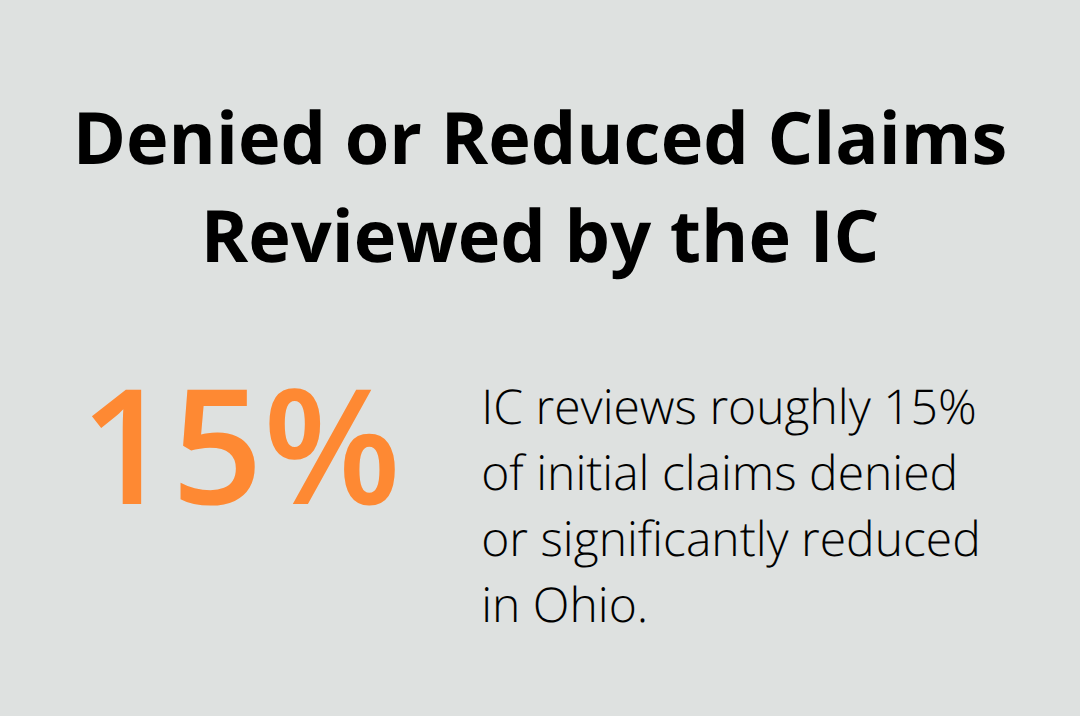
The IC handles roughly 15% of initial Ohio workers’ compensation claims that are denied or significantly reduced, according to BWC data. This means thousands of workers challenge decisions annually. Your appeal gives you a formal opportunity to present medical evidence, challenge factual errors, and argue why the denial was wrong.
The hearing takes place at an IC office, typically the one closest to your home, and the process remains intentionally less formal than court proceedings.
Why the BWC Gets Decisions Wrong
The BWC denies claims for specific reasons, and most appeals succeed because those reasons are flawed or incomplete. Common grounds for denial include disputes over the injury date, which body parts qualify for compensation, and eligibility for ongoing medical treatment.
The BWC often makes decisions based on insufficient medical documentation. Your treating physician’s opinion supporting your claim simply wasn’t part of the file when they reviewed it. Misinterpretation of medical evidence happens frequently-the BWC reads a doctor’s report differently than the physician intended or ignores a clear diagnosis.
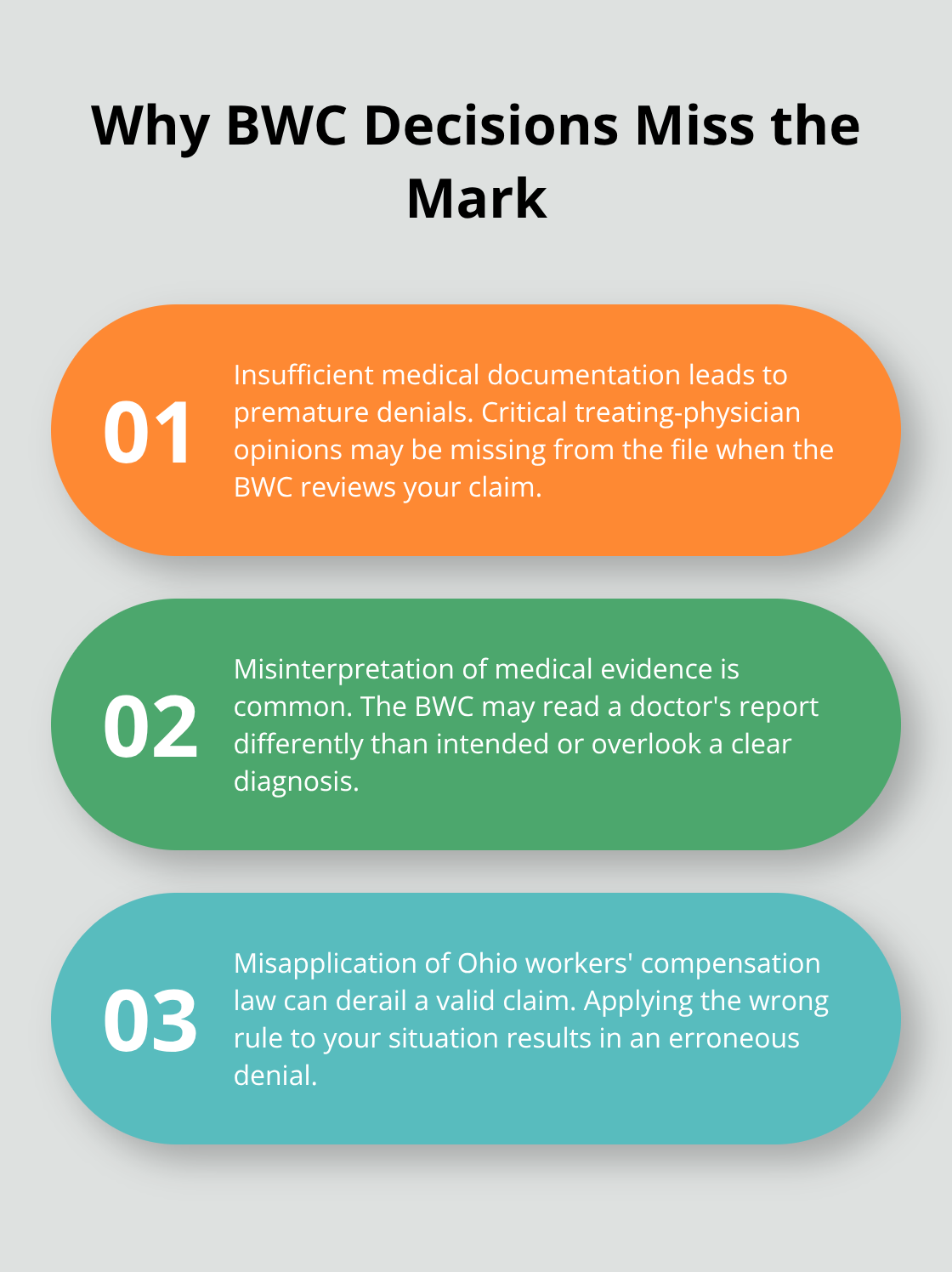
Another frequent error involves misapplication of Ohio workers’ compensation law itself, where the BWC misunderstands which rules apply to your situation.
New medical documentation can also prompt re-evaluation, especially if your condition worsened or if you obtained a specialist’s opinion after the initial denial. The critical point is this: winning an appeal requires identifying concrete errors in the BWC’s reasoning with specific evidence, not broad complaints about unfairness.
What You Must Prove on Appeal
You must show exactly what the BWC missed or misunderstood and provide documentation that proves your position. Medical evidence forms the backbone of successful appeals. The Commission prioritizes treating-physician opinions and doctors who examined you over other sources.
If the initial denial was due to insufficient medical evidence, submit additional reports that specifically address the denial reasons and support your qualification. Organize medical records chronologically with clear labels and highlight passages that support your position. This helps the hearing officer navigate your case quickly.
The 14-Day Deadline That Controls Everything
The 14-day deadline to appeal after receiving the BWC’s decision is absolute. The clock starts when you receive the notice, and you are responsible for meeting this deadline regardless of whether you have an attorney. File early to avoid mail delays or processing errors, since you control the timeline. With this deadline in mind, the next step involves understanding exactly how to file your appeal and what forms the Industrial Commission requires.
How to File Your Appeal and Prepare for the Hearing
Filing Your IC-12 Notice of Appeal
You must submit Form IC-12, the Notice of Appeal, within 14 days of receiving the BWC’s decision. File online through ICON (the Industrial Commission Online Network) or submit the form in person at your local IC office. The form requires your claim number, the specific BWC decision you’re challenging, and a brief statement explaining why the decision was wrong. No filing fee applies. The most common mistake workers make is waiting until the last moment. Even with an attorney representing you, you bear responsibility for meeting the deadline. File at least five business days before the deadline to account for mail delays or processing errors.
Understanding Your Hearing Notice
Once you file, the IC schedules your hearing at the office closest to your home. You’ll receive a hearing notice by mail at least 14 days before the scheduled date. This notice specifies the exact date, time, location, and the issues the hearing officer will address. Only issues listed on that notice can be considered during your hearing, so review it carefully. Contact the IC immediately if anything is missing or incorrect-particularly if your representative’s name doesn’t appear on the notice.
What to Bring and How to Prepare
Arrive 10 to 15 minutes early and bring your hearing notice to show at reception. Bring original medical records, medical reports, imaging results, all correspondence with the BWC, employment history documents, and wage information. Organize your medical records chronologically with clear labels and highlight passages supporting your position.
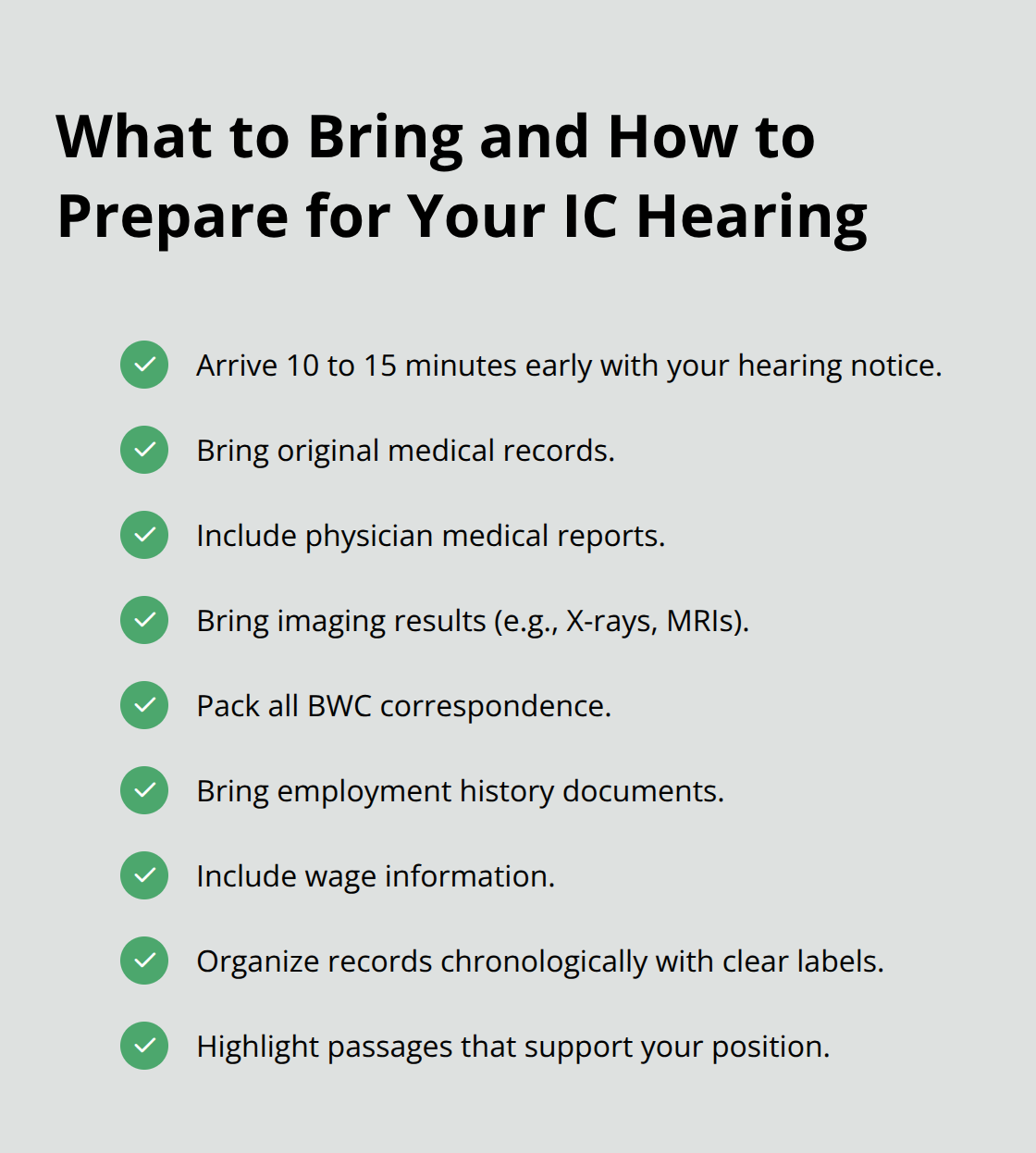
This helps the hearing officer navigate your case quickly.
If your original denial stemmed from insufficient medical evidence, submit additional reports that specifically address the reasons for denial. New medical evidence not available at the time of the original decision carries particular weight if you explain its relevance and how it contradicts the denial. Anticipate how the BWC will challenge your evidence and prepare counterarguments beforehand.
Presenting Your Case at the Hearing
Your hearing typically lasts between 30 minutes and two hours depending on case complexity. The hearing officer, who is an impartial IC attorney trained in workers’ compensation law, will review your evidence and the BWC’s reasoning. Present your case in a clear, logical narrative because hearing officers review hundreds of cases monthly. The hearing remains informal but guided by legal professionals who understand Ohio workers’ compensation law.
After the hearing, the officer issues a written decision by mail to all parties. Self-representation carries significantly higher risk of losing compared to having experienced legal representation, which helps organize evidence, anticipate counterarguments, and present a compelling narrative. Understanding what happens after the hearing decision-and whether you need to file another appeal-depends on the outcome and the specific issues involved in your case.
Building Your Appeal Case
Medical Evidence That Wins Appeals
Medical evidence determines whether you win or lose your appeal, and this is where most workers either succeed or fail. The hearing officer needs treating-physician opinions that directly address why the BWC’s denial was wrong. If your original denial cited insufficient medical documentation, obtain a written report from your treating physician that explains your diagnosis, confirms the injury is work-related, and details why ongoing treatment is necessary. This report must specifically reference the BWC’s denial reasons and explain how the physician’s examination or records contradict them.
New medical evidence carries significant weight when you explain its relevance to the case. If your condition worsened after the initial denial and you obtained specialist imaging or a second opinion, that documentation proves the BWC underestimated your injury’s severity. Organize all medical records chronologically with clear labels and highlight specific passages that support your position. The hearing officer reviews hundreds of cases annually, so a straightforward, well-organized medical narrative saves time and increases the likelihood they understand your argument quickly.
Preparing Your Medical Narrative
Anticipate exactly how the BWC will challenge your evidence and prepare counterarguments before the hearing. If the BWC claims your symptoms are unrelated to work, have your physician’s statement ready that establishes the causal connection. If they argue your injury classification is wrong, bring documentation showing the correct classification under Ohio law. This preparation transforms your medical evidence from a collection of documents into a coherent story that the hearing officer can follow.
Correcting Factual Errors in the Original Decision
Factual errors in the original decision often stem from incomplete information rather than deliberate mistakes, and correcting them requires specificity. The BWC may have misread your employment history, miscalculated your average weekly wage, or misunderstood which body parts qualify for compensation under your injury classification. Bring original employment records, wage statements, and any prior correspondence with the BWC that shows what information was actually available at the time of the decision. The difference between winning and losing often comes down to how clearly you establish that the BWC missed or misinterpreted specific facts, not whether you feel the decision was unfair generally.
The Advantage of Legal Representation
Self-representation significantly increases your risk of losing because you must identify concrete legal errors and present them effectively under pressure. Experienced representation helps organize evidence logically, anticipate the BWC’s counterarguments, and present a compelling narrative that the hearing officer can follow. Representation matters most when your case involves complex medical issues or disputed wage calculations (areas where hearing officers frequently see errors). Workers represented by attorneys succeed at substantially higher rates than those who represent themselves, according to IC data on appeal outcomes.
Final Thoughts
File your IC-12 form within 14 days, organize medical evidence that directly addresses the BWC’s denial reasons, and present your case with clear organization and specificity. The 14-day deadline is absolute and non-negotiable, so filing early protects you from mail delays or administrative errors. Your success in an Industrial Commission appeal Ohio hinges on identifying concrete errors in the original decision and supporting those errors with documentation that the hearing officer can quickly understand.
Medical evidence forms the foundation of your appeal, but only when it specifically contradicts the BWC’s reasoning. Organize your records chronologically, highlight supporting passages, and anticipate how the BWC will challenge your position. Arrive early to your hearing, bring all required documents, and present your argument in a straightforward narrative that respects the hearing officer’s time.
We at Robin J Peterson Company, LLC represent injured workers throughout Ohio’s workers’ compensation system, helping clients challenge BWC decisions and secure the benefits they deserve. An experienced attorney organizes your evidence effectively, identifies legal errors the BWC made, and presents your case compellingly before the hearing officer. The investment in representation typically pays for itself through successful appeals that restore denied benefits.