
A work injury in Cleveland can feel overwhelming, especially when you’re navigating the Ohio Bureau of Workers’ Compensation system for the first time. We at Robin J Peterson Company, LLC understand that getting Cleveland BWC claim help requires knowing exactly what steps to take and what to expect.
This guide walks you through the entire process-from filing your initial claim to handling denials and appeals. You’ll also learn when local legal support makes the difference in protecting your rights.
How the Ohio BWC Claims Process Actually Works
Filing Your Initial Claim with the Bureau of Workers’ Compensation
Filing a claim with the Ohio Bureau of Workers’ Compensation is straightforward, but timing matters more than most injured workers realize. You must report your injury to your employer within 24 hours, and your employer has seven days to submit the First Report of Injury to the BWC. If your employer drags their feet, file it yourself immediately through the BWC online portal. The BWC then has 28 days to investigate and decide whether your claim qualifies for coverage. This investigation phase is critical because the agency examines whether your injury happened during work duties and whether you sought medical treatment.
Provide complete documentation from day one: medical records, witness statements, photos of the injury site, and a detailed account of exactly what happened. Vague or incomplete reports slow decisions and give the BWC room to deny your claim. Once the BWC makes its determination, you’ll receive a letter stating whether your claim is allowed or denied. An allowed claim means you qualify for medical benefits, wage replacement, and other compensation. A denied claim means the BWC found your injury doesn’t meet coverage requirements under Ohio’s no-fault system.
Understanding Why the BWC Denies Claims
Denials occur for specific reasons, and understanding them helps you fight back effectively. The most common reason is failure to report the injury within the required timeframe, though Ohio’s rules offer some flexibility if you have a legitimate reason for delay. The second major reason involves disputes over whether the injury truly occurred at work, which happens when the evidence doesn’t clearly connect your injury to job duties. The third reason involves pre-existing conditions, where the BWC claims your condition existed before the workplace incident.
This is where most injured workers lose their cases because they haven’t gathered enough evidence linking the workplace event to their current symptoms. You must prove a causal connection between what happened at work and your medical diagnosis. The burden falls on you to show that the workplace incident triggered or aggravated your condition.
Fighting Back: The Appeal Process
If the BWC denies your claim, you have 14 days to request a hearing before the Ohio Industrial Commission. This hearing is your formal appeal opportunity, and you can present evidence, medical testimony, and witness statements to challenge the denial. Many injured workers make the mistake of accepting a denial without fighting it.
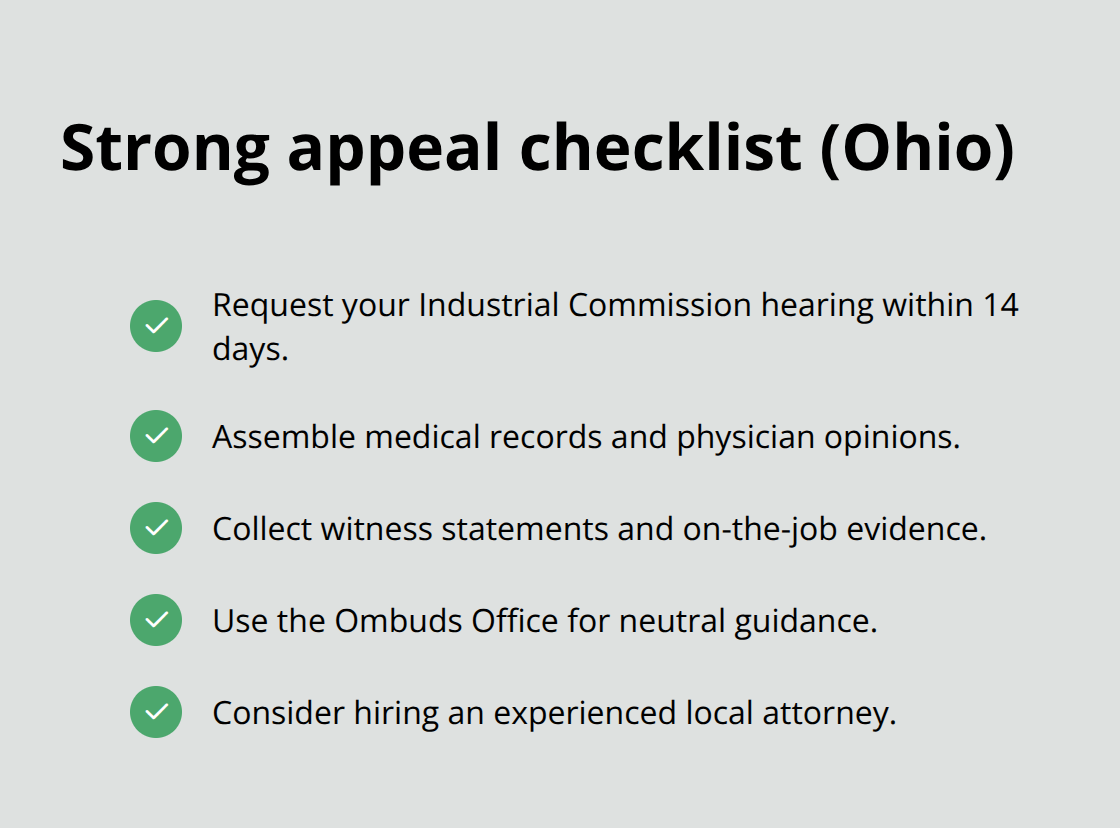
The Ohio Industrial Commission Ombuds Office offers free, neutral assistance to help you navigate appeals, and their guidance has helped countless Cleveland workers overturn initial denials.
Having legal representation during an appeal substantially increases your chances of success because an experienced attorney knows exactly which evidence the commission needs to see and how to present it persuasively. This is where the complexity of Ohio’s workers’ compensation system becomes apparent, and local legal support makes a measurable difference in outcomes.
Why the BWC Denies Claims and How to Prevent It
Report Your Injury on Time or Face Automatic Denial
The Ohio Bureau of Workers’ Compensation rejects thousands of claims annually, and most denials stem from preventable mistakes made immediately after injury. Timing kills legitimate claims faster than any other factor. Ohio law requires you to report your injury to your employer within 24 hours, and your employer must file the First Report of Injury with the BWC within seven days. Missing these deadlines gives the BWC grounds to deny your claim outright, even if your injury is legitimate. The agency interprets these timing requirements strictly because delayed reporting raises red flags about claim authenticity. If you report an injury weeks or months after it happens, the BWC questions whether the injury actually occurred at work or whether you fabricated a claim. Tell your supervisor the moment you’re injured and document the conversation in writing. File the claim yourself through the BWC online portal if your employer hesitates. Don’t wait for your employer to handle it.
Prove Your Injury Happened at Work with Solid Evidence
Disputes over whether your injury occurred at work represent the second major denial category, and weak evidence destroys otherwise valid claims. The BWC needs clear proof that your injury happened during job duties, not before you arrived or after you left work. If you suffered a back injury while lifting boxes, provide the weight specifications of those boxes, photos of the lifting conditions, and witness statements from coworkers who saw the incident. Include your medical records showing the exact timing of symptom onset. Vague descriptions like “I felt pain while working” guarantee denial. The agency receives hundreds of claims monthly and investigates only what evidence you provide. A detailed written account of the injury-including the exact time, location, equipment involved, and physical movements that caused the injury-makes the difference between approval and rejection. Many injured workers assume the BWC will figure it out, but the agency operates on the principle that undocumented events didn’t happen.
Connect Pre-Existing Conditions to Your Workplace Injury
The third major denial reason involves pre-existing conditions, where the BWC claims your medical problem existed before the workplace incident. Ohio’s system places the burden on you to prove causation. If you had a knee problem five years ago and your knee worsened after a fall at work, the BWC may argue your current condition stems from the old injury, not the new one. Medical records showing the prior condition actually work against you unless you have evidence proving the workplace incident aggravated it. Request detailed medical documentation from your treating physician explaining exactly how the workplace event worsened your condition. Medical imaging before and after the injury, comparative strength testing, or functional capacity evaluations that show deterioration help establish causation. Many injured workers skip this step and lose their appeals because judges cannot award benefits without proof that work caused or substantially worsened the injury. The Ohio Industrial Commission Ombuds Office can guide you through gathering the right medical evidence, but you must be proactive in requesting these specific comparisons from your healthcare providers.
Know When to Bring in Legal Expertise
Navigating these denial reasons alone puts you at a disadvantage, especially when the BWC challenges your evidence or questions your medical causation. An experienced workers’ compensation attorney knows exactly which documentation the Ohio Industrial Commission needs to see and how to present it persuasively. At Robin J Peterson Company, LLC, we represent injured workers throughout the Cleveland area who face claim denials and need to fight back through the appeals process. The complexity of Ohio’s workers’ compensation system becomes apparent when you’re challenging a denial, and local legal support makes a measurable difference in outcomes.
When You Need a Workers’ Compensation Attorney in Cleveland
How Legal Representation Strengthens Your Appeal
An attorney transforms your appeal from a paperwork exercise into a strategic fight backed by legal expertise. The Ohio Industrial Commission receives thousands of appeals annually, and injured workers who arrive without representation lose far more often than those with legal counsel. An experienced workers’ compensation attorney knows the specific evidence the commission needs to overturn a denial, understands how to challenge the BWC’s medical interpretations, and can cross-examine the agency’s witnesses effectively. The difference between winning and losing your appeal often comes down to how your evidence is presented and which legal arguments resonate with the administrative judge.
Why Ohio-Specific Knowledge Matters
Local representation matters because Ohio’s workers’ compensation system operates with specific rules, timelines, and procedural requirements that differ from other states and from general legal practice. The Ohio Industrial Commission follows particular standards for evaluating causation in pre-existing condition cases, specific protocols for medical evidence submission, and established practices for witness testimony that an out-of-state or generalist attorney might miss entirely. A Cleveland-based firm familiar with the local BWC service offices, the preferences of specific administrative judges, and the patterns in how the Industrial Commission rules on similar cases brings tactical advantages to your appeal.
What Local Expertise Delivers
Deep knowledge of Ohio’s workers’ compensation system translates directly into stronger appeals, better-prepared medical testimony, and more persuasive legal arguments that address the commission’s actual concerns rather than generic workers’ compensation principles. An attorney with years of experience in the Cleveland area understands how individual decision-makers evaluate evidence and which documentation carries the most weight in specific types of cases. This familiarity with local patterns and preferences shapes case strategy from the beginning, allowing your attorney to anticipate the BWC’s arguments and counter them effectively before the Industrial Commission even hears your appeal.
The Stakes of Inadequate Representation
When your claim has been denied and the stakes involve your ability to pay medical bills and replace lost wages, the difference between competent representation and deep local expertise becomes the difference between receiving your benefits and walking away empty-handed. An attorney who understands Ohio’s system knows which medical experts will testify most persuasively, how to structure witness testimony for maximum impact, and which procedural moves strengthen your position at the Industrial Commission. The complexity of Ohio’s workers’ compensation system becomes apparent when you’re challenging a denial, and local legal support makes a measurable difference in outcomes.
Final Thoughts
Filing a claim with the Ohio Bureau of Workers’ Compensation demands precision from the moment you’re injured. Report your injury to your employer within 24 hours, gather detailed documentation immediately, and file your claim through the BWC online portal if your employer delays. Missing these steps guarantees denial, regardless of how legitimate your injury is.
Understanding Ohio’s appeals process matters because denials aren’t final. You have 14 days to request a hearing before the Ohio Industrial Commission, and this hearing gives you the opportunity to present evidence, medical testimony, and witness statements that challenge the BWC’s decision. The Ohio Industrial Commission Ombuds Office provides free assistance, but many injured workers benefit from having an attorney guide them through the appeal (especially when pre-existing conditions complicate causation).
Cleveland BWC claim help becomes essential when the stakes involve your medical bills and lost wages. Contact Robin J Peterson Company, LLC for a complimentary case evaluation if your claim has been denied or you’re uncertain whether you’ve filed correctly. Don’t accept a denial without fighting back.