
Additional conditions in an Ohio workers’ comp claim can make the difference between getting the treatment you actually need and fighting the system every step of the way. Many injured workers assume that once their claim is approved, everything connected to the injury is covered. In reality, an Ohio claim is allowed for specific medical conditions, and when a doctor later finds a new diagnosis, that condition usually has to be formally added before the claim fully recognizes it. Understanding how that process works gives you real control over your recovery and your benefits.
At Robin J Peterson Company, LLC, we help injured workers across Ohio understand how their claims are built and how to protect them as their medical picture changes, so you can move forward with confidence. This guide explains what an additional allowance actually is, how to request one with the Bureau of Workers’ Compensation, what the evidence needs to show, and the mistakes that most often derail a request.
What an Additional Allowance Actually Means in an Ohio Claim
When the Bureau of Workers’ Compensation (BWC) or a self-insuring employer allows a claim, the decision lists the conditions that are recognized as part of that claim. Those allowed conditions are the foundation of everything that follows. Treatment requests, compensation for time off work, and later decisions about your claim are all measured against the conditions that have been formally allowed. If a diagnosis is not on that list, the claim may not recognize it, even when your doctor believes it came from the same workplace accident.
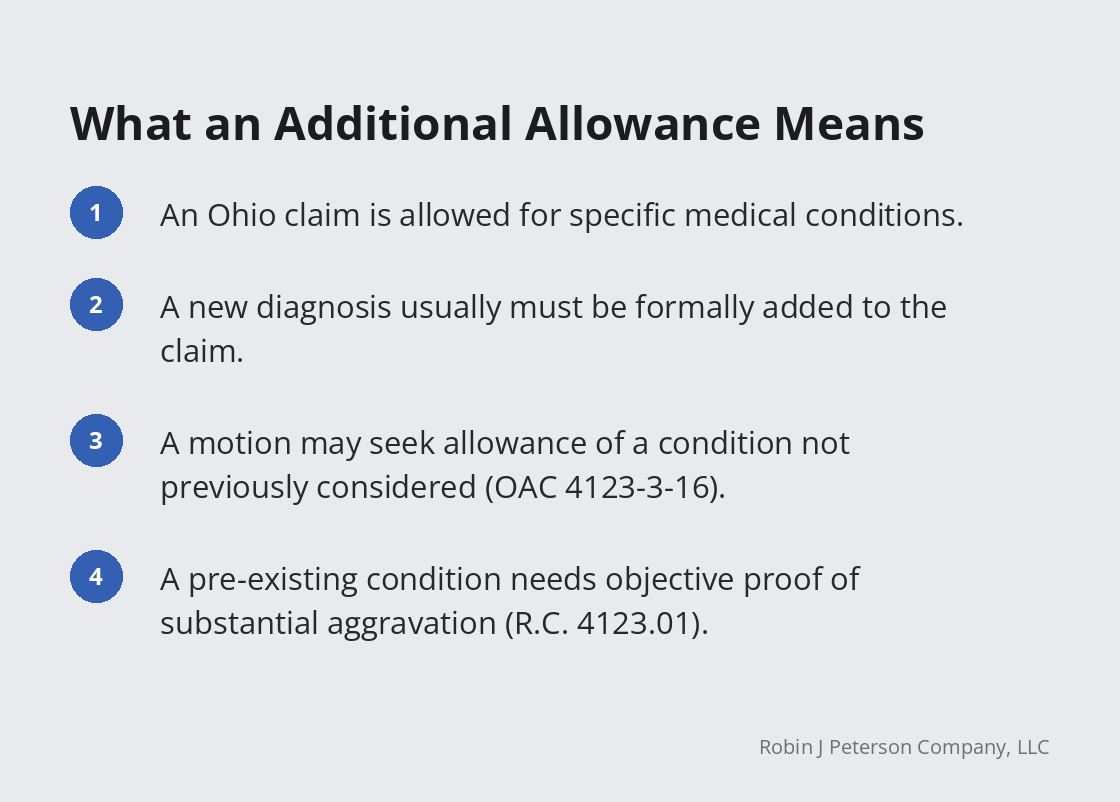
An additional allowance is the process of asking the BWC or the Industrial Commission of Ohio to recognize a condition that was not included when the claim was first decided. Ohio Administrative Code 4123-3-16 provides that it is appropriate to file a motion to secure allowance of a disability or condition not previously considered in a claim. The BWC’s own claims policy describes its goal as allowing an additional condition only after an investigation confirms that the condition is supported by medical evidence and is causally related to the original injury.
Why the Allowed Conditions Matter So Much
Think of the allowed conditions as the official description of your injury. A claim allowed only for a strain of the lower back describes a much smaller injury than one allowed for a herniated disc at a specific level of the spine. When your records and your allowed conditions do not match, treatment can be questioned, requests can be delayed, and decisions about your ability to work can be made on an incomplete picture. Keeping the list accurate protects you from having to argue about the basics every time a new issue comes up.
How a Simple Diagnosis Can Turn Into Something Bigger
It is common for the first diagnosis after a workplace accident to be fairly general. An emergency room or urgent care visit may result in a diagnosis of a sprain or contusion because no imaging beyond an X-ray has been done yet. Weeks or months later, continued pain may lead your doctor to order an MRI or another test that reveals a more specific problem, such as a torn ligament or a disc injury. When that happens, the new diagnosis does not automatically become part of the claim. It has to be requested and decided.
Pre-Existing Conditions and Substantial Aggravation
Some injured workers had a condition before the accident that the work injury made worse. Under Ohio Revised Code 4123.01(C)(5), a pre-existing condition is not covered as an injury unless it is substantially aggravated by the injury, and that substantial aggravation must be documented by objective diagnostic findings, objective clinical findings, or objective test results. The statute also says subjective complaints alone are not enough. The BWC’s motion form instructions make the same point for injuries on or after August 25, 2006, so the medical evidence for this type of request needs to be specific and well documented.
How to Request an Additional Condition With the BWC
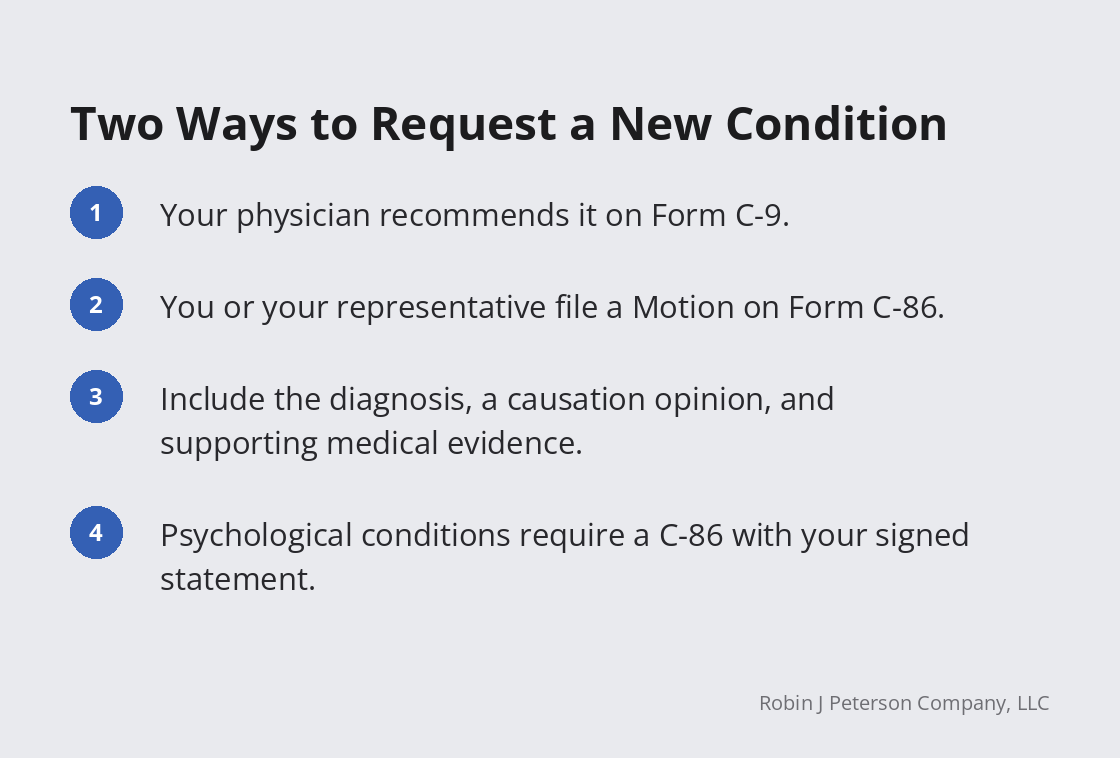
Ohio gives injured workers and their doctors two main routes for asking that a new condition be added to a claim. According to BWC claims policy, an additional allowance may be recommended by a provider on the Request for Medical Service Reimbursement or Recommendation for Additional Conditions (Form C-9), or requested by the injured worker or the worker’s representative on a Motion (Form C-86). Which route makes sense depends on the condition, the evidence, and whether there is likely to be a dispute.
The Physician’s Recommendation on a C-9
Your treating physician can recommend that a condition be added to your claim by completing the additional conditions section of a C-9. For state-fund claims, the C-9 goes to your managed care organization. BWC policy directs the managed care organization to review the recommendation within three business days to confirm that it includes a clear narrative description of each recommended condition, evidence supporting the condition, and a physician’s statement on causation. If something is missing, the managed care organization contacts the physician, and the claims staff then works through the recommendation before a decision is made.
Filing a Motion on Form C-86
The Motion (C-86) is the form an injured worker or representative uses to ask the BWC or the Industrial Commission to take action on a claim, including allowing an additional condition. Ohio Administrative Code 4123-3-16 requires a motion to state the question presented and the relief sought, to be accompanied by competent proof, to be signed by the applicant or the applicant’s authorized representative, and, in most situations, to be copied to the opposite party. The rule also warns that a motion cannot be used as a substitute for an appeal that was not filed on time.
What the Medical Evidence Needs to Show
BWC policy directs claims staff to confirm that a request includes a clear narrative description of each condition, including location and level when applicable, a causality statement, and specific evidence supporting each condition. In practical terms, that usually means imaging results, examination findings, or operative reports, along with a doctor’s written opinion explaining how the new condition is related to the work injury. The BWC may also seek its own review of the request through a physician file review or by requiring you to attend an independent medical examination.
Psychological Conditions Follow a Separate Path
Mental health conditions that develop after a physical work injury have their own requirements. BWC policy states that it will not address a recommendation for a psychological or psychiatric condition on a C-9. Instead, Ohio Administrative Code 4123-3-16 requires a motion that includes a statement personally signed and dated by the injured worker, along with a supporting report from a medical doctor, a doctor of osteopathic medicine, a clinical psychologist, a licensed professional clinical counselor, or a licensed independent social worker.
What Derails an Additional Allowance Request
Most denied or dismissed requests do not fail because the worker was untruthful. They fail because the paperwork did not give decision makers what the rules require. Knowing the common problems in advance helps you and your doctor build a request that holds up.
Requesting a Symptom Instead of a Diagnosis
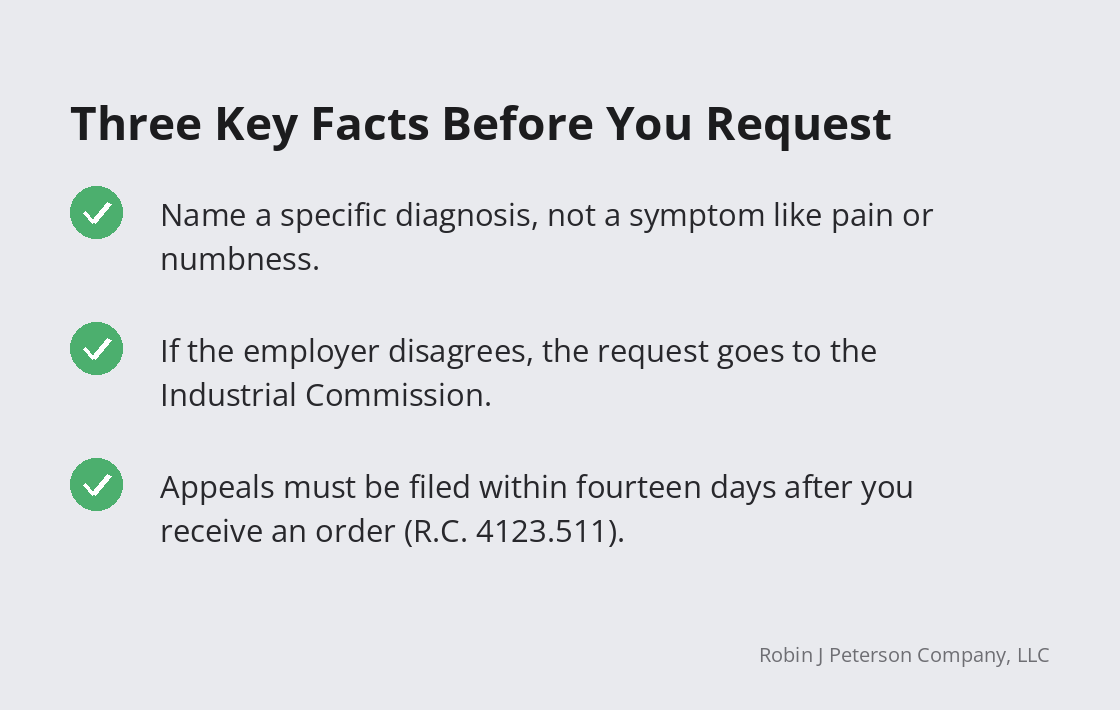
BWC policy instructs claims staff to make sure a requested condition is not a symptom. Words like pain, numbness, or stiffness describe how an injury feels, but they do not identify the underlying medical condition. When a symptom is requested, the BWC tries to clarify with the filing party what condition is causing it, and a request may be dismissed if that contact is unsuccessful. Working with your doctor to name the specific diagnosis, including the body part, side, and level when relevant, avoids this delay.
Weak or Missing Causation Opinions
A diagnosis alone does not prove that the condition came from the workplace accident. Decision makers want a physician to explain the connection. A short note saying the condition is “work related” is often not enough when the employer disputes the request. A stronger report explains the mechanism of injury, the timeline of symptoms, the test results, and why the doctor believes the accident caused or substantially aggravated the condition.
When the Employer Disagrees
Under BWC policy, when the BWC agrees with a requested condition, claims staff contact the employer, and the BWC can issue an order allowing the condition if the employer agrees or does not respond. If the employer disagrees, or if the BWC recommends denial, the request is referred to the Industrial Commission for a hearing. That means a contested request may be decided by a hearing officer who weighs the competing medical opinions, so the quality of your evidence matters.
Letting Time Run on Your Claim
Ohio claims do not stay open forever. Revised Code 4123.52 limits the ability of the Industrial Commission and the BWC to make new findings or awards in a claim after five years without medical services being rendered or compensation being paid, subject to the specific terms of the statute. Revised Code 4123.84 separately bars claims for specific parts of the body unless notice of those body parts is given within one year after the injury, or one of the other events listed in the statute occurs. Raising new conditions promptly protects your options.
Missing the Window to Appeal
If a request is denied, the clock starts quickly. Under Revised Code 4123.511, parties may appeal an order within fourteen days after receiving it, and the same fourteen-day window applies to appeals from district hearing officer and staff hearing officer orders. Because a motion cannot replace a missed appeal, reading every order as soon as it arrives and acting within that window is one of the most important habits an injured worker can build.
Final Thoughts
Adding a condition to an Ohio workers’ comp claim is often necessary as your doctors learn more about your injury. The process depends on the right form, a specific diagnosis, objective medical evidence, and a clear explanation of how the condition is connected to your work accident. Paying attention to deadlines and responding quickly to orders keeps your claim on track.
You should not have to accept a claim that describes only part of your injury. When the allowed conditions match your real medical situation, your treatment and benefits rest on a much stronger foundation.
If your doctor has found a new diagnosis connected to your work injury, contact Robin J Peterson Company, LLC to speak with our team about your Ohio workers’ comp claim. We will review your records, explain your options, and help you take the next step with confidence.