
Independent contractor status in Ohio workers’ comp is one of the most misunderstood issues for people who get hurt on the job. Many workers are told they are “1099 contractors” or “subs” and assume that means they have no right to benefits after an injury. In reality, Ohio law does not let a label or a payment form settle the question. What matters is the actual working relationship, and in construction and trucking, the Ohio Revised Code sets out its own specific tests. Understanding how those rules work gives you real control over your claim and helps you avoid giving up benefits you may be entitled to receive.
At Robin J Peterson Company, LLC, we help injured workers across Cleveland, Akron, Canton, and Independence protect their Ohio workers’ compensation rights so you can move forward with confidence. This guide explains what independent contractor status actually means under Ohio law, how the Bureau of Workers’ Compensation decides whether you are covered, and the mistakes that most often derail claims from workers who were classified as contractors.
What Independent Contractor Status Actually Means in Ohio
Ohio workers’ compensation covers employees. Section 4123.01(A)(1) of the Ohio Revised Code defines who counts as an employee, and for private employers, it includes every person in the service of a business that employs one or more persons regularly in the same business under any contract of hire, express or implied, oral or written. A true independent contractor running a separate business generally falls outside that definition, which is why the classification question can decide whether a claim moves forward at all.
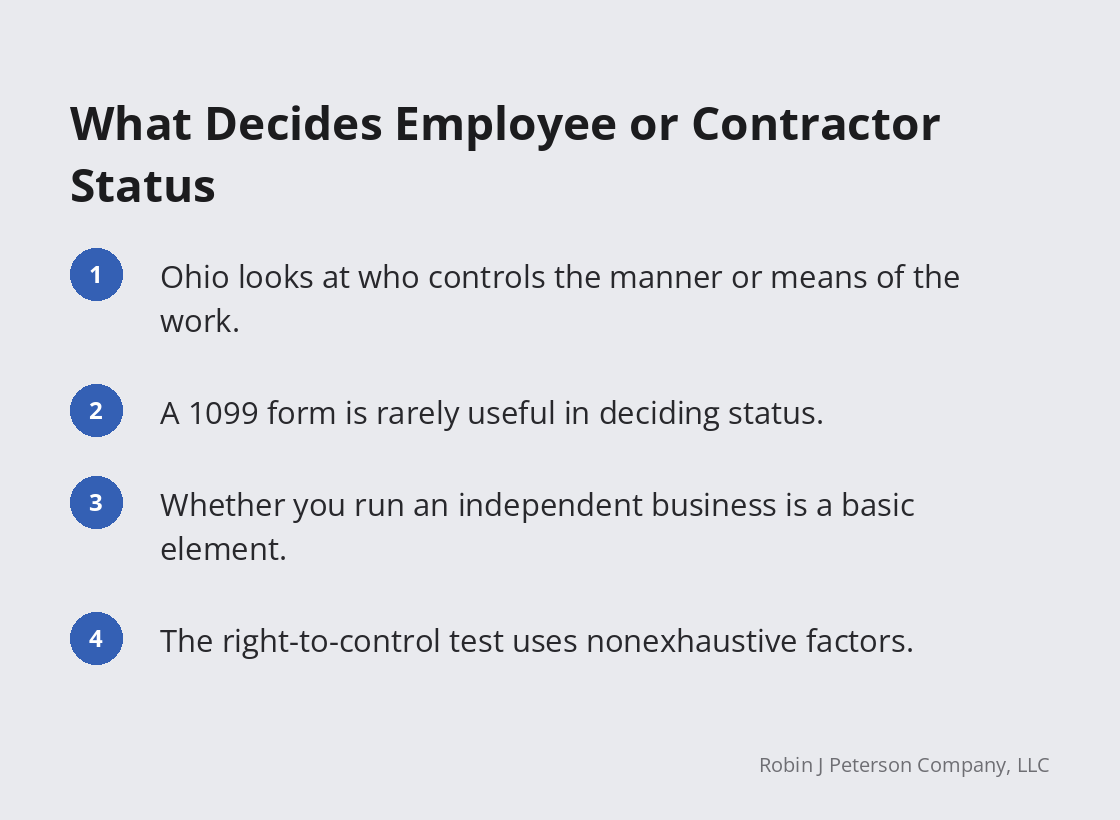
The challenge is that the line between an employee and an independent contractor is not always obvious. Ohio law looks past the paperwork to the facts of the relationship.
The Right-to-Control Test
Outside of the special construction and trucking rules, Ohio uses common-law factors to decide whether someone is an employee or an independent contractor. In State ex rel. Friendship Supported Living v. Ohio Bureau of Workers’ Compensation, 2023-Ohio-957, the Supreme Court of Ohio repeated the rule from its earlier decision in Bostic v. Connor that the key factual determination is who had the right to control the manner or means of doing the work. The Court explained that the right-to-control test is not marked by a bright-line rule, but rather a set of nonexhaustive factors. Those factors include who controls the details and quality of the work, who controls the hours worked, who selects the materials, tools, and personnel used, who selects the routes traveled, the length of employment, the type of business, the method of payment, and any pertinent agreements or contracts.
Why a 1099 or a Contract Label Is Not the Final Word
The Bureau of Workers’ Compensation’s own claims policy on coverage and employer-employee status lists receipt of an IRS Form 1099 as a factor that is rarely useful, because both properly classified independent contractors and misclassified employees may be paid that way. The same policy describes whether the injured worker is operating their own independent business or occupation as one of the basic elements of the independent contractor relationship, and it explains that if that factor is not met, other factors will generally not support independent contractor status. In other words, a worker who has no business of their own and simply works for one company under its direction may be an employee even if a written agreement calls them a contractor.
Factors BWC Treats as Most Important
The BWC policy groups the factors it weighs by usefulness. The factors it calls critically useful are the type of business, whether the worker is engaged in an independent business or occupation, and whether the work is part of the regular business of the entity paying the worker. Generally useful factors include the skills required for the occupation, the method of payment, whether the worker incurs the main expenses and provides the necessary tools, whether the worker may earn a profit or suffer a loss, and whether the worker has continuing business obligations.
How BWC Decides Whether You Are Covered
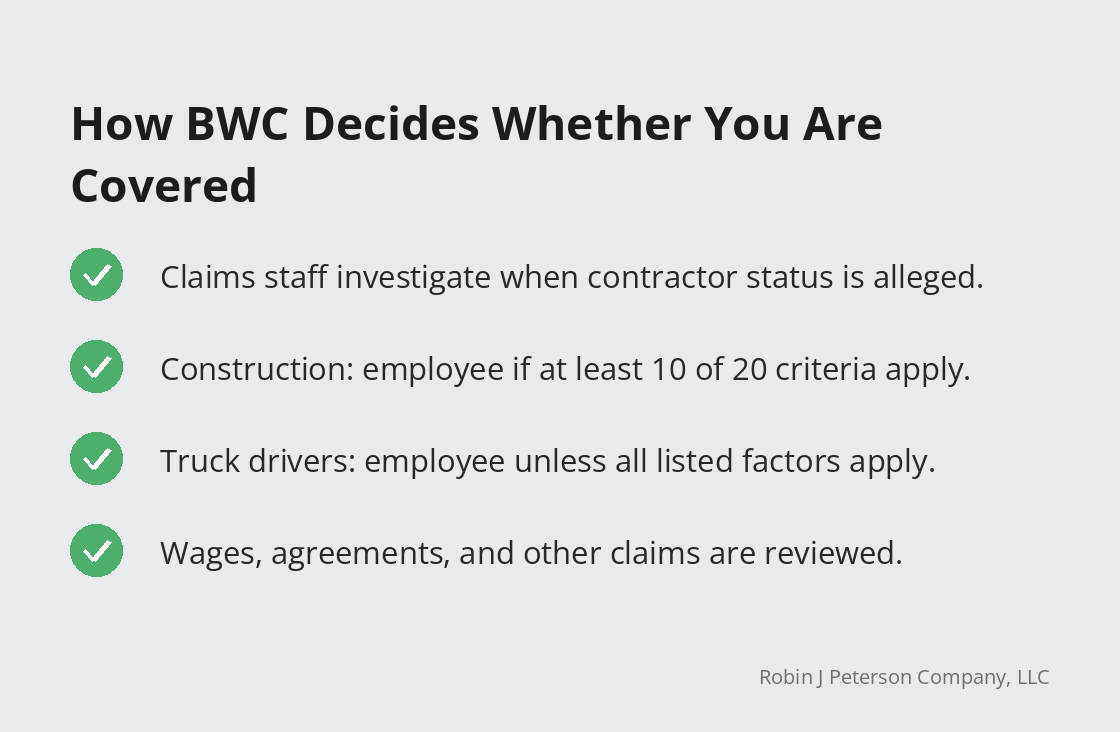
When a claim raises the question of independent contractor status, the Bureau does not simply accept the employer’s description. Its policy requires claims staff to complete a thorough investigation to determine the appropriate employer-employee relationship, and the specific rules that apply depend on the type of work you were doing when you were hurt.
The Claim Investigation and Questionnaire
According to the BWC coverage policy, if there is an allegation that the injured worker is an independent contractor, claims staff must obtain answers to the questions on the Bureau’s Independent Contractor Questionnaire, first by trying to reach the worker and the alleged employer by phone and then by mail or email if needed. Staff must also review documentation of the worker’s wages, request any written agreement between the worker and the alleged employer, review other claims against the same employer, and seek any other information that may help clarify the worker’s status. Accurate answers backed by records such as schedules and messages can make a significant difference.
Special Rules for Construction Workers
Construction work has its own test. Under Section 4123.01(A)(1)(c), a person who performs labor or provides services under a construction contract is an employee if at least ten of twenty listed criteria apply. Those criteria include whether the person must follow instructions about the manner or method of the work, whether the person’s hours are set by the other party, whether the person must perform the work personally, whether tools and materials are furnished by the other party, whether the person is paid on a regular basis such as hourly, weekly, or monthly, whether the person makes the same services available to the general public, and whether the other party has the right to discharge the person. Section 4123.79 defines a construction contract broadly as any oral or written agreement involving the erection, alteration, repair, replacement, renovation, installation, or demolition of any building, structure, highway, or bridge.
Special Rules for Truck Drivers
Drivers who haul property for motor carriers face a different statutory test. Section 4123.01(A)(1)(d) treats a person who operates a vehicle or vessel for or on behalf of a motor carrier transporting property as an employee unless all of the listed factors apply. Those factors include owning the vehicle or leasing it under a bona fide lease, substantially controlling the means and manner of performing the services, having a written contract with the carrier describing the relationship as independent contractor, and being responsible for any economic loss or gain from the arrangement. Because every factor must be present to avoid employee status, many drivers who are called owner-operators may still qualify for coverage. Our guide to trucking industry injury rights in Ohio covers other issues drivers often face.
What Derails Claims From Workers Labeled as Contractors
Workers who have been classified as contractors face extra hurdles, and small missteps early in the process can jeopardize their benefits.
Overlooking the Uninsured Subcontractor Rule
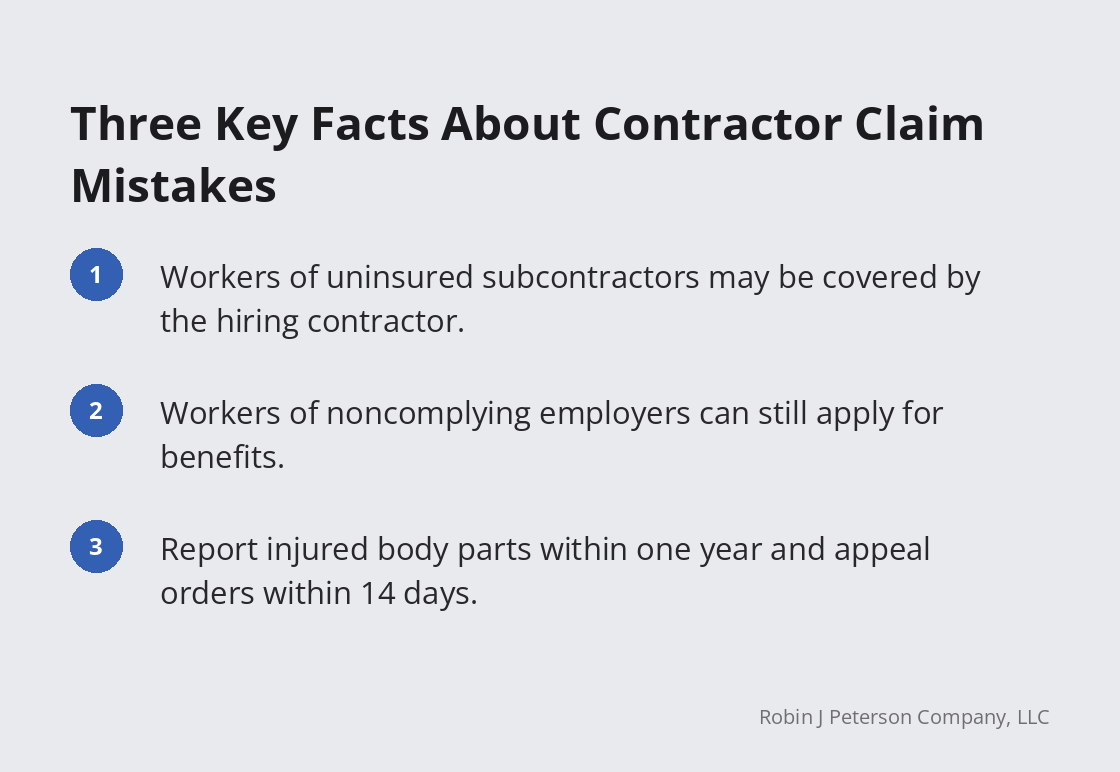
On multi-tier jobs, the company that hired you may not be the only party responsible. Section 4123.01(A)(1)(c) provides that every person in the service of an independent contractor or subcontractor who has failed to pay into the state insurance fund as required, or a self-insuring employer that has failed to pay compensation and benefits directly as required by Section 4123.35, is considered the employee of the person who contracted with that independent contractor, unless the worker elects after the injury to regard the independent contractor as the employer. This means that if your direct employer had no coverage, the contractor above it on the project may be treated as your employer for workers’ compensation purposes.
Assuming There Is No Remedy When the Employer Is Not Covered
Some workers give up because their employer never obtained workers’ compensation coverage. Ohio law addresses that situation directly. Under Section 4123.75, an employee whose employer failed to comply with Section 4123.35 and who was injured or developed an occupational disease in the course of employment may file an application with the Industrial Commission or the Bureau, and the claim is decided as it would be if the employer had complied. Section 4123.77 adds that noncomplying private employers are liable to their employees for damages caused by the wrongful act, neglect, or default of the employer, and in those actions they cannot rely on the common-law defenses of the fellow servant rule, assumption of the risk, or contributory negligence.
Missing the Filing Deadline
Classification disputes take time, but the filing deadline does not wait. Section 4123.84(A) provides that claims for the specific part or parts of the body injured are forever barred unless, within one year after the injury or death, written notice of those body parts is made to the Industrial Commission or the Bureau, or another event listed in the statute occurs. Filing promptly, even while your status is disputed, protects your claim.
Letting an Adverse Order Become Final
If the Bureau decides you were an independent contractor and disallows your claim, you can challenge that decision. Section 4123.511(B) allows the employer or claimant to appeal an initial order within fourteen days after receipt of the order, and orders of district and staff hearing officers carry their own fourteen-day appeal windows. Missing those windows can leave a mistaken classification in place. To learn what happens at each level of review, see our guide to the Ohio Industrial Commission hearing process.
Final Thoughts
Being called an independent contractor does not automatically mean you are shut out of Ohio workers’ compensation. Ohio law looks at who controls the work, whether you run an independent business, and, in construction and trucking, the specific statutory criteria in Section 4123.01. Even when an employer is uninsured or a subcontractor failed to maintain coverage, Ohio law provides paths to benefits for injured workers.
The key is to act quickly, file within the deadline, and gather the facts that show how your work was actually controlled.
If you were hurt on the job and told you are not covered because you are a contractor, contact Robin J Peterson Company, LLC to speak with our workers’ compensation team. We will review how your work was structured, explain your rights under Ohio law, and help you take the next step with confidence.