
Ohio workers’ comp retaliation is something many injured workers fear but few fully understand. You get hurt on the job, you report it, and suddenly your hours are cut, your shift changes, or you are let go. Ohio law protects employees who use the workers’ compensation system, and knowing exactly how that protection works, including its strict notice and filing deadlines, gives you real control over what happens next.
At Robin J Peterson Company, LLC, we help injured workers across Cleveland, Akron, Canton, and Independence protect their Ohio workers’ compensation rights from the first report of injury through every step that follows, so you can move forward with confidence. This guide explains what retaliation actually means under Ohio law, the steps to take if you suspect it, and the mistakes that most often weaken a retaliation claim.
What Workers’ Comp Retaliation Actually Means in Ohio
Retaliation happens when an employer punishes a worker for using a legal right. In the workers’ compensation setting, that usually means taking action against an employee because the employee filed a claim or took part in a claim proceeding. Ohio addresses this directly in the workers’ compensation statutes, and the Supreme Court of Ohio has also recognized related protection for workers who are punished before a claim is ever filed.
The Protection in Ohio Revised Code 4123.90
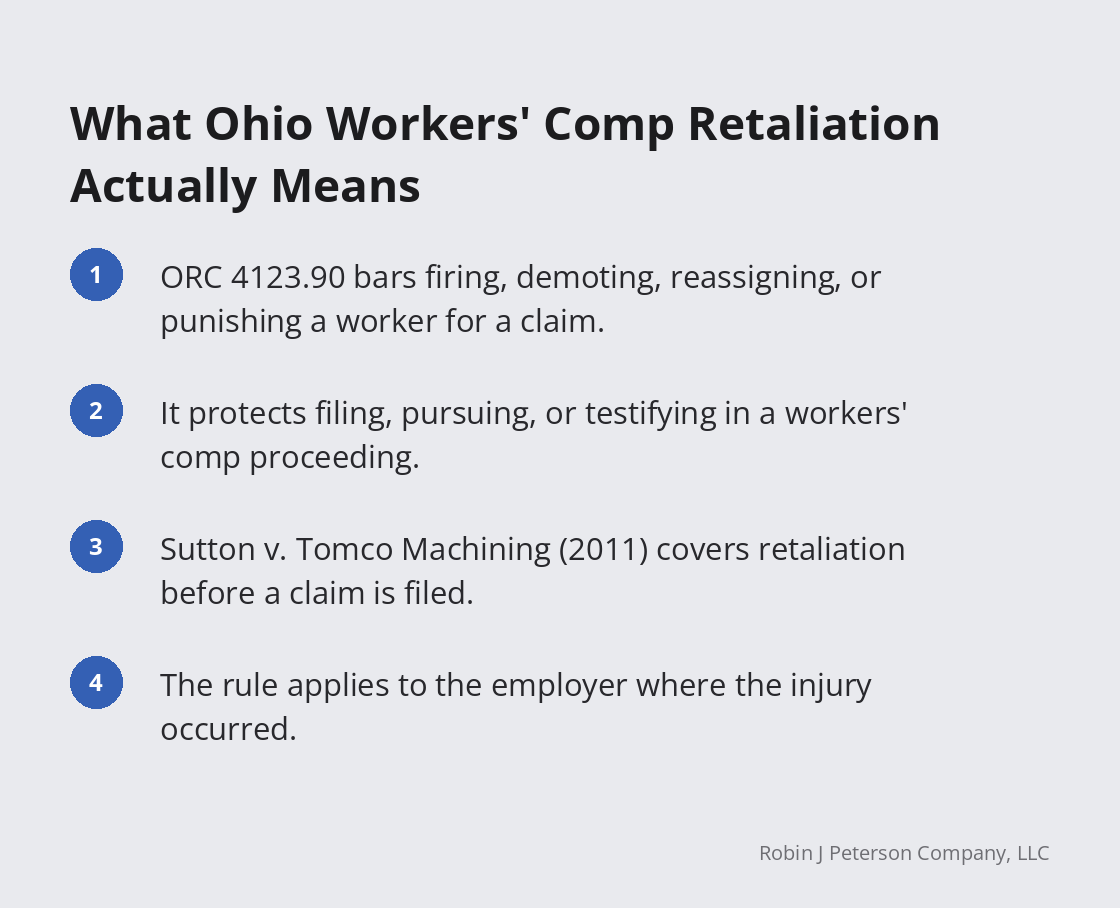
Ohio Revised Code 4123.90 provides that no employer shall discharge, demote, reassign, or take any punitive action against any employee because the employee filed a claim or instituted, pursued, or testified in any proceedings under the workers’ compensation act for an injury or occupational disease which occurred in the course of and arising out of his employment with that employer. In plain terms, using the workers’ compensation system for a work injury is not a legitimate reason for your employer to fire you or treat you worse. The protection covers filing the claim, pursuing it through the Bureau of Workers’ Compensation and the Industrial Commission, and testifying in a claim proceeding.
What Counts as Punitive Action
The statute is broader than firing alone. It names four kinds of employer conduct: discharge, demotion, reassignment, and any other punitive action. A sudden move to a less desirable shift, a transfer to a different position, a reduction in responsibilities, or discipline that appears right after a claim is filed can all raise questions under this rule. What matters is the reason behind the action. An employer may still make ordinary business decisions, but it may not make them because you filed or pursued a workers’ compensation claim.
Protection Before a Claim Is Filed
Some employers act quickly, letting a worker go after an injury but before any claim paperwork is submitted. In Sutton v. Tomco Machining, Inc. (2011), the Supreme Court of Ohio held that Ohio recognizes a common-law claim for wrongful discharge in violation of public policy when an injured employee suffers retaliatory employment action after injury on the job but before the employee files a workers’ compensation claim. The court also held that the available remedies in that situation are limited to those listed in Ohio Revised Code 4123.90. This decision closed a gap that some employers had tried to use.
Which Employer the Rule Covers
The wording of Ohio Revised Code 4123.90 ties the protection to the employer where the injury happened. It applies to an injury or occupational disease which occurred in the course of and arising out of the employee’s employment with that employer. If you were hurt at one job and later had problems at a different job, the analysis may be different, so it helps to be precise about where and when the injury occurred. The injury report filed with BWC, your claim number, and your medical records usually establish those details and become key evidence if retaliation is later alleged.
Steps to Take If You Suspect Retaliation
Retaliation claims are won or lost on timing and records. Because the deadlines are short, the steps you take in the first weeks after an adverse action carry special weight. Thinking of the process as a sequence of checkpoints helps keep both your workers’ compensation claim and any retaliation claim on track.
Keep Your Workers’ Comp Claim on Track
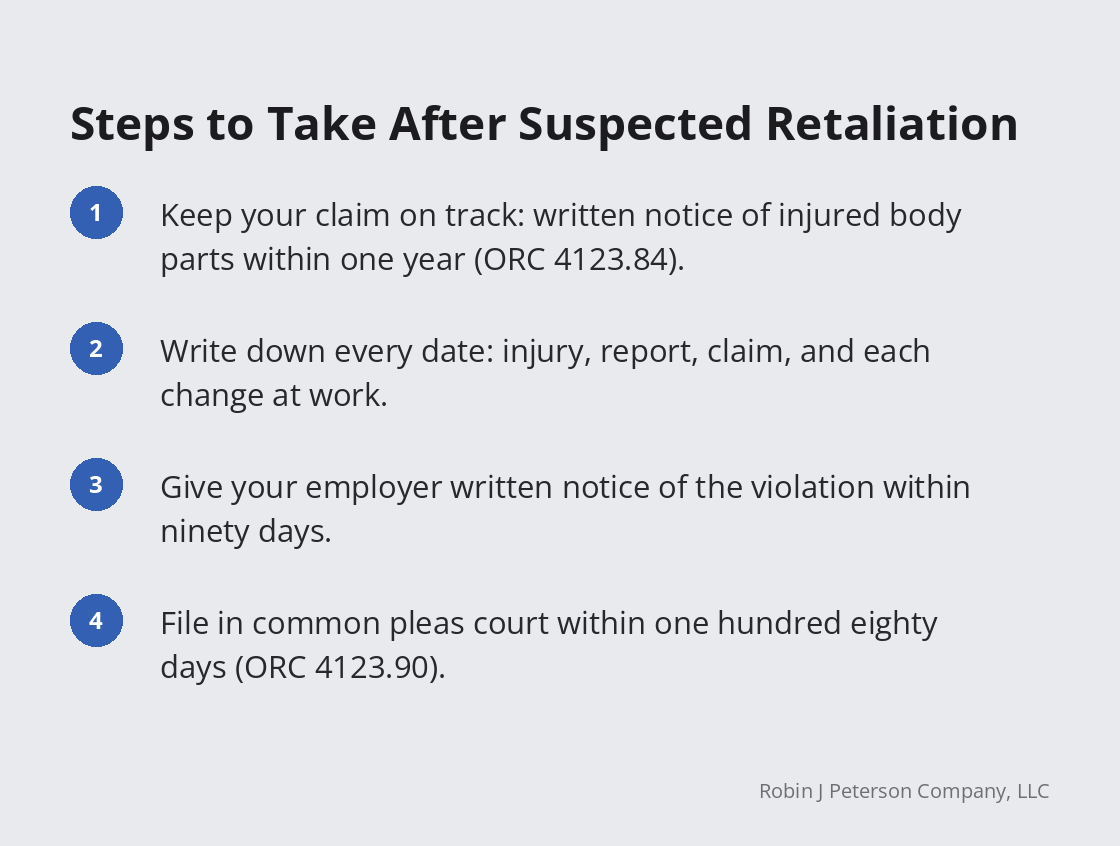
A retaliation dispute does not replace your underlying claim. Ohio Revised Code 4123.84 provides that claims for compensation or benefits for the specific part or parts of the body injured are forever barred unless, within one year after the injury, written notice of the specific part or parts of the body claimed to have been injured has been made to the Industrial Commission or the Bureau of Workers’ Compensation, or another event listed in the statute has occurred. Continuing to treat with your doctor, keeping appointments, and responding to BWC requests protect your benefits while you address any problems at work.
Document the Timeline
Retaliation is often proven through timing and patterns. Write down the date you were hurt, the date you reported the injury, the date the claim was filed, and the date of every change at work that followed. Save schedules, emails, text messages, performance reviews, and any written discipline. If coworkers heard a supervisor comment on your claim, note who they are and what was said. A clear, dated record makes it much easier to show a connection between your claim and the employer’s action.
Give Written Notice Within Ninety Days
Ohio Revised Code 4123.90 contains a notice requirement that surprises many workers. Under the statute, no action may be instituted or maintained unless the employer has received written notice of a claimed violation within the ninety days immediately following the discharge, demotion, reassignment, or punitive action taken. The notice must be in writing and must actually reach the employer within that window. Missing this step can end a retaliation case before it begins, even when the facts are strong.
File in Common Pleas Court Within 180 Days
The statute also sets a filing deadline. An employee may file an action in the common pleas court of the county of employment, and the action shall be forever barred unless filed within one hundred eighty days immediately following the discharge, demotion, reassignment, or punitive action taken. Because the written notice and the lawsuit run on separate clocks, it helps to calendar both dates as soon as the adverse action happens.
Mistakes That Weaken an Ohio Retaliation Claim
Many retaliation claims fail not because the employer acted fairly, but because the worker waited, assumed too much, or misunderstood what the law allows. These are some of the most common missteps.
Waiting for the Employer to Fix It
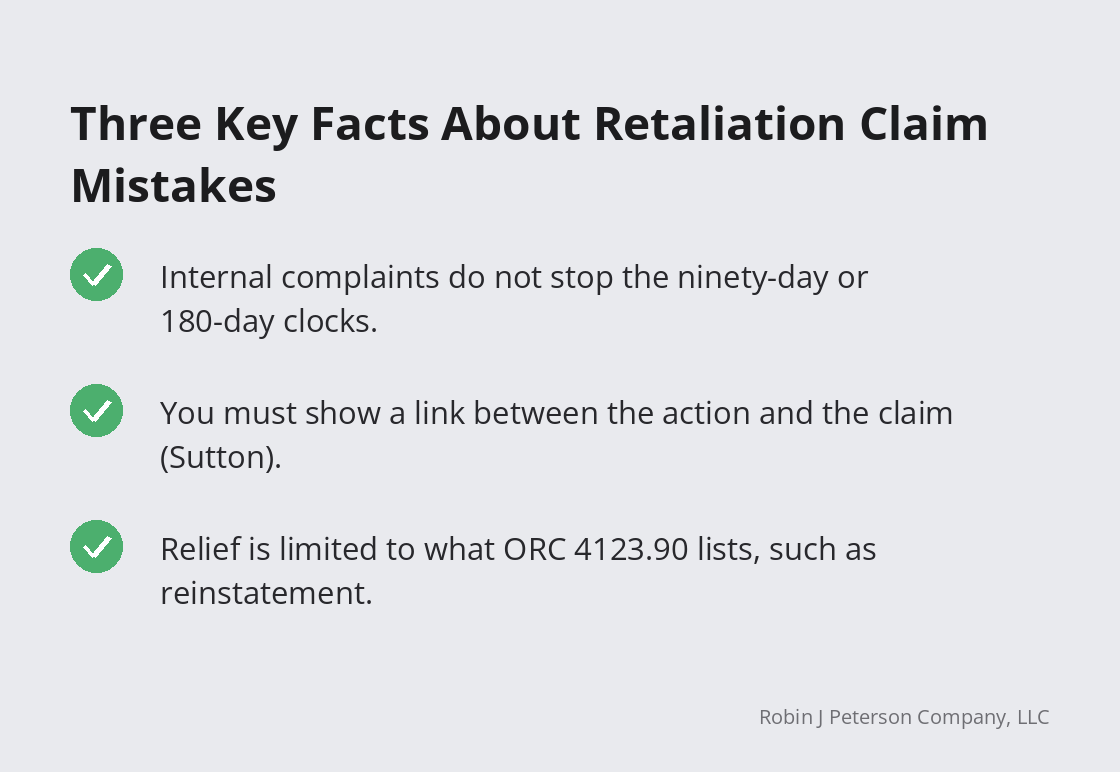
It is natural to hope that a supervisor will reverse a decision or that human resources will sort things out. Unfortunately, the ninety-day notice period and the one hundred eighty-day filing period keep running while you wait. Internal complaints and conversations do not stop either clock. If you believe an action was taken because of your claim, getting advice early protects your options.
Assuming Every Adverse Action Is Retaliation
Not every firing or schedule change after an injury is illegal. In Sutton, the Supreme Court of Ohio explained that a worker must prove the adverse employment action was retaliatory, which requires proof of a nexus between the action and the workers’ compensation claim. Employers often point to attendance, performance, or business reasons. Other laws may also matter: Ohio Revised Code 4112.02 makes it an unlawful discriminatory practice for an employer to discharge without just cause or otherwise discriminate against a person because of disability, which can come into play if a work injury leads to a lasting impairment. Sorting out which rules apply depends on the facts.
Expecting the Same Relief as Other Lawsuits
The relief available under Ohio Revised Code 4123.90 is specific. For a discharge, the statute limits relief to reinstatement with back pay; for a demotion, reassignment, or other punitive action, it allows an award for wages lost. Those awards are reduced by earnings after the action and by payments received under Ohio Revised Code 4123.56 and Ohio’s unemployment compensation law. Understanding these limits from the start helps you set realistic goals and choose the right strategy.
Final Thoughts
Ohio law is clear that filing or pursuing a workers’ compensation claim is not a valid reason to fire, demote, reassign, or punish an injured worker. The protection is real, but it comes with short, strict deadlines: written notice to the employer within ninety days and a lawsuit within one hundred eighty days. Acting promptly and keeping good records are what make the protection work.
Just as important, your workers’ compensation claim itself needs attention while any dispute with your employer plays out. Staying current with treatment and BWC requirements keeps your benefits moving even when your job situation is uncertain.
If you believe your employer punished you for an Ohio workers’ compensation claim, contact Robin J Peterson Company, LLC to speak with our team serving Cleveland, Akron, Canton, and Independence. We’ll review your timeline, protect your claim, and help you take the next step with a practical plan.