
Ohio workers’ comp claim expiration is one of the least understood rules in the system, and it catches many injured workers by surprise years after an injury. A claim that was allowed and paid can still reach the end of its statutory life, and once that happens, the Bureau of Workers’ Compensation and the Industrial Commission generally can no longer act on it. Knowing how the clock works, and what keeps it from running out, gives you real control over whether your claim is still there when you need it.
At Robin J Peterson Company, LLC, we help injured workers across Cleveland, Akron, Canton, and Independence protect their Ohio workers’ compensation claims from the first report through every later request, so you can move forward with confidence. This guide explains what claim expiration actually means, how to keep a claim active and complete, and the timing mistakes that most often cause a claim to lapse.
What Ohio Workers’ Comp Claim Expiration Actually Means
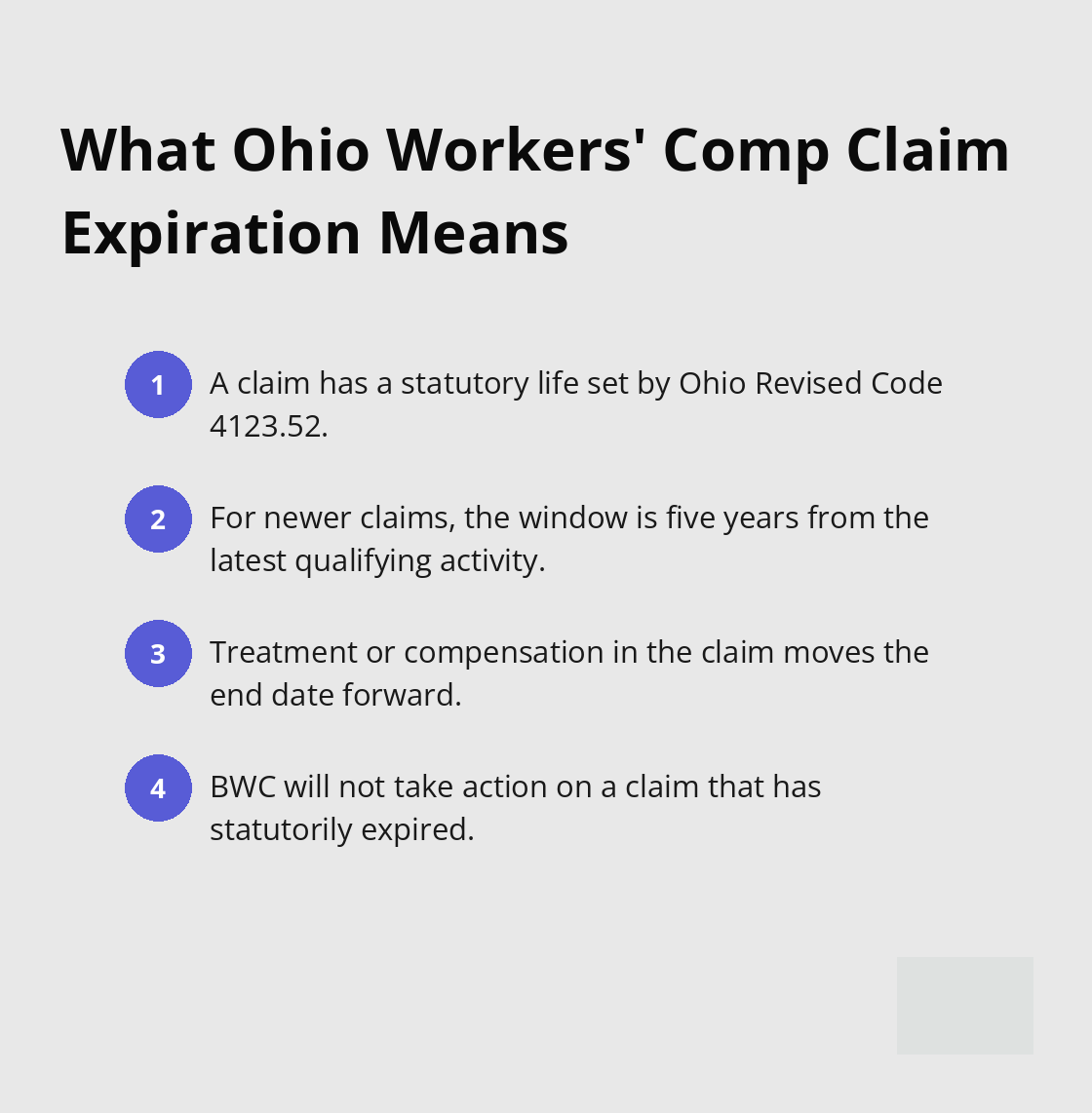
An Ohio workers’ compensation claim does not stay open forever. The law gives the Bureau and the Industrial Commission authority over a claim for a defined period, which the Bureau calls the statutory life of the claim. The Bureau’s Statute of Limitations policy defines that term as the period during which the Bureau or the Commission may, by law, make or modify a finding or award related to disability, compensation, dependency, or benefits in a claim. When that period ends, the policy states plainly that the Bureau will not take any action on a claim that has statutorily expired.
The Five-Year Rule in Ohio Revised Code 4123.52
The core rule appears in Ohio Revised Code 4123.52(A). It provides that no modification, change, finding, or award may be made with respect to disability, compensation, dependency, or benefits after five years from the date of injury, unless medical benefits have been provided or certain compensation has been paid. When medical services or compensation have been provided, the five years run from the date of the last medical services being rendered or the date of the last payment of compensation. In other words, activity in the claim pushes the end date forward, and long periods with no treatment and no compensation allow the clock to run.
What Resets the Five-Year Window
The Bureau’s policy spells out how the rule applies by date of injury. For a date of injury on or after July 1, 2020, a claim ends five years from the date of injury, the date of payment of compensation, wages in lieu of compensation, or the date medical benefits were provided, whichever is later. For a date of injury from August 25, 2006, to June 30, 2020, the period is five years from the date of injury, the date of payment of compensation, wages in lieu of compensation, or the medical bill payment, whichever is later. Older claims follow different time periods under the same policy, so the date of injury is always the first fact to confirm when you are trying to figure out whether a claim is still active.
Continuing Jurisdiction of the Commission and the Bureau
While a claim is within its statutory life, Ohio Revised Code 4123.52 gives the Industrial Commission continuing jurisdiction and the Administrator continuing authority over the case, and the Commission may modify or change former findings or orders when it believes the change is justified. Ohio Revised Code 4123.84(C) adds that this continuing jurisdiction can include awarding compensation or benefits for loss or impairment in a part of the body that was not listed in the original notice, if the Commission finds it was due to and a result of the original injury. The Bureau’s policy also notes that if the Bureau or the Commission suspends a claim, the statute of limitations on the statutory life of the claim stops running as of the date of that suspension.
How to Keep Your Ohio BWC Claim Active and Complete
Keeping a claim alive is mostly about steady, documented activity and making sure the claim reflects every condition your injury actually caused. Injured workers in Northeast Ohio often focus on getting a claim allowed and then assume the hard part is over. In reality, the steps you take months and years later can decide whether future treatment, compensation, or additional conditions are still available.
Stay Consistent With Medical Care in the Allowed Claim
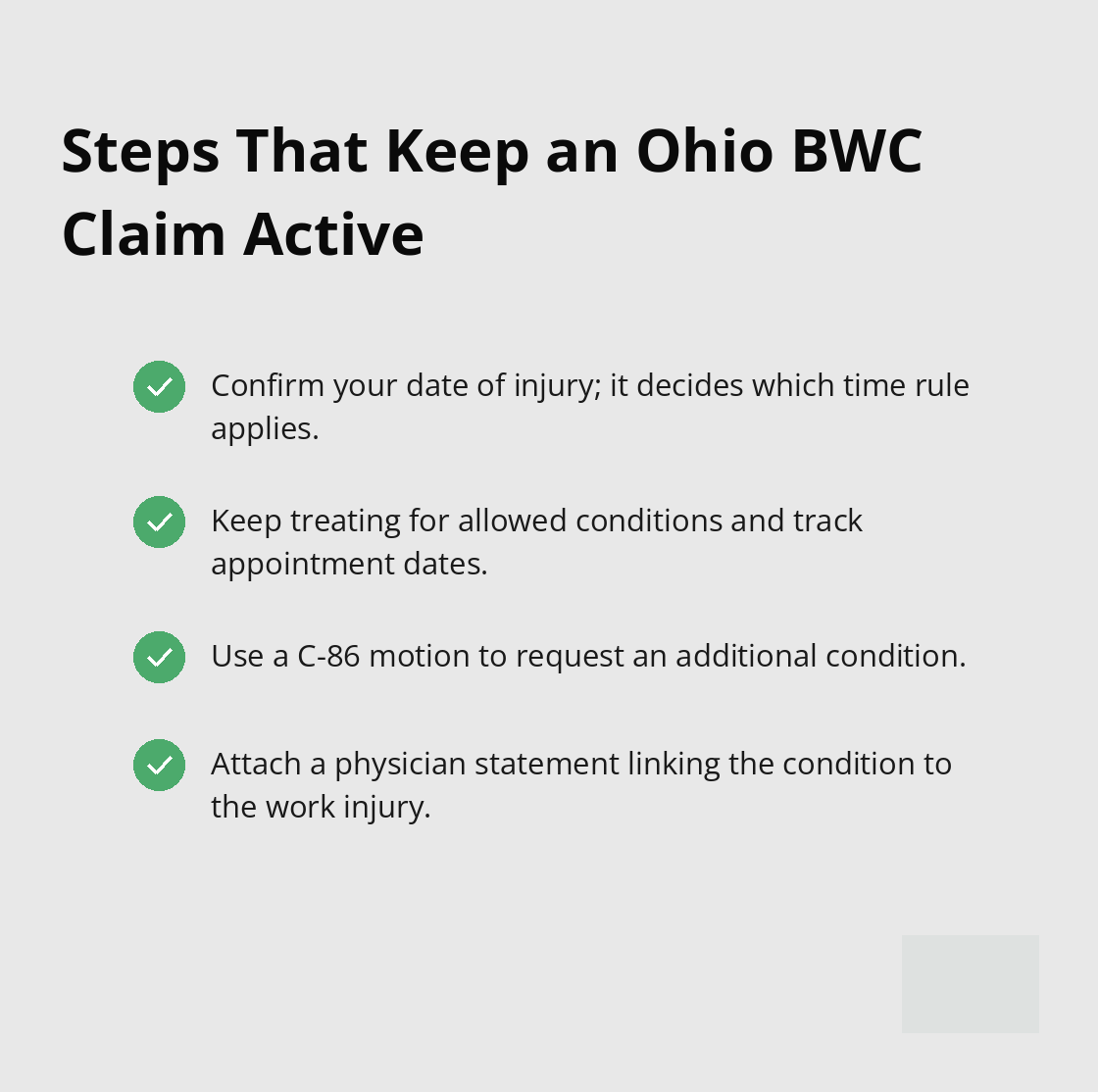
Because the statutory life of a newer claim runs from the later of the date of injury, the last compensation payment, wages in lieu of compensation, or the date medical benefits were provided, continued treatment for allowed conditions is one of the clearest ways a claim stays within its active period. If you are still having symptoms from an allowed condition, follow through with the care your treating provider recommends and keep your own record of appointment dates. A long gap followed by a sudden need for treatment is exactly the situation where an expired claim becomes a serious problem.
Adding a Condition With a Motion (C-86)
Sometimes the original claim does not capture everything the injury caused. Ohio Administrative Code 4123-3-16 provides that a motion on Form C-86, or its equivalent, is used to request action from the Bureau or the Commission, and that it is appropriate to file a motion to secure allowance of a disability or condition not previously considered in a claim. The Bureau’s C-86 instructions ask you to state the diagnosis of each condition you want considered and to attach or identify supporting medical documentation, including a physician statement addressing the causal relationship between the requested diagnosis and the work-related injury. The Bureau’s Additional Allowance policy explains that a provider may recommend an additional condition on a C-9, while the injured worker or representative requests one on a C-86.
Proving an Aggravation of a Pre-Existing Condition
When a work injury worsens a condition you already had, the evidence standard depends on the date of injury. The C-86 instructions state that if the date of injury is on or after August 25, 2006, you must clearly identify the request as a substantial aggravation of the specific pre-existing condition and provide objective diagnostic findings, objective clinical findings, or objective test results showing that the condition has substantially worsened due to the work-related injury. For earlier dates of injury, the instructions allow objective or subjective evidence, or both, showing some real adverse effect on the condition. Getting this standard right the first time can prevent a request from being denied for lack of proof.
What Causes Ohio Claims to Lapse or Fall Short
Many claim problems tied to timing are avoidable. They usually come from missing an early deadline, letting the claim sit without activity, or using the wrong procedural tool when a decision goes against you. Understanding these traps is just as important as understanding your benefits.
Missing the One-Year Filing Deadline at the Start
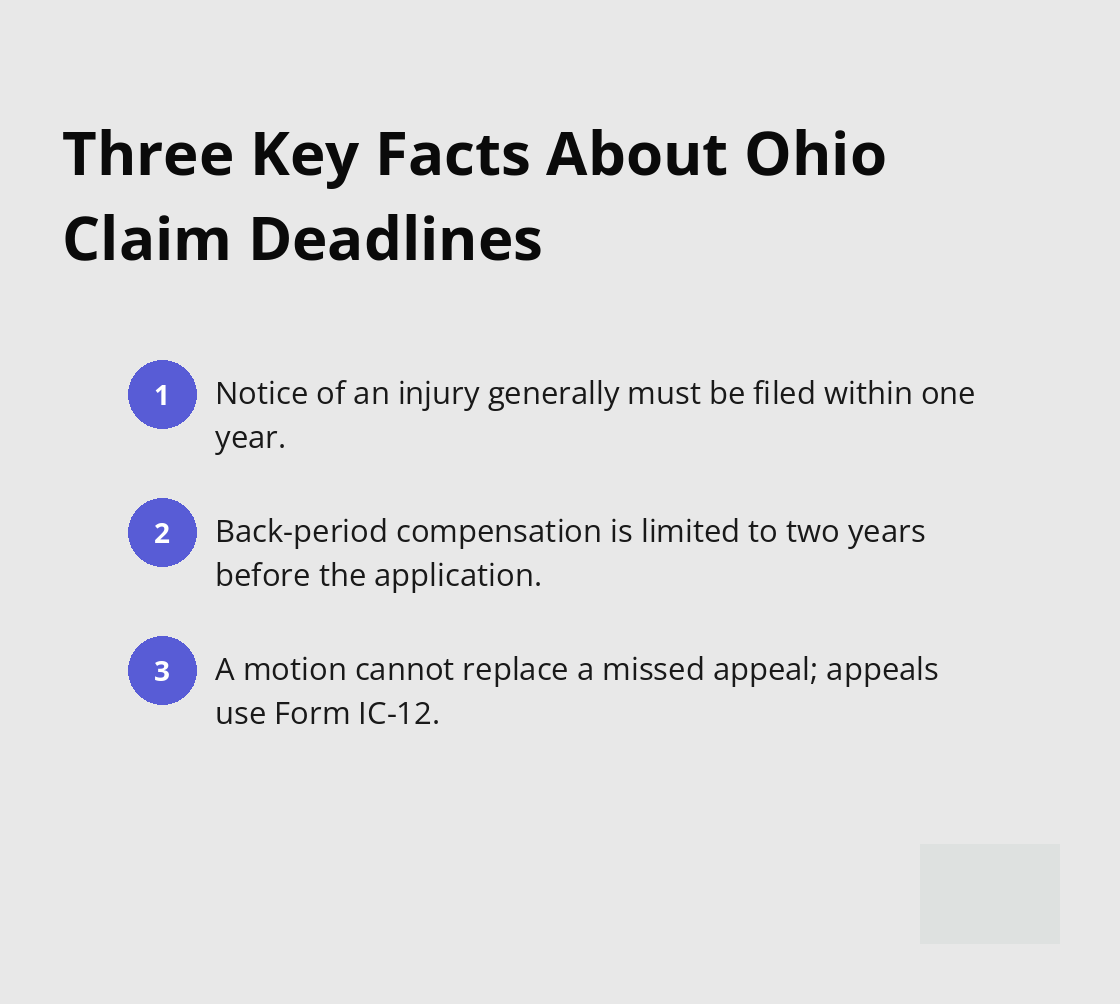
Claim expiration only matters if a claim was filed in time to begin with. Ohio Revised Code 4123.84(A) provides that claims for the specific parts of the body injured are forever barred unless, within one year after the injury or death, written or facsimile notice of the specific parts of the body claimed to have been injured is made to the Industrial Commission or the Bureau, or another listed event occurs, such as the employer paying wages in lieu of compensation for total disability. Occupational disease claims follow a separate timing rule in Ohio Revised Code 4123.85 that is tied to when disability due to the disease began and when a licensed physician or other provider listed in the statute diagnosed the disease. Ohio Revised Code 4123.28 also provides that each day an employer fails to file a required injury report adds a day to the filing period, up to two additional years.
Long Gaps in Treatment or Activity
A common way an allowed claim lapses is simple inactivity. An injured worker returns to work, feels better for a while, and stops treating. Years later, the same injury flares up, but in a newer claim, if more than five years have passed since the last qualifying activity, the Bureau will not take action on a claim that has statutorily expired. Checking the date of the last treatment or compensation payment in your claim, and talking with your provider before the window closes, can help you avoid losing access to care for a condition that was already allowed.
Waiting Too Long to Ask for Past Benefits
Even within the statutory life of a claim, timing still matters for requests that look backward. Ohio Revised Code 4123.52(A) provides that the Commission shall not make any modification, change, finding, or award which awards compensation for a back period in excess of two years prior to the date of filing the application. If you believe you were entitled to compensation for a past period, filing the request promptly protects as much of that period as the law allows.
Using a Motion Instead of a Timely Appeal
A motion is a powerful tool, but it is not a second chance at a missed appeal. Ohio Administrative Code 4123-3-16 states that a motion shall not be used as a substitute for an untimely appeal, and the C-86 instructions direct you not to use that form to appeal a Bureau or Industrial Commission hearing order and to use the Notice of Appeal (IC-12) instead. Treat every order as a deadline that has already started, and choose the correct form for the decision you are challenging.
Final Thoughts
Ohio workers’ comp claim expiration is governed by clear rules. Ohio Revised Code 4123.52 sets the five-year statutory life tied to the date of injury, the last compensation payment, and the last medical services, while the Bureau’s policy explains how those dates apply to newer and older claims. Filing on time under Ohio Revised Code 4123.84, keeping the claim active, and adding conditions properly with a C-86 are the habits that protect your benefits over the long term.
If you were hurt at work years ago and are not sure whether your claim is still active, or you need a condition added to your claim, the right next step is to confirm your date of injury and the last activity in the claim before you assume anything.
If you need help protecting an Ohio workers’ compensation claim, contact Robin J Peterson Company, LLC to speak with our team serving Cleveland, Akron, Canton, and Independence. We help injured workers keep their claims active and complete so you can move forward with a practical plan.