
A work injury doesn’t have to mean the end of your career. At Robin J Peterson Company, LLC, we know that understanding your return to work rights is the first step toward reclaiming your professional life.
Whether you’re facing employer resistance, unclear medical restrictions, or disputes about job availability, you have legal protections in Ohio. This guide walks you through what you’re entitled to and how to navigate the path back to work with confidence.
Understanding Your Return to Work Rights
What Ohio’s Workers’ Compensation System Covers
Ohio’s Bureau of Workers’ Compensation operates under a no-fault system, so you don’t need to prove your employer was negligent to receive benefits. This gives you a significant advantage compared to states with fault-based systems. If you suffered a work-related injury or occupational disease, the BWC covers medical treatment, rehabilitation services, and wage replacement benefits while you cannot work.
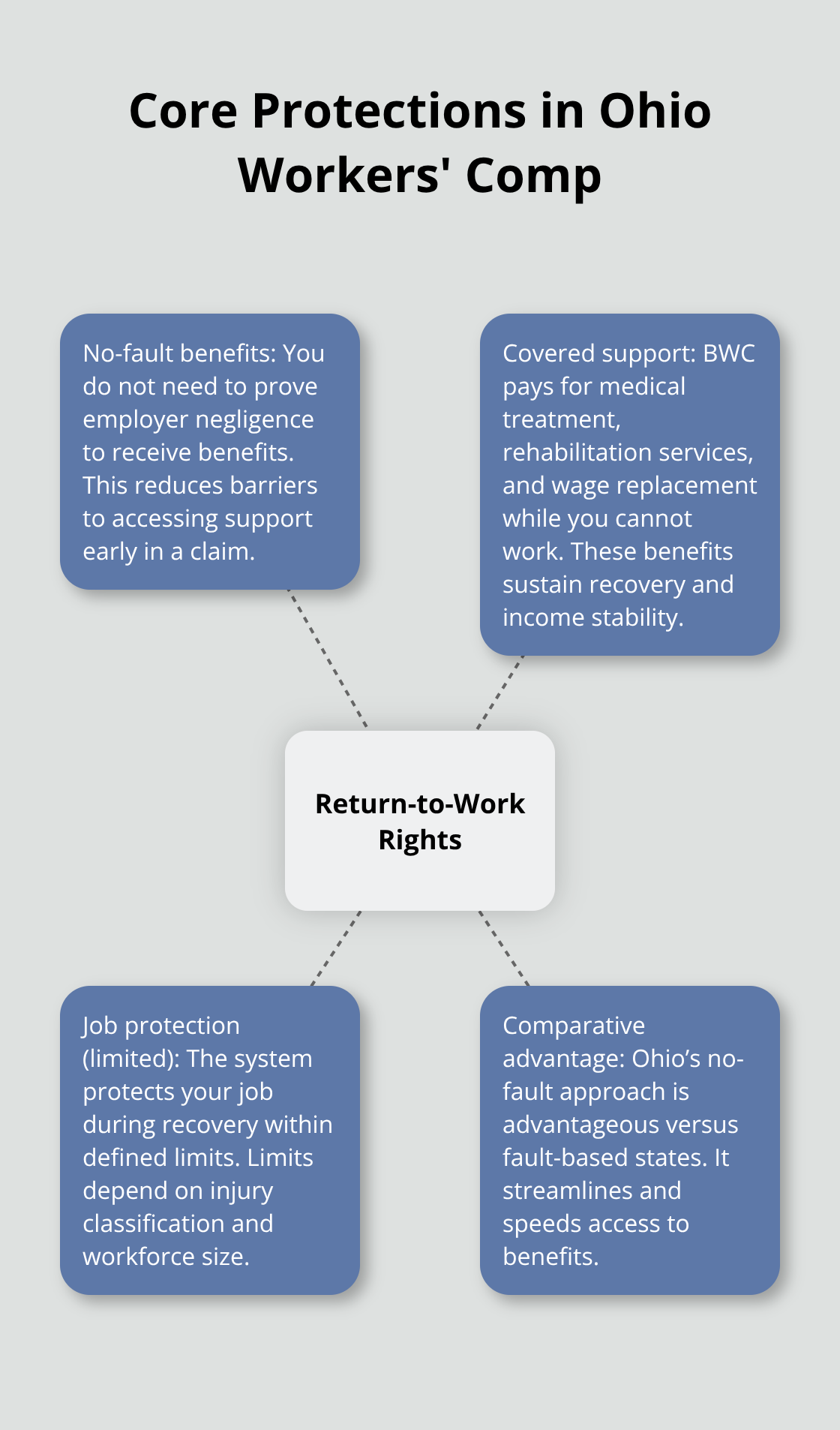
The system also protects your job during your recovery period, though protection limits exist based on your injury classification and your employer’s workforce size.
Your Rehiring Rights and Employer Size
Employers with ten or more employees must rehire you in a suitable position if one becomes available within two years of your injury date. Smaller employers face fewer rehiring obligations, but retaliation for filing a workers’ compensation claim remains illegal regardless of company size. This distinction matters because many injured workers don’t realize their rehiring rights depend on specific employment thresholds, leading them to accept inadequate return-to-work offers.
Modified Duty and Light Duty Work
Modified duty and light duty work represent your pathway back without full recovery. Modified duty means you perform your regular job with temporary restrictions-reduced hours, eliminated tasks, or workplace accommodations. Light duty means you perform different work that fits your medical limitations. Your doctor establishes what work capacity you can handle through functional capacity evaluations, which test your physical abilities against specific job demands.
How Employers Must Accommodate Your Restrictions
Ohio law requires employers to accommodate legitimate medical restrictions, but disputes frequently arise over whether available work actually matches your capabilities. The BWC doesn’t automatically approve modified duty assignments; you and your employer must agree that the work aligns with your restrictions (or disputes go to the Industrial Commission of Ohio for resolution). Many workers accept unsuitable modified duty simply because they fear losing benefits, which is why you should document your actual medical limitations in writing with your physician before returning to any work.
Navigating the Return to Work Process
Start with Your Doctor, Not Your Employer
Getting back to work after an injury requires three critical actions that most workers handle poorly: establishing clear medical restrictions in writing, communicating those restrictions to your employer before you return, and ensuring your doctor understands the specific job demands you’ll face. Start with your doctor, not your employer. Request a functional capacity evaluation if your physician hasn’t already completed one, as this assessment determines exactly what physical activities you can perform.
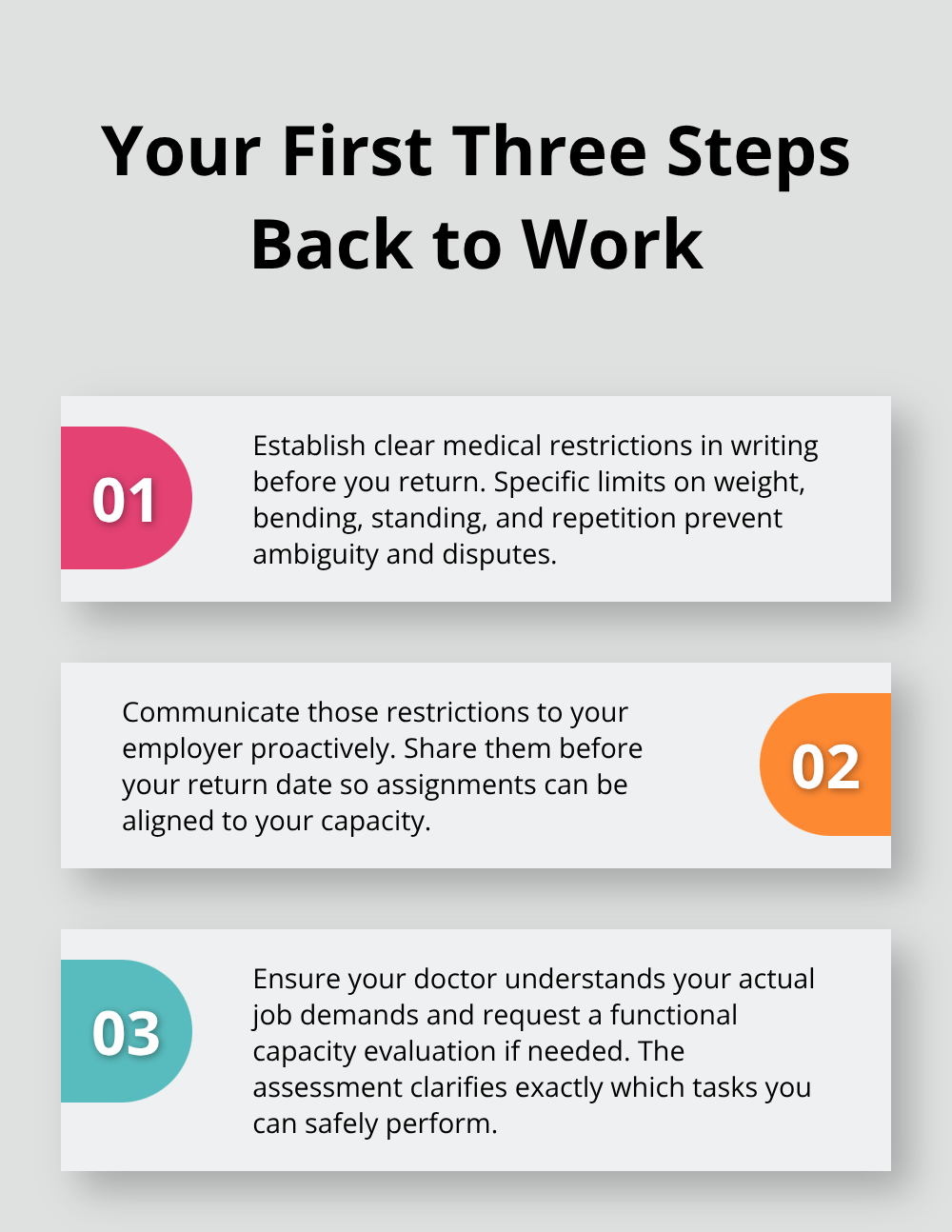
Your doctor needs to know the actual job duties you performed before injury-not a generic job description-to write restrictions that match reality. Bring your job description, describe the physical demands you faced, and ask your physician to document restrictions in specific terms like maximum weight limits, frequency of bending, standing tolerance in hours, or repetitive motion restrictions. Vague restrictions such as light duty or no heavy lifting create disputes because employers will interpret them differently than you do.
Document Your Medical Limitations in Writing
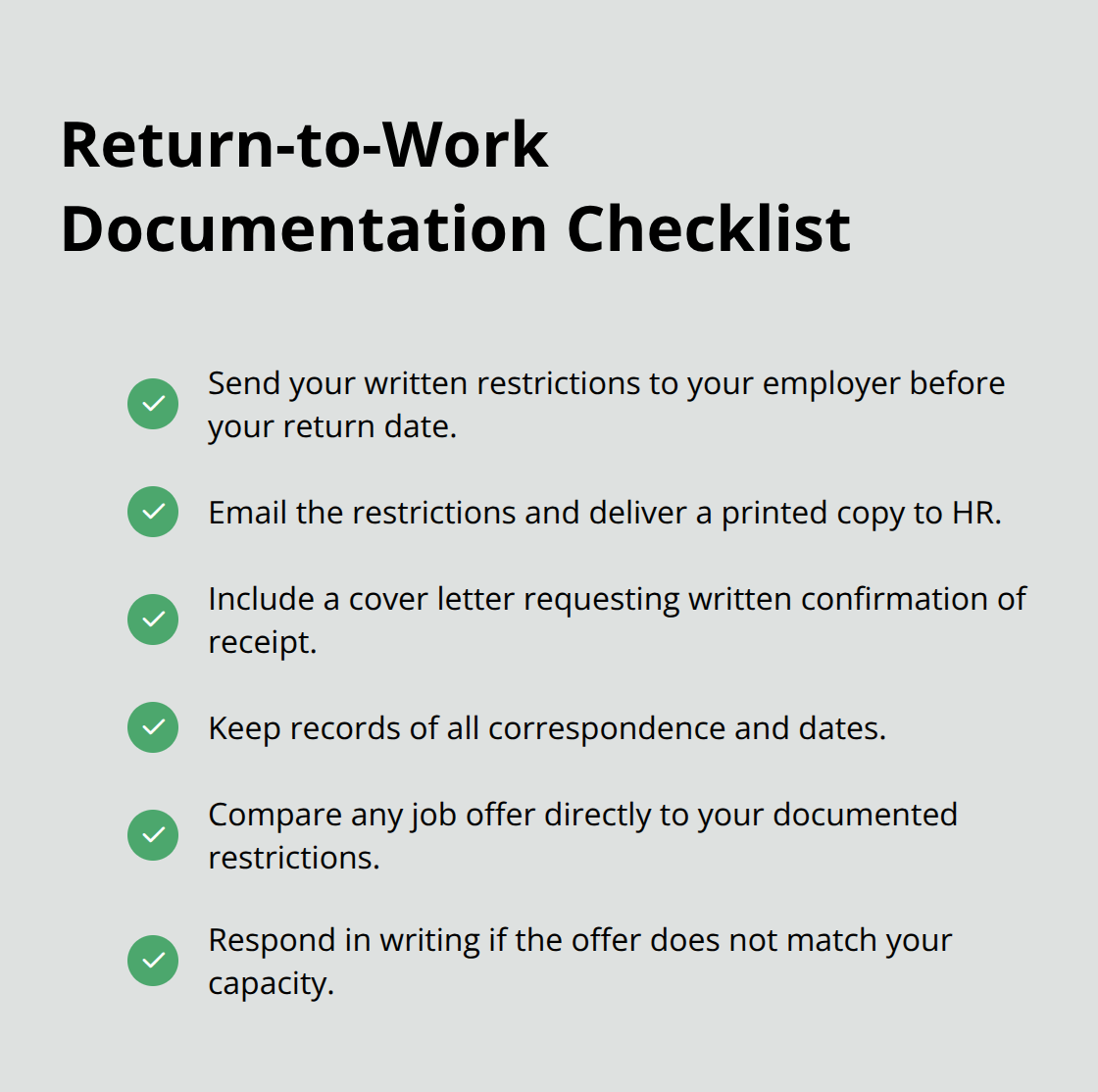
The Industrial Commission of Ohio frequently hears cases where workers and employers disagree about what modified duty actually means, often because the medical documentation lacked specificity. Once your doctor provides written restrictions, send them to your employer in writing before your return-to-work date arrives. Email works, but follow up with a printed copy to your human resources department.
Include a cover letter that explicitly states you are providing medical restrictions to support suitable work assignments and request written confirmation that your employer received them. This documentation protects you if disputes later arise about whether your employer knew your limitations. When your employer proposes a return-to-work position, evaluate it against your medical restrictions in writing.
Evaluate Proposed Work Against Your Restrictions
Does the job require standing for eight hours when your doctor restricted you to four? Does it involve lifting when your restrictions prohibit it? If the proposed work doesn’t match your capabilities, state so immediately and in writing. Workers who accept unsuitable assignments often lose wage replacement benefits retroactively if the BWC later determines the work violated their medical restrictions.
Ohio law protects your right to refuse work that exceeds your medical capacity. Many injured workers hesitate to reject unsuitable work because they fear losing benefits entirely, but this protection remains solid. If disagreements arise between you and your employer about whether work is suitable, the Industrial Commission of Ohio resolves the dispute-you don’t have to accept unsuitable assignments to keep your benefits. When employer resistance emerges (and it often does), knowing your documentation is solid gives you the foundation to push back effectively.
Common Obstacles When Returning to Work
Employer Resistance to Accommodations
Employer resistance to accommodations remains the most common barrier injured workers face, and it typically stems from cost concerns rather than legitimate operational challenges. When you request modified duty, employers often respond with vague pushback about job availability or business needs, even when suitable work exists. The Ohio Industrial Commission receives thousands of disputes annually where workers claim employers rejected reasonable accommodations, and in many cases, the employers simply wanted to avoid temporary wage replacement costs or feared setting a precedent.
Your documentation strategy from the previous section becomes your defense here: when you have written medical restrictions and a written job proposal, employers cannot later claim they never understood your limitations. If an employer denies suitable modified duty work without legitimate business reasons, that action violates Ohio workers’ compensation law.
Disputes Over Job Suitability
Disputes over job suitability happen because employers and workers define the same position differently. Your employer may claim a job is light duty when it actually requires activities your doctor prohibited. For example, an employer might offer a desk position as light duty for someone with a shoulder injury, but if the job involves filing overhead or frequent reaching, it violates your restrictions.
The Industrial Commission of Ohio requires employers to match available work to your actual medical restrictions, not to generic job titles. When you receive a job offer, evaluate it against your written restrictions immediately. If the work exceeds your medical capacity, state so in writing and request a different assignment.
Wage Differences and Reduced Hours
When wage differences emerge after returning to work, the situation becomes particularly contentious. If you return to modified duty at reduced hours or lower-skill work, your wage replacement benefits typically continue to cover the gap between your modified wage and your average weekly wage before injury, but only if the work genuinely matches your restrictions.
Some employers deliberately assign unsuitable work at lower pay, hoping injured workers will accept reduced benefits rather than fight. This tactic fails when you have solid documentation. If you accepted modified duty work that your medical restrictions prohibited, you can challenge the wage calculation retroactively through the Industrial Commission of Ohio and potentially recover lost benefits.
Escalating Your Response
The strongest defense against these obstacles involves proactive communication and unwavering documentation. Before returning to any position, send your employer a written summary stating exactly what work you can and cannot perform based on your medical restrictions. Request written confirmation that the proposed job aligns with those restrictions.
When disputes arise, most injured workers attempt informal resolution first, which rarely works because employers know most workers fear losing benefits. If your employer refuses suitable modified duty, misrepresents a position’s demands, or retaliates against you for asserting your rights, the Industrial Commission of Ohio provides formal dispute resolution. You have the right to an attorney throughout this process, and many injured workers discover that employer behavior changes dramatically once legal representation enters the picture.
Recognizing When to Seek Help
Watch for early warning signs that signal you need formal dispute resolution. When an employer claims no suitable work exists but continues operating normally, when they offer positions that clearly exceed your restrictions, or when they suddenly reduce your hours or pay after you filed a workers’ compensation claim, these moments require escalation from documentation to formal action. If you work with an experienced workers’ compensation attorney in Ohio, you gain someone who understands how the Industrial Commission evaluates these disputes and can present your case effectively.
Final Thoughts
Your return to work rights in Ohio remain stronger than most injured workers realize, but only if you act strategically from the moment you file your claim. The foundation of every successful return involves three elements: clear medical documentation, written communication with your employer, and unwavering documentation of every decision. When you establish these practices early, employer resistance becomes manageable and disputes become winnable.
Employers will test your resolve, medical restrictions will sometimes feel unclear, and wage calculations will occasionally seem unfair-these obstacles are predictable, which means you can prepare for them. You now know how to avoid the critical mistake that most injured workers make: accepting unsuitable work or failing to document restrictions clearly. When you return to work, your employer must match available positions to your actual medical capacity, not to generic job titles or their preferred interpretation of light duty.
If your employer denies suitable modified duty, misrepresents job demands, or retaliates against you for asserting your return to work rights, that moment demands professional legal guidance. Visit Robin J Peterson Company, LLC to discuss your specific situation with our team, which understands how the Industrial Commission evaluates these disputes and knows how to present your case effectively.