
Repetitive strain injuries affect millions of workers across Ohio, from office employees to manufacturing staff. These conditions develop gradually through repeated motions, often going unnoticed until pain becomes severe.
Understanding your repetitive strain injury rights is the first step toward protecting your health and securing the support you deserve. We at Robin J Peterson Company, LLC help injured workers navigate workers’ compensation claims and access the benefits they’re entitled to.
What RSI Actually Looks Like on the Job
Repetitive strain injury isn’t a single condition-it’s a collection of injuries that develop when your body performs the same motion repeatedly without adequate rest or proper positioning. RSI damages muscles, nerves, and tendons, primarily in the upper body. The U.S. Bureau of Labor Statistics reported over 17,000 workplace injuries from repetitive microtasks in 2019, and that number continues to rise. What makes RSI dangerous is how quietly it develops. You might feel mild discomfort only during specific tasks at first, but without intervention, that ache becomes constant pain that persists long after work ends. Eventually, the injury can cause weakness, numbness, tingling, or burning sensations that interfere with basic activities like opening jars or holding objects.
Where RSI Strikes Hardest
Office workers face enormous RSI risk from typing and mouse use without ergonomic support. Assembly line workers, supermarket checkout staff, hairdressers, musicians, and anyone using vibrating tools encounter significant exposure. Manufacturing environments amplify risk because cold temperatures reduce muscle flexibility, and vibrating equipment directly stresses tissues. Poor workspace design accelerates injury development-inadequate chair support, monitors positioned too high or low, and keyboards at the wrong height force your body into awkward positions for hours. Cold working environments compound the problem by making muscles less flexible and more prone to strain. Stress also plays a role; when you’re anxious or tense at work, you unconsciously tighten muscles and reduce blood flow to affected areas.
How Injury Develops Silently
RSI progression follows a predictable pattern that most workers miss until damage is substantial. Initial symptoms appear only during the repetitive activity itself-a slight ache in your wrist while typing or a mild throb in your forearm after assembly work. These early signs are easy to ignore because they vanish once you stop the activity. Over weeks or months, symptoms shift. Pain now lingers after work ends, and you notice stiffness the next morning.
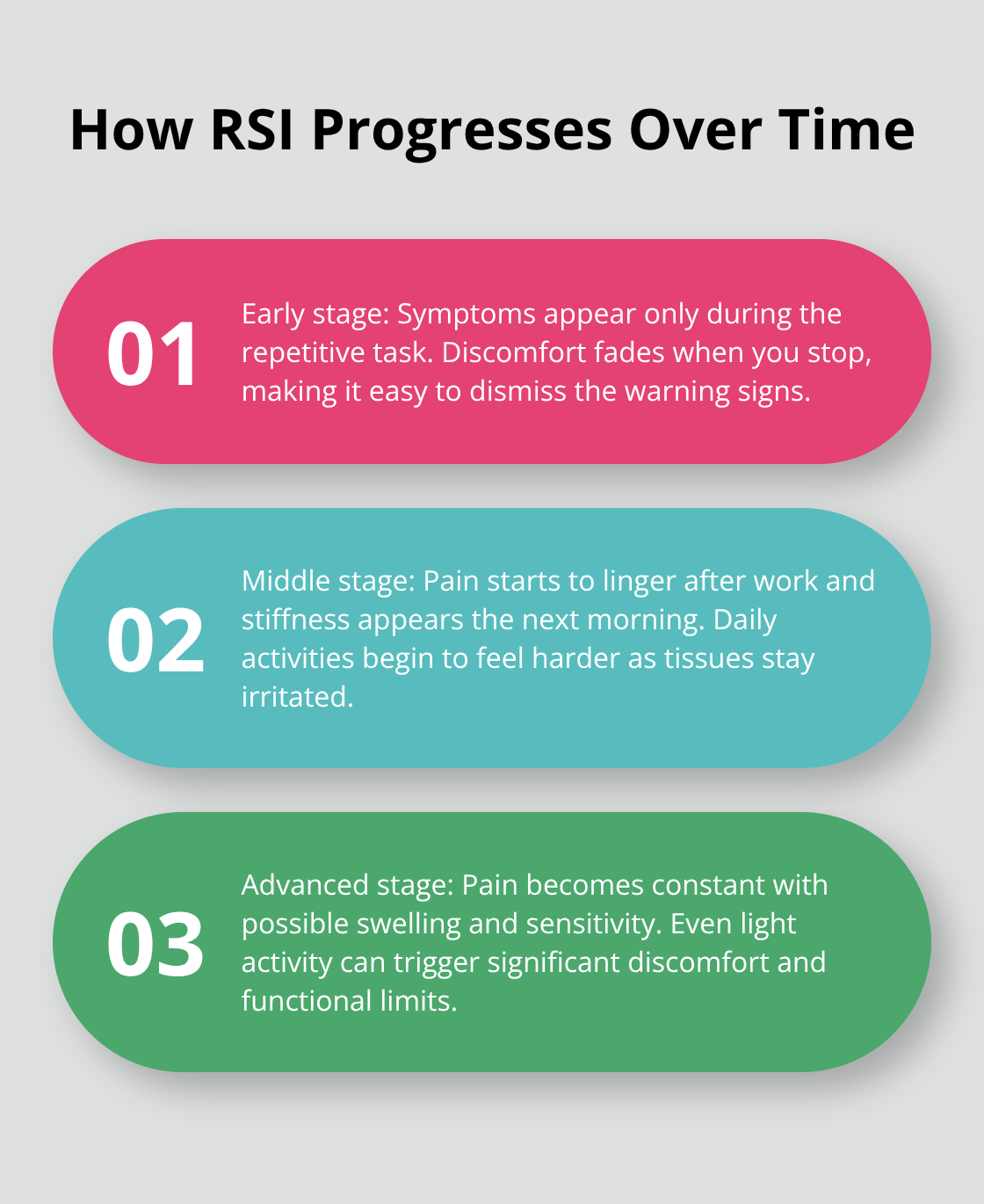
Without ergonomic adjustments or treatment, the injury crosses a critical threshold where pain becomes constant, swelling develops, and symptoms persist for months. At this advanced stage, even light activity triggers discomfort.
Why Early Action Matters
The NHS emphasizes that early intervention through ergonomic adjustments, breaks, and gradual activity increases dramatically improves recovery outcomes. Waiting until pain is severe means longer recovery and higher risk of permanent damage. Your employer bears responsibility for providing a safe workplace, and you have the right to request reasonable adjustments-whether that means repositioning your workstation, reducing hours, or switching tasks to prevent overuse of the same muscles. If your workplace refuses these accommodations or if symptoms persist despite adjustments, documenting your condition and understanding your workers’ compensation rights becomes essential. This is where the claims process in Ohio begins, and knowing what steps to take next protects both your health and your legal standing.
Claiming Your RSI Benefits in Ohio
Ohio’s Workers’ Compensation System Protects RSI Injuries
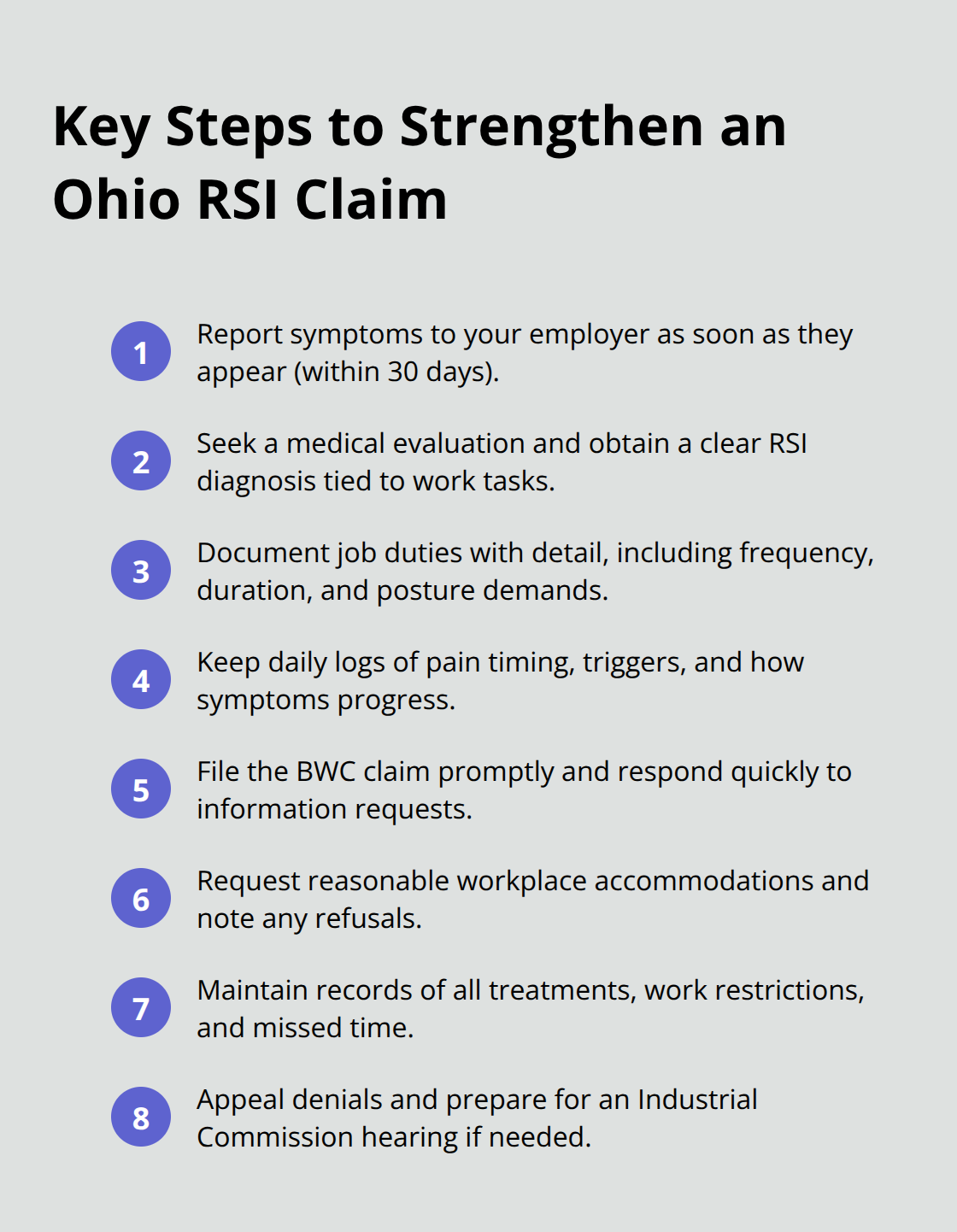
Ohio’s workers’ compensation system exists specifically to protect workers injured on the job, and RSI qualifies as a legitimate workplace injury when it arises from your job duties. The Ohio Bureau of Workers’ Compensation handles these claims, and filing within the correct timeframe is non-negotiable. You must report your injury to your employer within 30 days of discovery, though reporting immediately after symptoms appear is far safer because RSI claims lack a single incident moment that makes timing obvious. Carriers frequently dispute work-relatedness when there’s delay, arguing that your condition developed outside work or from personal factors.
Building Your Case With Documentation
Once you report, your employer files a claim with the BWC, which investigates whether your RSI genuinely connects to your work activities. This is where documentation becomes your strongest weapon. Medical records proving your diagnosis, detailed descriptions of your job tasks, and a clear timeline showing how symptoms progressed directly tied to specific work motions all strengthen your position against the BWC’s skepticism. Keep contemporaneous logs of when pain occurs, which tasks trigger it, and how it worsens over weeks or months. This evidence demonstrates the causal link that carriers demand. If your employer or the BWC denies your claim, you have the right to appeal and request a hearing before the Industrial Commission of Ohio.
Understanding BWC Benefits and Coverage
Medical treatment for RSI, including physiotherapy, occupational therapy assessments, and necessary medications, is covered by BWC with all costs paid directly to providers. You also receive partial wage replacement if RSI forces you to miss work or reduces your earning capacity, calculated as a percentage of your average weekly wage. The system recognizes that recovery takes time, and benefits continue throughout your treatment period. However, the BWC won’t voluntarily offer maximum benefits-you must actively document everything and push back against denials. Many workers accept initial claim denials without realizing they can challenge them.
When You Need Legal Representation
An experienced workers’ compensation attorney knows exactly what medical evidence and employment records the BWC respects, how to present your job duties in ways that demonstrate RSI risk, and how to navigate appeals when denials occur. This expertise transforms a claim from one the BWC casually denies into one they must approve because the evidence is undeniable. As you move forward with your claim, understanding what happens next in the treatment and recovery process becomes equally important to securing your benefits.
Managing RSI Before It Becomes Permanent
Fix Your Workspace First
The gap between early RSI symptoms and permanent damage is narrow, which is why workplace modifications and active treatment cannot wait. Your workspace directly causes or prevents RSI, so fixing it matters more than any medication or therapy alone. If your monitor sits too high, you crane your neck for eight hours daily, forcing muscles into constant tension that no amount of stretching fixes after work. The UC Merced Ergonomics program found that pairing ergonomic evaluation tools with actual workstation adjustments significantly reduces RSI progression.
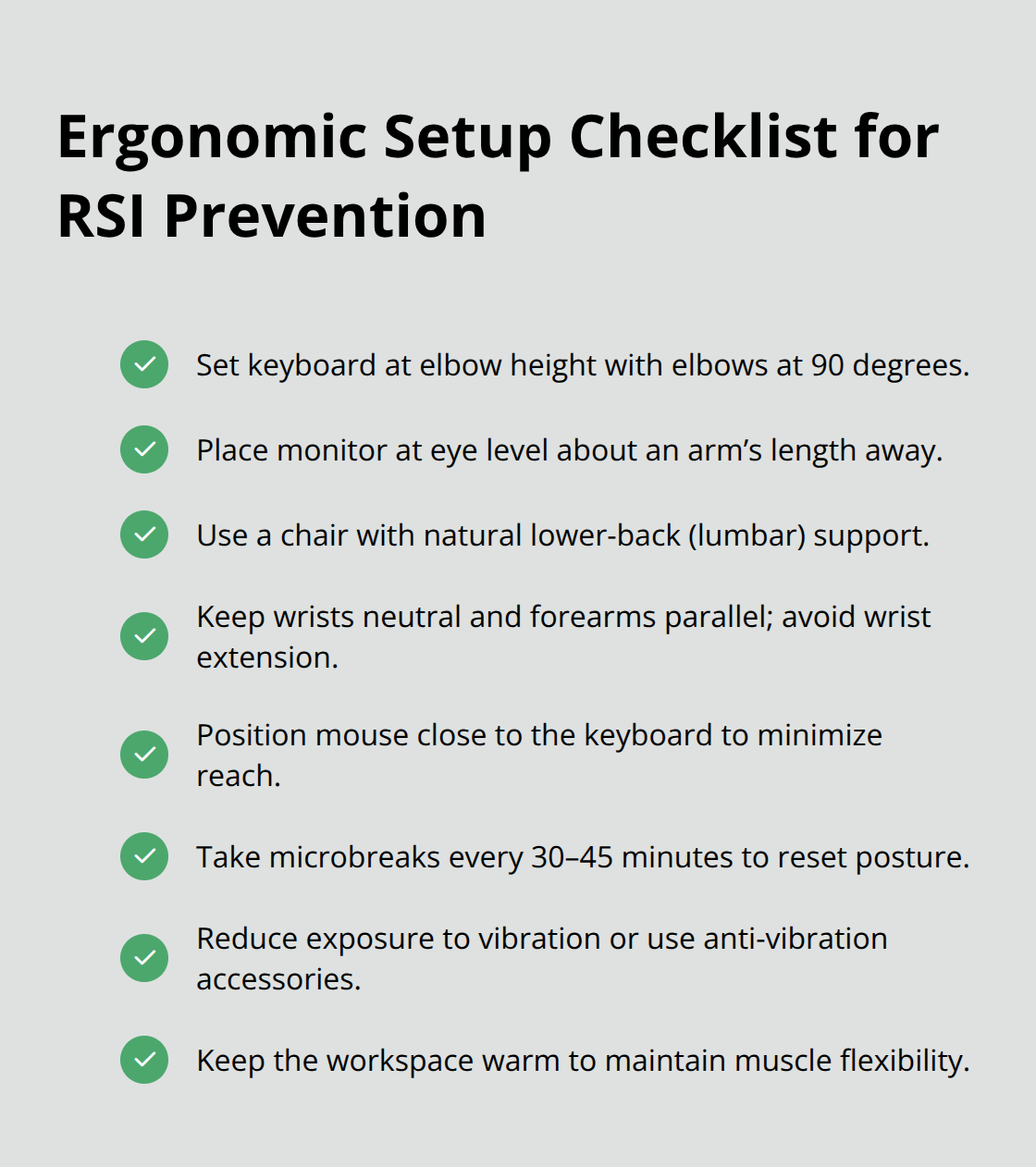
Position your keyboard at elbow height with your elbows at 90 degrees, place your monitor directly at eye level about an arm’s length away, and ensure your chair supports your lower back naturally without forcing you forward. These specific adjustments eliminate the awkward positioning that damages tendons and nerves. If your employer refuses to make these changes despite your request, document the refusal in writing because this demonstrates your workplace created or worsened your condition, strengthening any future workers’ compensation claim.
Prioritize Movement Over Rest
Movement matters more than rest for RSI recovery, contrary to outdated advice about immobilizing injured areas. The NHS emphasizes that extended rest weakens muscles and reduces flexibility, actually prolonging recovery. Instead, take smaller frequent breaks every 30 to 45 minutes rather than one long break, because consistent rest periods prevent fatigue accumulation that triggers overuse injuries.
Physiotherapy targets the specific muscles and tendons damaged by your repetitive work, using prescribed exercises to rebuild strength and improve posture through movements tailored to your job. Occupational therapists assess what about your actual work tasks causes pain and recommend equipment modifications or technique changes that let you work without injury.
Address Inflammation and Seek Professional Care
Cold packs applied for 20 minutes every two to three hours reduce inflammation when pain flares. If symptoms persist beyond two weeks despite ergonomic fixes and self-care, see a healthcare provider immediately because early intervention prevents the progression to constant pain that forces time off work. When workplace accommodations fail and symptoms worsen despite treatment, consulting with an attorney experienced in Ohio workers’ compensation becomes necessary because your employer may bear responsibility for providing safe working conditions, and you may qualify for benefits covering medical treatment and lost wages.
Final Thoughts
RSI develops quietly and progresses fast, but you hold the power to stop it. Act early by fixing your workspace immediately, taking frequent breaks, and seeking medical attention within weeks of noticing symptoms rather than months. Document everything from the moment pain appears, including when it happens, which tasks trigger it, and how it worsens, because this documentation becomes your strongest evidence if you file a workers’ compensation claim in Ohio.
Your repetitive strain injury rights are real and enforceable under Ohio law. The state’s workers’ compensation system covers medical treatment, physiotherapy, occupational therapy assessments, and wage replacement when RSI forces you to miss work or reduces your earning capacity. You have the right to request workplace accommodations, and your employer must provide a safe working environment free from known hazards that cause injury.
The challenge is that the BWC does not automatically grant maximum benefits-they investigate whether your RSI genuinely connects to your job duties and often dispute claims when documentation is weak. Contact our office to discuss your situation with an attorney who knows Ohio workers’ compensation law and can fight to secure the benefits you deserve.